
How to Use AI to Update Old SEO Articles Section by Section
Last updated: November 19, 2026
Quick answer: update one section at a time, using a 6-step workflow, so you can refresh old SEO articles without changing the whole page. How to use AI to update old SEO articles section by section works best when you fix stale facts, weak headings, and thin spots while keeping the page’s original angle. This guide shows exactly what to change, what to leave alone, and how to do it with ChatGPT, Claude, Google Search Console, headings, and a content brief. For related workflow context, see Google Search Console help and OpenAI’s prompting guide.
Start with the section, not the page
A 2,000-word article can still get traffic even when three sections are stale and one heading no longer matches search intent. You do not need to start from zero. You need a section-by-section content update, one block at a time.
A good way to use AI here is to treat each section as a separate task. Preserve the page angle, then update the facts, subheadings, and examples inside the section that is falling behind. That keeps the article recognizable to search engines and useful to readers who already trust it.
The catch is that most people ask AI to “rewrite the article,” which often changes the voice, the intent, or both. That is a common mistake.
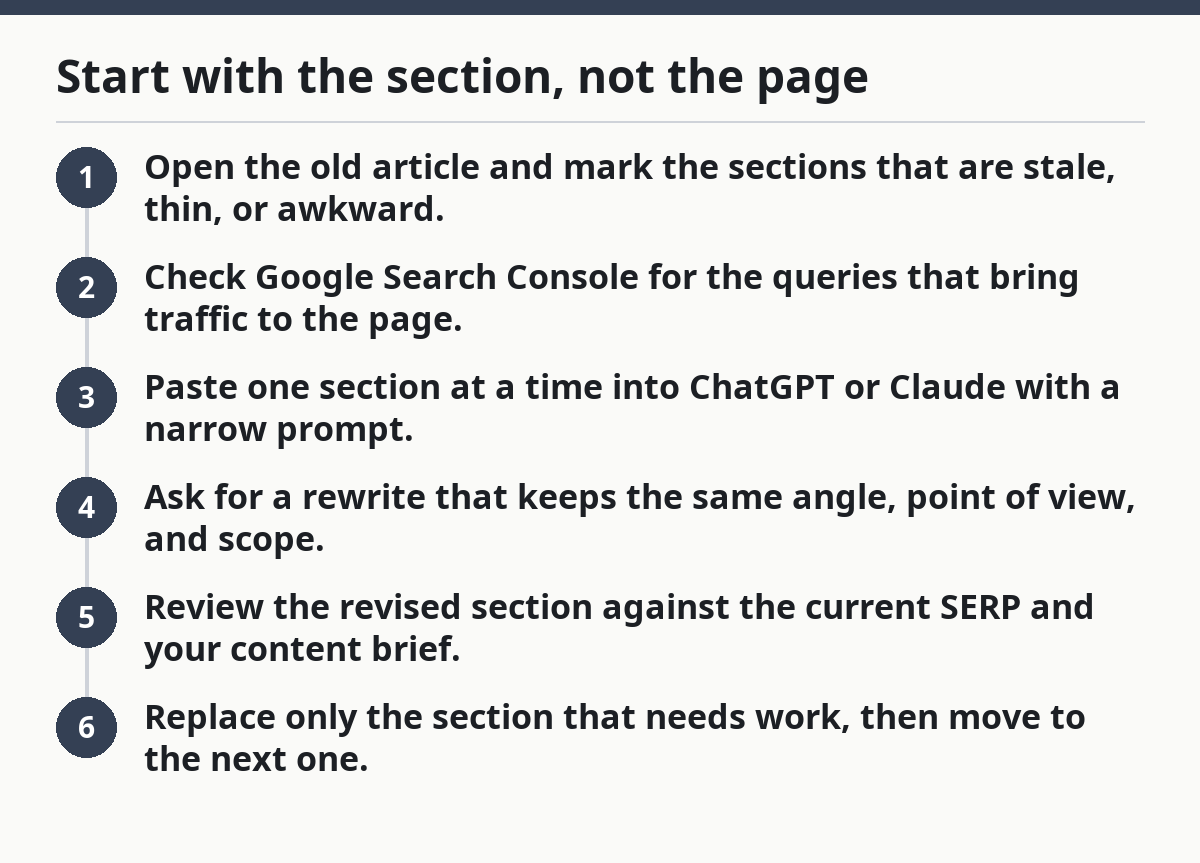
A cleaner workflow looks like this:
- Open the old article and mark the sections that are stale, thin, or awkward.
- Check Google Search Console for the queries that bring traffic to the page.
- Paste one section at a time into ChatGPT or Claude with a narrow prompt.
- Ask for a rewrite that keeps the same angle, point of view, and scope.
- Review the revised section against the current SERP and your content brief.
- Replace only the section that needs work, then move to the next one.
That approach is slower than a full-page prompt, but it gives you control. It also makes it easier to spot the one paragraph that needs a stronger heading, a newer example, or a cleaner transition.
What should you check before you touch a single section?

You should check the article’s search intent, top-performing queries, and weak headings before you ask AI to write anything. That often takes 10 to 15 minutes per page and saves a lot of cleanup later.
Open Google Search Console and look at the queries tied to the URL. If the page gets impressions for one main query and four related ones, that tells you which sections matter most. It also tells you what not to drift away from.
Use this quick pre-edit pass:
- Open the page in Search Console and note the query terms tied to the URL.
- Scan the current headings and mark any section that no longer fits the query.
- Compare the article’s structure to a current content brief.
- Flag sections that contain outdated dates, tools, examples, or process steps.
- Decide which parts need a light refresh and which need a deeper rewrite.
The truth is, AI works best when you give it a tight job. A prompt like “rewrite this section for clarity” is too vague. A prompt like “update this H2 to reflect 2026 tools while keeping the same advice” gives the model a real lane.
Here’s a simple rule: if a section still matches the query and just needs fresher proof, keep the angle. If the section answers a different question now, change the heading before you change the body.
How do I update one section without rewriting the whole article?
You update one section by feeding AI the section text, the target heading, and the exact constraint that nothing else should change. That is the core move.
A 180-word section about keyword research can get stale fast, especially if half of it is dated. You do not want a new article. You want a cleaner version of that one block, with the same role in the page.
Use this workflow:
- Copy only the target section, not the whole page.
- Paste it into ChatGPT or Claude with the current H2.
- Add one sentence on what should stay the same, such as tone, angle, or audience.
- Add one sentence on what should change, such as newer examples, tighter wording, or a more specific subpoint.
- Ask for a revised section plus a short note on what changed.
- Read the result against the surrounding paragraphs so the transition still works.
A good prompt sounds like this: “Rewrite this section for clarity and freshness. Keep the same angle, keep it useful for SEO readers, and do not change the rest of the article’s structure. Keep the section around 180 to 200 words.”
That kind of prompt can help keep the model from wandering. It also makes it easier to compare the new version against the old one line by line.
Use Claude when you want longer context handled cleanly. Use ChatGPT when you want fast drafts and quick variants. Either way, do not ask for a full-page rewrite unless you really want a bigger structural change.
How do I use AI to fix stale facts and examples?

You use AI to flag the stale parts first, then rewrite only those lines with current terms, current tools, and current dates. That can be the quickest way to clean up old SEO articles without breaking the rest of the page.
The section may still read well, but it can name an old tool version, an outdated workflow, or a dated reference. The prose is fine. The proof is not.
A practical process helps here:
- Highlight every date, tool name, platform reference, and step that could be outdated.
- Ask AI to list which details look stale and which are still safe to keep.
- Replace the stale items with current names or current wording.
- Keep the claim level honest if you do not have a source.
- Recheck the section against the live SERP and any source material you trust.
AI is good at spotting places that smell old. It is not good at inventing reliable proof. If a section needs a current standard, a current product name, or a current process change, give the model a source or write around the gap instead of guessing. Google’s guidance on helpful, reliable content is a good reference point here, and Google Search Central is the authoritative source to start with.
A useful prompt is: “Find any dated references in this section and suggest neutral replacements that preserve the original meaning.” That keeps the update modest. It also reduces the risk of overclaiming.
Not every stale detail needs replacement. If the old example still illustrates the point and does not mislead, leave it alone. The goal is not to make every sentence new. The goal is to make every sentence still true.
How should I revise headings without breaking the page?
You should revise headings only when the old heading no longer matches the section’s actual job or the query the page is meant to win. A heading change can help the page; a random heading change can confuse it.
One H2 might say “Tips for better results,” but the section now explains content brief use, angle control, and source checks. That heading is too vague to carry the section. It wastes the reader’s time and the page’s clarity.
Try this sequence:
- Read the section and name its one job in plain language.
- Check whether the current heading says that job clearly.
- Rewrite the heading so it matches the section’s real purpose.
- Keep the wording natural and specific, not stuffed.
- Make sure the new heading still fits the page’s topic map.
A strong heading does two things at once. It tells the reader what the section delivers, and it helps search engines understand how the page is organized. A weak heading does neither.
If the section is about section-level updates, say so. If it is about fact updates, say that. If it is about preserving angle while revising a block, make the heading reflect that task. The reader should not have to decode your labels.
You can often improve a page by replacing three vague headings with three precise ones. That is a small change with real payback.
What does a good section-by-section AI prompt include?
A good prompt includes the original section, the target heading, the audience, the limit on change, and the outcome you want. Without those pieces, AI tends to flatten the article into generic advice.
A paste-and-go prompt can also strip out the nuance that made the section useful. That happens a lot.
Use a prompt frame like this:
- Source text: paste the exact section.
- Target heading: include the H2 or H3.
- Goal: explain what the section should do better.
- Limits: keep the angle, keep the length close, do not add new sections.
- Checks: preserve meaning, avoid fluff, keep terminology consistent.
A better prompt might say: “Rewrite this section so it is clearer and more specific for SEO writers updating old pages. Keep the same angle, keep the section under 180 words, and do not introduce a new strategy that changes the article’s purpose.”
That prompt works because it gives the model boundaries. It also gives you a cleaner draft to review.
Be careful with prompts that ask for “SEO optimization” in the abstract. That phrase often produces bloated copy, more keywords than needed, and headings that sound machine-made. Ask for section utility instead. That gets you closer to the reader’s actual need.
What should I avoid when updating old SEO articles section by section?
You should avoid changing the page’s angle, over-editing every paragraph, and treating AI output as final copy. Those three mistakes create the most damage.
The article can start as a practical how-to, then drift into something else after a broad AI rewrite. The title still promises one thing, and the body now delivers another. That mismatch hurts trust and often hurts rankings too.
The most common mistakes are these:
- Changing the angle: the article stops answering the same main question.
- Rewriting every section: the page loses its original structure and voice.
- Adding filler: AI pads the section with broad advice that adds no value.
- Ignoring the brief: the update drifts away from the page’s job.
- Skipping final checks: headings and body text no longer line up.
Each mistake has a cost. Angle changes confuse readers. Overwrites erase useful material. Filler makes the page longer without making it better. Ignoring the brief makes the update impossible to maintain later. Nielsen Norman Group has long emphasized clarity and usability in content, which is useful context when you are deciding how much to change.
The fix is simple, though not always easy: update only the sections that need work, then read the page as a whole. The revised sections should sound like they belong on the same page, not like they came from three different drafts.
Key Takeaways
- Section-level updates are best for pages that still have a good structure but need fresher parts.
- AI works best when you give it one block, one goal, and tight limits.
- Google Search Console helps you pick the sections that matter most.
- Headings should match the real job of the section, not just sound polished.
- The safest win is a smaller rewrite that keeps the original angle intact.
How do I know the page still holds together after AI edits?
You know the page still holds together when the updated sections read like part of one article, not a pile of patched paragraphs. The test is simple: the heading flow, tone, and intent should still feel consistent from top to bottom.
You may replace three sections with AI-assisted drafts and still end up with a weird rhythm. One section is plain, one is punchy, and one is stuffed with marketing language. That needs a pass.
Run a final review in this order:
- Read the headings only. Do they form a sensible path?
- Read the first sentence of each section. Do they match the headings?
- Skim for repeated claims, repeated phrases, and weak transitions.
- Compare the updated sections against the content brief.
- Check whether the main query still matches the page’s real focus.
This review matters because section-by-section editing can create tiny mismatches that are hard to see in the draft. A heading can overpromise. A paragraph can drift. A transition can sound like it was copied from another page.
If the article still answers the same central question and each section does one job cleanly, the update is working. If the page now feels stitched together, back up and trim the edits.
The strongest updates are not the ones that look dramatic. They are the ones readers barely notice, because the page simply feels current, clear, and easier to use.
How do I use AI to update old blog posts?
Use AI one section at a time, not on the whole article at once. Start with the weakest section, give the model the exact text and the exact job, then compare the draft to your current search intent and content brief. That keeps the post stable while you refresh the parts that need it.
How do I refresh sections without rewriting the whole article?
Refresh only the sections that are stale, weak, or poorly headed. Keep the original angle, update the facts and examples, and leave the parts that still work. That is the safest way to improve an old SEO article without changing what made it rank.
What sections should I update first?
Update the sections with stale facts, vague headings, or the highest search value first. I usually start with the intro-adjacent section, then the section that answers the main query, then any block that looks dated in Google Search Console. That order gives you the biggest payoff with the least risk.
Drafted with AI; not yet reviewed by a person.