
How to Use AI to Expand Outdated Sections
Last updated: November 19, 2026
Quick Answer: Use AI to expand outdated sections by keeping the same point and adding current examples, details, and dates. In practice, that usually means one section at a time, not a full-page rewrite.
Key Takeaways
- AI should add missing detail, not change the page’s core promise.
- The stale parts are usually the example, the detail, or the reference date.
- Update outdated examples by swapping in a current one that proves the same point.
- Expand a thin section by adding context, one concrete example, and one practical detail.
AI can help you turn thin, stale sections into fuller ones with current examples, newer details, and cleaner brand voice. The best use of AI here is usually section expansion, not page rewrites. The steps below show how to update one section at a time without changing the page’s purpose.
In short: give the model the old section, the page goal, the brand voice, and a short list of current facts or examples; then ask for a fuller rewrite that keeps the same angle. The sections below settle what to feed AI, what to avoid, and how to check the result before you publish. How to use AI to expand outdated sections with current examples and details is about keeping the same job while updating the evidence.
What AI should do in an outdated section

AI should add missing detail, not change the promise of the page. Picture this: you have a 120-word section that still mentions old tools, old platform names, or examples from 2021, and you need it to feel current without turning it into a new article. That is section expansion.
Use AI for current examples, detail expansion, and reference cleanup. A good output keeps the same point, but replaces stale names, weak examples, and vague filler with specific, up-to-date support. If the section used to say “social media ads,” for example, AI can help you swap in a current platform mention, a newer ad format, or a recent workflow pattern without changing the page’s job.
Bad use looks different. It turns one tight paragraph into a mini-essay that drifts into new subtopics, new audience groups, or a new search angle. That creates a page that feels busy but still thin where it matters.
Use this rule set:
- Keep the same section purpose.
- Add one or two fresh examples, not six.
- Replace old references, but do not change the main claim.
- Match the page’s brand voice so the new text sounds like the rest of the article.
- Leave out claims you cannot verify with a source or a live product page.
A simple test helps: if the revised section could sit in the same place on the page and still make sense, AI did the right job. If it starts answering a different question, it missed.
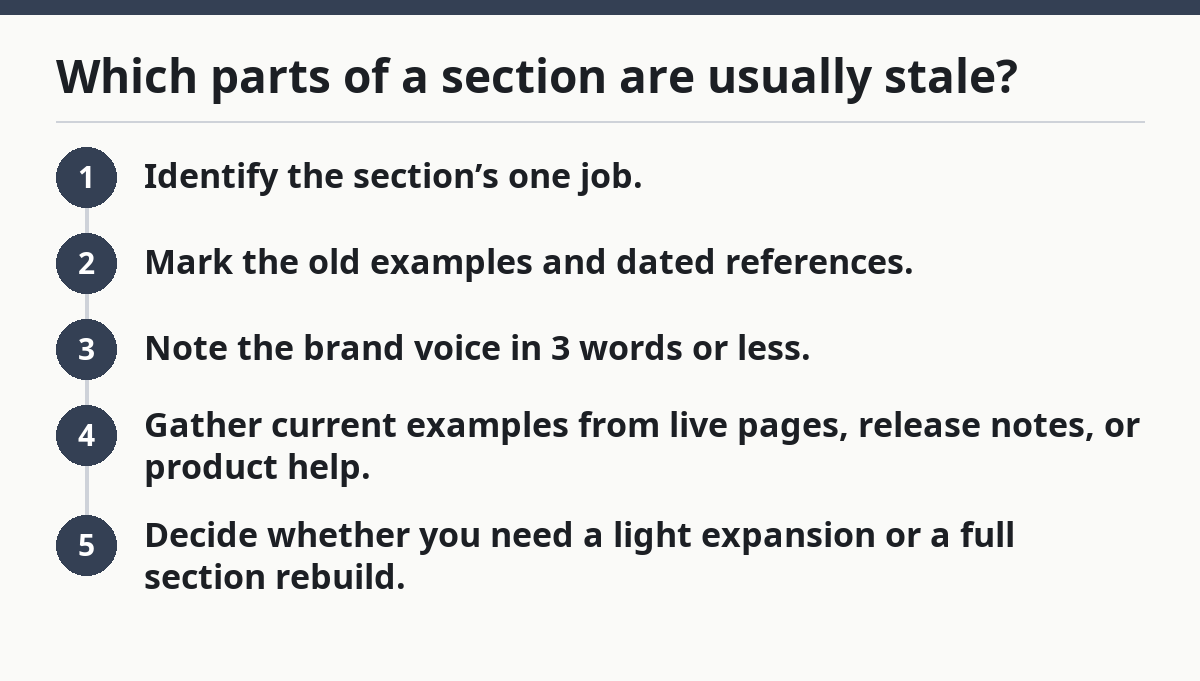
Which parts of a section are usually stale?
The stale parts are usually the example, the detail, or the reference date. You might have a section that still points to a discontinued product, a platform feature that moved, or a generic “for example” line that says nothing useful. That is where AI earns its keep.
Here are the most common weak spots:
- A named tool or platform that changed its interface
- A stat, policy, or feature reference that is now outdated
- An example that sounds abstract because it lacks a real setting
- A paragraph that repeats the heading without adding facts
- A brand voice that feels flat because every sentence sounds like a template
The fix is usually small but specific. A section about email subject lines, for instance, may only need a newer example from a current inbox style, one clearer use case, and a tighter explanation of why the line works. That kind of update often takes 3 to 5 sentences, not a full rewrite.
Now, you might be wondering how to spot the stale part fast. Read the section aloud and mark every place where you hear “for example,” “etc.,” or a brand name that no longer reflects today’s product set. Those spots usually need the most help.
Use this checklist before you prompt AI:
- Identify the section’s one job.
- Mark the old examples and dated references.
- Note the brand voice in 3 words or less.
- Gather current examples from live pages, release notes, or product help.
- Decide whether you need a light expansion or a full section rebuild.
The more precise your inputs, the less cleanup you do later.
How do I update outdated examples in SEO content?

Update outdated examples by replacing the old reference with a current one that proves the same point. That is the cleanest answer for a reader who wants to keep the page accurate without changing its purpose. A strong update usually takes one old example and swaps it for one new example with a better fit.
Start with a simple prompt structure. Give AI the old paragraph, the section goal, the audience, and 2 to 3 current examples you trust. If you want the section to sound like the rest of the page, include a short brand voice note such as “plain, practical, no hype.” That keeps the rewrite from sounding like a generic chatbot draft.
A useful workflow looks like this:
- Paste the original section.
- State the section goal in one line.
- Add 2 current examples or references.
- Ask for a rewrite that keeps the same angle.
- Tell AI to avoid changing the page’s main promise.
- Review the draft for facts, tone, and fit.
If the section talks about a product or platform, include the exact name and version if that matters. If it talks about a process, give the model a real situation, like “small ecommerce store,” “B2B landing page,” or “newsletter intro.” That kind of detail helps AI generate examples that feel grounded instead of generic.
The best outcome is not more novelty. You do not need to add every new trend. One strong current example often beats three weak ones. If the section is about paid search, a single recent platform behavior can be enough. If it is about content updates, one current publishing pattern is usually enough.
Be careful with examples that are trendy but off-topic. A flashy example can make the section feel current and still make it less useful. The reader wants relevance first.
How to expand a thin section without changing the page purpose
Expand a thin section by adding context, one concrete example, and one practical detail that supports the same point. That gives the reader more value without turning the section into a different article. The goal is section enrichment, not topic drift.
This is where AI can help most. Feed it the short section and ask for more depth in 150 to 250 words while keeping the same heading intent. Tell it what not to do, too: no new subtopics, no new audience, no new claim. That guardrail matters because a model will often keep going once it finds a related idea.
A strong expansion usually adds three things:
- A clearer setup for why the point matters now
- A specific current example from the real world
- A short explanation of what the reader should notice
Here’s a simple prompt frame you can reuse:
“Expand this section for a reader who needs current examples and more detail. Keep the same point, keep the same audience, use a plain brand voice, and do not add a new section angle. Replace outdated references with current ones where needed.”
If you want better output, give AI a limit and a target. For example, tell it to add one tool mention, one current example, and one sentence of context. That keeps the model from padding the paragraph with empty summary lines.
Here’s the catch: more words do not equal better expansion. A 90-word section that becomes 220 words can still be weak if the new lines only restate the heading. A good expansion adds useful specifics, not just length.
Before you publish, ask one question: does the revised section tell the reader something they could not have guessed from the heading alone? If the answer is no, the section is still thin.
What inputs make AI expansion better?
AI expansion gets better when you feed it the old text, the current reference points, and the tone you want. Picture this: you are trying to refresh a section from a 2022 article, and you give the model nothing but “make this more current.” The result will usually sound broad and safe.
Give the model enough to anchor the rewrite. That means the original paragraph, the page’s purpose, the audience, and a few current details it can use. If the section mentions a platform, include the live product name. If it mentions a workflow, include the current tool or standard you want reflected. If you want the text to sound like your site, say what the brand voice is and what it is not.
A good input set often includes:
- The original section
- The section’s job in one sentence
- 2–4 current examples
- A voice note, such as “direct, calm, practical”
- A hard rule, such as “keep the same heading intent”
This is also where references matter. If the section needs support, point AI toward source types it should echo, such as official product docs, platform help pages, or current brand pages. I’d rather see a cautious rewrite based on solid references than a polished paragraph built on stale memory. A short section with clean references beats a long one with fuzzy claims.
If the old section has a brand voice problem, name it plainly. Say “too formal,” “too promotional,” or “too vague.” AI does better with a blunt note than with a vague request for “better writing.”
One practical trick: ask for two versions. One should stay close to the original. The other should be slightly fuller. That gives you a choice without forcing a full redo when the lighter version already works.
Common mistakes when using AI for section expansion
The biggest mistake is asking AI to “improve” the section without telling it what must stay the same. Picture this: the model rewrites a stale paragraph, but it also changes the angle, adds a new audience, and drops the original point. That costs you time because you now need to reverse the damage.
The next mistake is stuffing the section with current names but no actual usefulness. A paragraph that mentions five modern tools and no clear takeaway is still weak. It looks updated and reads hollow.
Watch for these errors:
- Adding new claims that the page never supported
- Replacing one stale example with three unrelated ones
- Letting the tone drift away from the rest of the article
- Using current references that do not match the reader’s level
- Expanding a section so much that it swallows the next heading
Another common problem is fake freshness. A model may use current-sounding phrasing while still describing an old workflow. That is worse than leaving the section alone, because it creates a false sense of accuracy. If the section talks about software, check whether the interface, feature, or terminology still exists.
The fix is simple but disciplined: keep the rewrite tied to the original job, then edit for precision. If a sentence does not help the reader understand the point faster, cut it. If a new example is neat but unrelated, cut it too.
This is also where page-level coherence matters. If one section gets a major expansion, the neighboring sections may need a light touch so the page still reads as one piece. A single updated section should not feel like it came from a different article.
A practical workflow for section expansion with AI
Use a repeatable workflow so each section gets the same level of care. Picture this: you have a stale article with five weak sections, and you need a way to refresh them one by one without losing the original structure. A 6-step process keeps that manageable.
- Select one section. Pick the section that is most outdated or most visible in the page flow.
- Write its job in one line. For example: “Explain why current examples matter in this process.”
- Gather current inputs. Pull live examples, current product names, or recent references from source material.
- Prompt AI with limits. Ask for a rewrite that keeps the same purpose, tone, and heading angle.
- Check the draft against the old text. Confirm the section still answers the same reader need.
- Edit for truth and voice. Trim fluff, correct names, and make sure the section sounds like the rest of the page.
That process works best when you keep the review step human. AI can widen the section and sharpen the examples, but it does not know which sentence feels off-brand or which reference is outdated in your niche. You do.
A useful rule of thumb: if the new section adds detail but loses the original point, it failed. If it keeps the point and adds one current example and one clearer explanation, it succeeded. That’s the real job.
If you want a stronger output across several sections, keep a small “voice sheet” with sample phrases, forbidden phrases, and preferred terms. That can save a lot of cleanup when you refresh the next article. This workflow fits cleanly inside the larger AI-assisted content refresh workflows hub.
How do I add current details without changing the page purpose?
Add current details by swapping in fresh facts that support the same argument, not a new one. The safest move is usually to keep the section’s structure and replace only the parts that age fast: examples, product names, feature references, and context lines.
Start with the sentence that carries the main point. Leave that point alone. Then look for one place to add current context, one place to replace an old example, and one place to tighten the explanation. That usually gives the reader enough new value without altering the page’s intent.
A good update uses current details like:
- A live product name instead of a retired one
- A current interface or workflow term
- A present-day scenario that matches the same reader need
- A recent standard or official term if the field changed
What you do not want is a section that starts teaching a new lesson. If the page is about one process, do not let AI wander into a second process. If the section is about examples, do not let it become a strategy essay.
The easiest way to stay on track is to compare the old and new versions side by side. Ask: did the heading still match the paragraph after the rewrite? Did the section keep the same promise? Did the current details improve clarity instead of changing the subject? If not, trim it back.
A section refresh works when the reader feels, “This is the same page, just better informed.” That is the line to keep.
How do I update outdated examples in seo content?
Update outdated examples by replacing the old reference with a current one that proves the same point. Keep the section’s purpose, then swap the example, not the angle. If the new example needs extra setup, add just enough context to make it make sense.
How do I add current details without changing the page purpose?
Add current details by keeping the section’s claim fixed and updating only the facts around it. Use current details that fit the same argument.
Drafted with AI; not yet reviewed by a person.