How to Estimate Page Refresh Scope Before Writing
Last updated: November 19, 2026
Quick answer: estimate page refresh scope in 5 parts—section count, rewrite depth, research effort, examples, and content blocks—then label the job as light, medium, or full rewrite before you draft. For how to estimate page refresh scope before writing, start with the current article and compare it to the page you need to end up with; if the outline changes and the research changes, the scope changes too. If you want a broader planning lens, see Google Search Central on creating helpful, reliable content and Nielsen Norman Group on web writing and scannability.
Key takeaways
- Start with the current page, not the new idea. The gap between those two versions tells you how much work is ahead.
- Count sections first. A change from 4 sections to 8 is a bigger job than swapping a few sentences.
- Treat research, examples, and content blocks as separate costs, and check whether the scope is still appropriate for your team or a professional editor.
- A refresh scope is too big when the outline changes, the intent shifts, or most of the old draft has to be replaced.
- The point is not to guess word count. The point is to see how many parts of the page must move.
What does refresh scope mean?
Refresh scope means the size of the edit you need before you start writing. It is the difference between a quick cleanup of an existing article and a deeper rewrite that changes the outline, adds research, and replaces whole blocks of text.
For page refresh planning, that size is easier to judge in parts than in words. A 300-word update can be light if it only fixes a few lines, while a 300-word update can be heavy if it replaces the lead, the section structure, and half the examples. That is why “How many words?” is the wrong first question.
A better first pass is to mark the existing article into pieces: headline, intro, section 1, section 2, examples, conclusion, and any callout boxes. Then ask which parts stay, which parts change, and which parts are new. If more than one major block is missing from the current version, the refresh is probably closer to a rewrite than a tune-up.
This matters because scope controls the draft, the outline, the research plan, and the time you need. It also keeps a team from promising a “refresh” when the work is really a new article built on top of the old one. For broader page refresh planning, this sits inside the larger AI SEO refresh planning process.
How do I estimate scope before I start writing?
You estimate scope by matching the current page against the end state and sizing five things: section count, rewrite depth, research effort, new examples, and edit scope. Each one tells you something different about the amount of work.
-
Open the existing article and count the sections.
If the old draft has 4 sections and your outline needs 7, the page is already moving into major rewrite territory. A section count change of that size usually means new structure, new transitions, and a longer editing pass. -
Mark rewrite depth in the outline.
Label each part as keep, revise, or replace. If most sections are in the replace column, you are not doing a trim pass; you are rebuilding the article from the outline up. That is the cleanest way to see whether the draft survives or gets restarted. -
List the research effort in sources and checks.
Note how many facts, tools, standards, or references you need before the draft feels complete. If the old article needs fresh source checks, new terminology, or a different angle on the same topic, the research load rises even if the word count barely moves. -
Compare the old examples with the examples you need.
If the existing article has 2 examples and the new version needs 5, scope grows fast. New examples are not decoration; they change the shape of the page and often force new explanations around them. -
Map the content blocks you must add or remove.
A callout box, checklist, comparison table, or FAQ block each adds editing work. If the old article has none of these and the new draft needs all four, the refresh will take more than a quick pass even if the main body stays familiar. -
Write the edit scope in one sentence.
Say whether this is a light edit, medium refresh, or full rewrite. The sentence should name what changes: “keep the outline, update examples, and tighten the intro” is a different job from “replace the structure and add three new sections.”
That sequence gives you a rough scope before you write a line of new copy. It also keeps the draft from expanding while you work, because the limits are already visible in the outline.
Which signals mean a light edit?
A light edit means the existing article stays mostly intact and you are changing the page in a narrow way. The page may need a new intro, cleaner wording, a few updated examples, or a small adjustment to one section, but the structure remains the same.
A good clue is section count. If the old article and the new outline both have about the same number of sections, the refresh is often small. Another clue is rewrite depth: if most blocks are marked keep and only 1 or 2 are marked revise, the scope is usually manageable.
Light edits also need less research effort. You may only need to confirm a few facts, swap stale examples, or sharpen the wording around one point. That kind of work often leaves the draft close to the original, which is useful when the page already matches the topic and intent.
The trap is calling every small change a light edit. If the page needs a new outline, more than a few new examples, or a new content block like a comparison table, the work is no longer small just because the word count is modest. A 600-word refresh can still be a deep rewrite if the structure changes.
When is it a full rewrite?
A full rewrite is the right label when the current article cannot hold the new plan without major surgery. That usually happens when the outline changes, the section count changes by a lot, or most of the content blocks need replacement.
The clearest signal is rewrite depth. If half or more of the existing article is marked replace, you are probably not refreshing a page so much as building a new version from the old URL. The draft may still keep the same topic, but the shape, sequence, and support material will be different.
Another signal is research effort. If the refresh needs new sources, new definitions, or a different set of examples, the writing time stretches beyond a normal update. That is especially true when the old article was thin and the new version has to carry the whole job itself.
A full rewrite is not bad. It is often the honest choice when the page has drifted, the outline is weak, or the existing article no longer supports the searcher’s job. The cost is that it takes more planning before a single paragraph is written, because the old draft can mislead you into thinking the work is smaller than it is.
What should I compare in the draft and outline?
You should compare the draft and outline block by block so the scope shows up in plain view. A side-by-side check makes it easier to see what the page already has and what the new version still needs.
| What to compare | Ask yourself | What it means for scope |
|---|---|---|
| Section count | Do I need more sections than the existing article has? | More sections usually mean a bigger refresh. |
| Rewrite depth | Am I keeping, revising, or replacing each section? | More “replace” labels point to a rewrite. |
| Research effort | How many fresh checks or sources do I need? | More research adds time before and during writing. |
| New examples | How many examples does the new draft need? | New examples often force new explanations. |
| Content blocks | Do I need tables, checklists, or callouts? | Extra blocks increase edit scope. |
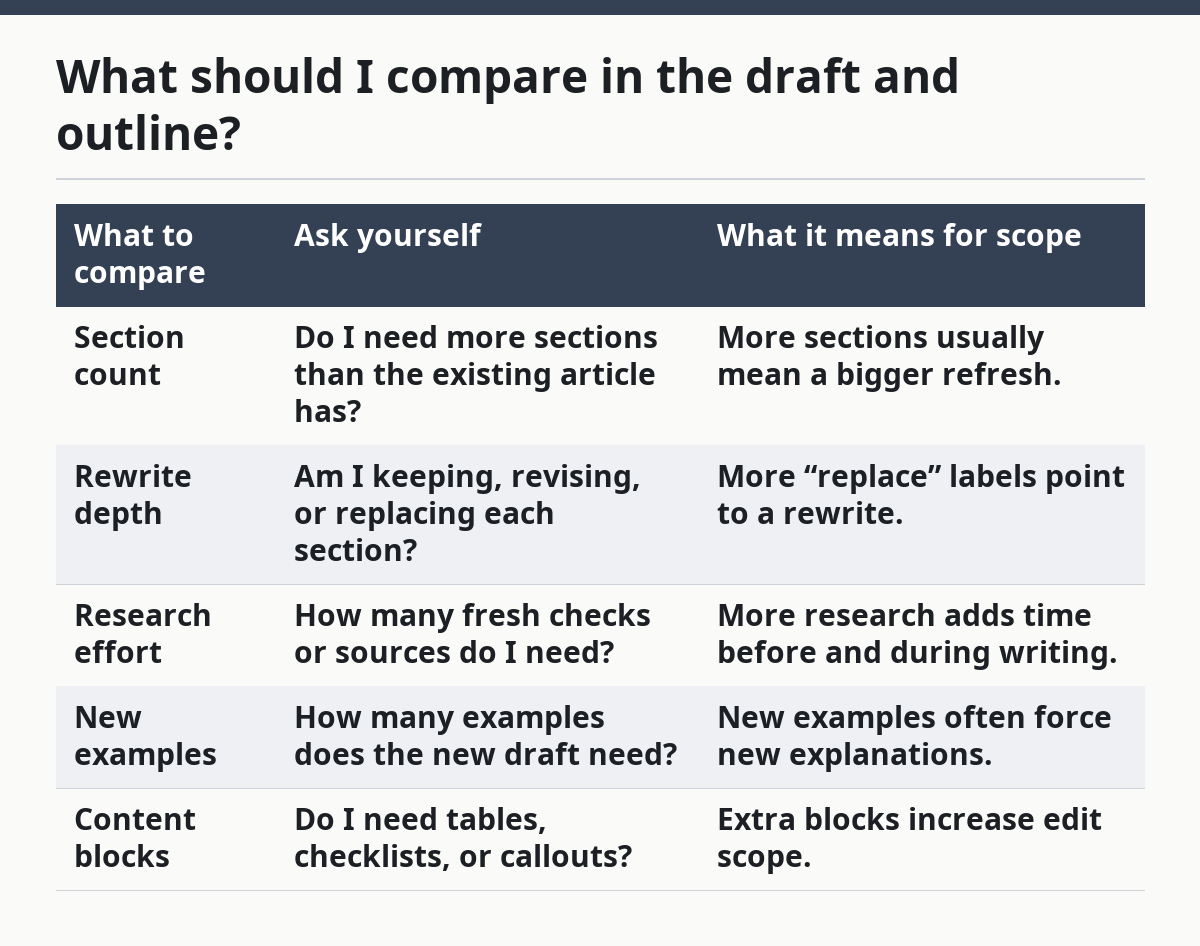
This comparison works because it separates the article into parts you can count. A page that needs one new example and a better headline is not the same as a page that needs four new sections and a new intro. Without that comparison, scope guesses tend to drift upward while the draft is already open.
The table also helps with handoff. A draft, an outline, and an editorial plan can all say “refresh,” but they do not mean the same thing unless the section count and rewrite depth are clear. If a team skips this step, the work often expands after writing starts, which is the point where scope is hardest to control.
What gets underestimated most often?
Research effort gets underestimated most often, and that mistake makes every other part of the refresh look smaller than it is. A page can seem like a quick rewrite until you see how much checking, sourcing, or example-building the new version needs.
New examples are the second common miss. One fresh example can be easy; three or four examples change the whole rhythm of the article and often create new section breaks. If the examples are central to the explanation, they are part of the structure, not decoration.
Content blocks also get missed. A comparison table, checklist, or callout box can look minor in a plan, but each one adds writing, formatting, and review time. If a page needs those blocks and the old article does not have them, the refresh is wider than it first looked.
The cost of underestimating scope is not just extra writing time. It also leads to drafts that feel half-finished because the outline was too small for the job. The fix is simple: size the page by what must exist in the final draft, not by how many lines of old copy you hope to keep.
How do I keep the scope from growing while I write?
You keep scope from growing by freezing the outline before the draft starts and treating every new idea as a trade-off. If a new section appears, something else should usually move out, or the refresh stops being the same project. If the page is mission-critical, consult a professional editor or strategist before widening the plan.
One practical rule is to set the edit scope in 3 buckets: must change, should change, and can wait. The must-change items belong in the draft now. The should-change items stay in reserve unless the page still needs them after the first pass. The can-wait items become notes for later refreshes.
This helps because page refresh work expands in small steps. A paragraph becomes a section, a section becomes a new subtopic, and the draft starts to eat the original plan. With a fixed outline, that drift is easier to catch before the whole page changes shape.
The other guardrail is to compare each new idea against the existing article. If the idea needs a different section count, a new research pass, or a new set of examples, it is probably not a small change. That does not mean it is wrong. It only means the scope has grown and should be named honestly before more writing happens.
What if the scope feels unclear?
If the scope feels unclear, the page probably needs a short planning pass before writing starts. That pass can be as simple as a one-page outline that lists the existing article, the desired draft, and the gaps between them.
A practical way to get clarity is to write down the edit scope in plain terms. Use phrases like “keep the outline,” “add 2 sections,” “replace the intro,” or “rewrite with new examples.” Those phrases are more useful than vague labels because they show what the draft will actually require.
When the answer still feels fuzzy, err on the side of a larger scope estimate. A small refresh with hidden structure changes often causes more trouble than a clearly named rewrite. The goal is not to make the work sound bigger than it is. The goal is to avoid being surprised halfway through the draft.
How big should a refresh be?
A refresh should be as big as the gap between the existing article and the outline you need. If the title, section count, and examples still work, the refresh can stay small. If the article needs new sections, a new structure, and new research, the refresh should be treated as a rewrite.
The wrong size is the one that hides the real work. A page that needs 3 new sections is not “just a tweak” because the text change looks short on paper. The right size is the one that matches the final draft, not the amount of editing you want to do.
What should I review before updating a page?
I should review the existing article, the draft outline, the section count, the rewrite depth, the research effort, and the examples before writing. That review shows where the page already works and where the new version needs real changes.
I should also check the content blocks that may be missing, such as tables, checklists, or callouts. Those blocks often change the workload more than a few new sentences do, so they belong in the scope check from the start.
How do I avoid over-editing a page?
I avoid over-editing by deciding what the page is supposed to change before I touch the copy. If the outline is sound, I keep the structure and only revise the parts that need it.
I also stop every new idea from entering the draft automatically. If a new section or example appears, it has to earn its place against the existing article, not just against my appetite to improve it. That habit keeps a refresh from turning into a second, unnecessary article.
Drafted with AI; not yet reviewed by a person.