
How to Analyze Why a Competitor Page Outranks Yours: Related Questions
Last updated: November 20, 2026
Quick answer: use 5 checks—search intent, page type, content depth, links, and technical access—to find out why a competitor page outranks yours. In How to Analyze Why a Competitor Page Outranks Yours: related questions, the page that wins is often the one that answers the query in the format Google expects, not the one with the most text. If you skip straight to backlinks or word count, you usually fix the wrong thing.
Key takeaways
- Start with the query, not your page. A mismatch in intent beats a stronger domain more often than people think.
- Check whether the ranking page is a list, guide, category page, tool page, or product page. The wrong format can lose even with better writing.
- Look for crawl, index, and canonicals before you blame content. A page that is blocked, duplicated, or weakly linked may never get a fair shot.
- Compare what the top page covers in the first 300 to 500 words, not just the full article.
- If the competitor is stronger because it has links, ask whether the link gap is the real issue or just a symptom of a better page.
What should you check first?

You should check search intent and page type first, because a format mismatch is the easiest reason to miss. If the competitor page is a comparison list, a category page, or a how-to guide and yours is built like a thin product pitch, the ranking difference may have little to do with authority.
Use this order:
- Search the target query in an incognito window and note the top 5 results.
- Write down each result’s page type: guide, list, landing page, category page, forum thread, or product page.
- Check whether your page matches the same type or tries to answer a different job.
- Read the first screen of the top ranking page and compare its promise to yours.
- Look at the headings on both pages and see which one solves the query more directly.
- Decide whether the fix is a rewrite, a new page, or a different keyword target.
If the top page is a long guide and your page is a short service page, the answer may be to stop competing on that query at all. If the pages match closely, then move to content coverage and technical checks. Quick check: if your page answers a different question than the one typed into search, this is the first problem.
Is the competitor matching intent better?
Yes, the competitor may be winning because it matches intent more cleanly than yours. A page can rank with fewer backlinks if it gives the searcher the exact format they want in the first 300 words.
Here is the practical split:
| Situation | Best Path | Why Other Options Fail |
|---|---|---|
| Your page is a sales page and the winner is a guide | Rewrite or create a guide page for the informational query | Pushing harder on sales copy usually makes the mismatch worse |
| Your page is a guide and the winner is a category page | Build or improve the category page for the commercial query | A blog post often cannot satisfy a browse-and-compare search |
| Your page is a short FAQ and the winner is a full explainer | Expand the page or target a narrower query | Thin answers lose when the query needs definitions and steps |
| Your page is a local page and the winner is national | Separate local intent from national intent | A local page cannot always compete for broad informational terms |
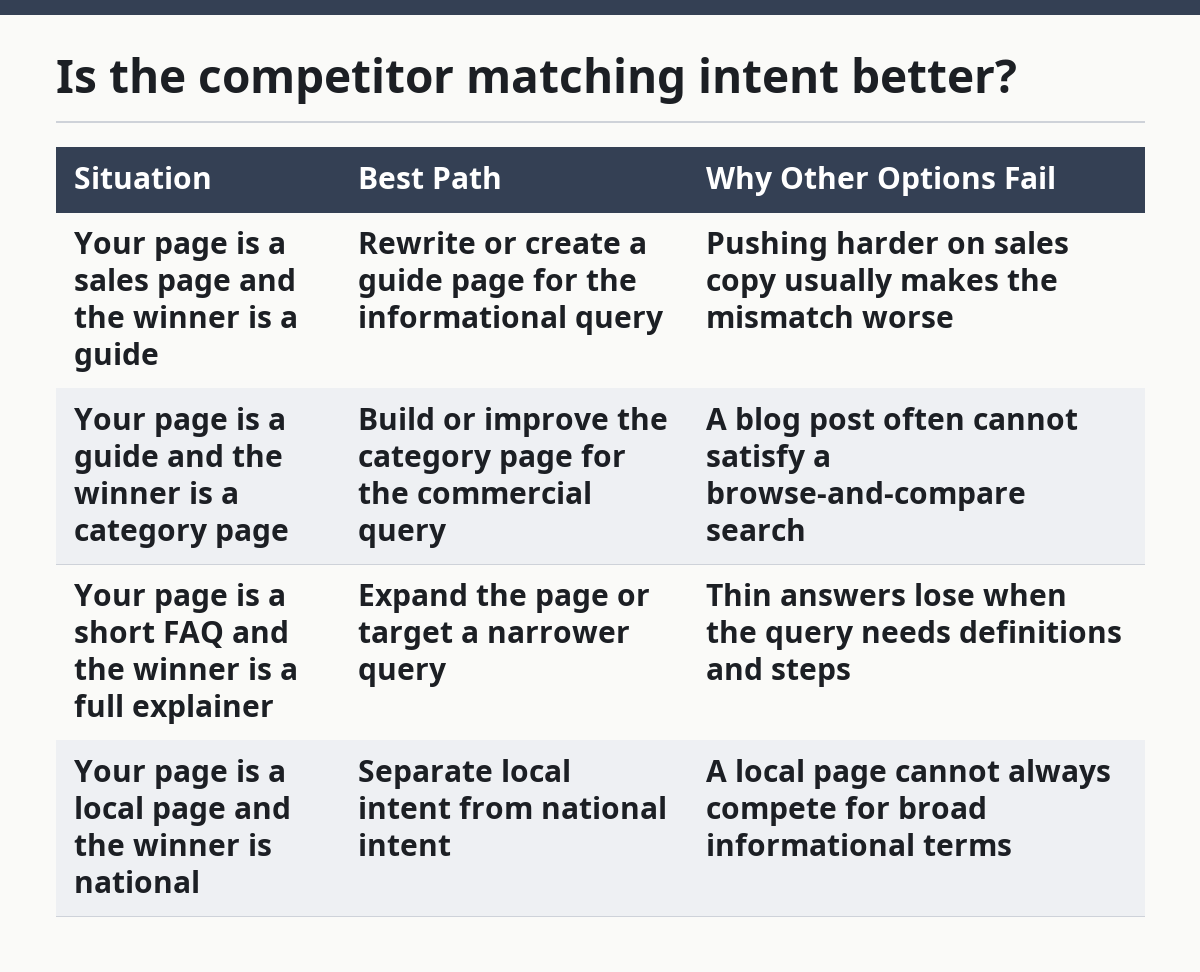
If the competitor’s title, first paragraph, and H2s all answer the query faster than yours, you have your answer. If not, the issue is deeper than intent and you need to inspect on-page coverage. Quick check: if a person could land on the competitor page and stop searching, intent is probably the reason it outranks you.
What content gap matters most?
The content gap that matters most is the gap in the first useful answer, not the raw word count. A 700-word page can beat a 1,500-word page if it covers the right subquestions in the right order.
Use this 5-step review:
- Copy the competitor’s headings into a note and mark which ones answer the core query.
- Check whether your page covers the same subquestions, such as definitions, steps, risks, or comparisons.
- Look for missing specifics like examples, limits, trade-offs, or edge cases.
- Read the top-ranking page’s opening 2 sections and see whether it gives the answer before the background.
- List the missing pieces you can add without changing the page’s actual purpose.
A generic article often gets this wrong by counting keywords instead of questions answered. If the competitor addresses “how to compare,” “what to do next,” and “when this fails,” while your page only restates the topic, the gap is structural. Searchers notice that in under a minute, and so do ranking systems that look for useful coverage.
Quick check: if the competitor answers three follow-up questions you skipped, that is the content gap to fix.
Are backlinks the real reason?
Backlinks may be part of the reason, but they are not always the first reason. If the top page has a clear intent match and a stronger content layout, it can outrank a better-linked page on relevance alone.
Check links only after you have ruled out intent, page type, and content depth. When you do compare links, look for the type of link, not just the count. A few relevant editorial mentions can matter more than a pile of weak links, and a page with good internal links from a strong section of the site may outrank a page with better external links but poor internal support.
The mistake is to treat backlinks as a verdict. They are one signal, not the whole case. If you are making major business decisions, consult an SEO professional or analyst and use Google’s guidance in the SEO starter guide and creating helpful, reliable content as a starting point. If the competitor’s page is older, better linked internally, and clearly matched to the searcher’s need, a weak backlink gap may not be the main issue at all.
Quick check: if the two pages are equally useful on the surface, then links may be the tie-breaker.
Is the page technically stronger?
Yes, a technically cleaner page can outrank yours even when the content looks similar. A page that is blocked, canonicalized, duplicated, or buried too deep in the site may lose before content even gets a fair look.
Use a basic technical pass:
- Check whether your page is indexable and not blocked by robots.txt or a noindex tag.
- Confirm the canonical points to the page you want to rank.
- Compare internal links to the page and ask whether the competitor gets more crawl paths from important pages.
- Look for duplicate or near-duplicate versions that may split signals.
- Check page speed and mobile rendering only after the indexing basics are clean.
If the competitor has one clean URL and your site has three similar URLs competing for the same query, the cleaner page can win without being better written. Google Search Central’s guidance on creating helpful, reliable content and its SEO starter guide are useful reference points for this kind of cleanup. Quick check: if the page is hard for crawlers to find or choose, technical issues are part of the answer.
When is the standard advice wrong?
The standard advice is wrong when the query is about comparison, freshness, or trust, because those cases do not behave like a normal blog-post contest. In those situations, the “write more and get links” answer can waste weeks.
Here are the edge cases that break the normal playbook:
- The competitor page is much newer. What changes: freshness may be part of the query. What to do instead: update the page with the current year, recent examples, or the latest version of the topic.
- The competitor is a big brand. What changes: trust and click preference can matter more. What to do instead: narrow the topic and make your page more specific, not just longer.
- The query is mixed intent. What changes: searchers want both facts and options. What to do instead: add a comparison section and make the page type obvious in the title.
- The competitor page is a forum thread or user-generated result. What changes: the search engine may want firsthand discussion. What to do instead: answer in a more practical format and include the exact terms users search.
- The pages are nearly identical. What changes: small technical differences decide the winner. What to do instead: check canonicals, internal links, and duplication before rewriting the article.
The Search Quality Rater Guidelines from Google are useful here because they remind you that usefulness, trust, and task completion matter together, not one at a time. Quick check: if your page looks fine but still loses to a newer, stronger, or more specific result, the usual advice is too broad.
How do you turn the diagnosis into a fix?
You turn the diagnosis into a fix by changing only the part that caused the loss. If the problem is intent, rewrite the page or make a new one. If the problem is coverage, add the missing subquestions. If the problem is technical, fix indexing before changing copy.
A clean repair sequence looks like this:
- Write the query at the top of your notes and name the ranking page that beat you.
- Mark the page type, intent, and searcher job in one sentence.
- List the top 3 differences: format, content, or technical access.
- Pick one fix that matches the biggest difference first.
- Recheck the page after the change and compare it against the same query, not a broader one.
Do not make five changes at once if you want to learn anything. If you rewrite the title, expand the article, change the URL, and add links at the same time, you will not know what helped. That matters when you are trying to diagnose one competitor page, not redesign the whole site. Quick check: if you can name the one problem in one sentence, you are ready to fix it.
Why do related questions matter here?
Related questions matter because they expose the real reason the competitor is stronger. The top page often wins by answering the next 2 or 3 things a searcher thinks about after the main query.
Why is the competitor page ranking above mine?
It is usually ranking above yours because it fits the search intent better, covers the query more completely, or has a cleaner technical setup. If the page also has stronger internal links or better external links, that can widen the gap, but it rarely explains everything by itself.
Should I rewrite my page or create a new one?
You should rewrite the page if the intent is the same and the topic is still the same page’s job. You should create a new page if the competitor is winning on a different intent, such as guide versus sales page, or broad query versus narrow comparison.
How do I know if backlinks are the real issue?
Backlinks are the likely issue when the pages are otherwise close in intent, format, and depth. If the competitor page is clearly better matched to the query, links are probably only part of the story.
What is the first thing to fix?
The first thing to fix is the mismatch between the query and the page type. If that is correct already, fix the missing subquestions next, then check indexing and canonicals.
Drafted with AI; not yet reviewed by a person.