How to Rewrite Outdated Examples Without Changing Meaning
Last updated: November 19, 2026
Quick Answer: 1 rule does the most work — replace the example, not the claim. If you are doing how to rewrite outdated examples without changing the meaning of a section, keep the same role, scale, and lesson, then verify the sentence still says exactly what it said before. Outdated examples can make a section feel stale, and a bad replacement can change the point by accident. The steps below show how to do example replacement without drifting into a new meaning.
Key Takeaways
- Keep the section’s job fixed before you touch the example.
- Match the old example’s function, not just its topic.
- Check for hidden signals like scale, tone, and comparison.
- If the example carries the argument, rewrite the sentence around it.
- If the example is only proof, you can swap it more freely.
What “example replacement” is really doing in a section
Example replacement keeps the section’s point intact while you update the support sentence. The example is there to clarify, not to take over the section’s meaning. If the reader would still agree with the paragraph after the swap, you’ve probably kept the meaning.
When you work through how to rewrite outdated examples without changing the meaning of a section, a 2018 app, an old platform, or a dead brand name can be replaced cleanly if the rest of the section still works. The fix is usually a 1-for-1 substitution, not a rewrite of the whole idea.
The reason is that examples carry more than subject matter. They can signal size, age, audience, difficulty, or contrast. “A newspaper ad” and “a TikTok ad” are both ads, but they do not do the same work in every sentence. One may suggest slow feedback and broad reach; the other may suggest speed and short attention spans.
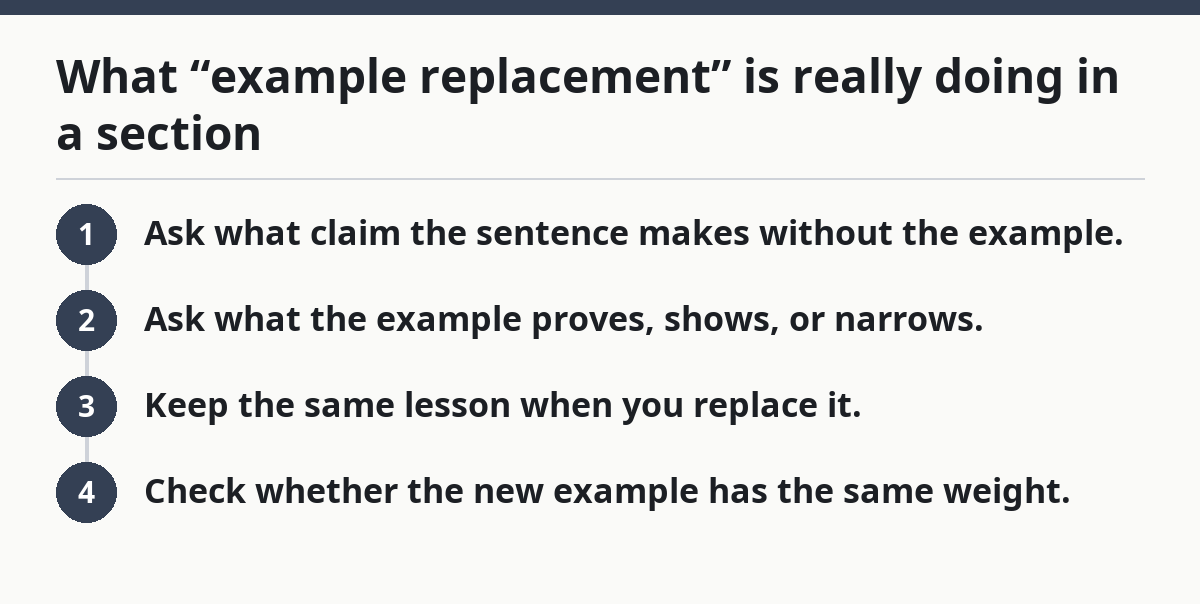
Use this test before you change anything:
- Ask what claim the sentence makes without the example.
- Ask what the example proves, shows, or narrows.
- Keep the same lesson when you replace it.
- Check whether the new example has the same weight.
If the section depends on the example for its logic, not just its illustration, you need a small rewrite around it. Not a full section refresh. Just enough to keep the point standing on its own.
How do I replace an outdated example without changing the meaning?
You replace it by matching function first and topic second. A clean swap keeps the same relationship between the example and the sentence around it, even if the surface details change.
Because of that, a paragraph about onboarding that mentions a “fax form” from 2009 still needs an equivalent slow manual step if the point is friction. A self-serve app screen would break the logic, but a PDF uploaded by email might fit. That is the core of how to rewrite outdated examples without changing the meaning of a section.
Here’s a practical workflow:
- Identify the source sentence — mark the exact claim the example supports.
- Name the example’s job — proof, contrast, analogy, warning, or shortcut.
- Swap in a current equivalent — choose a modern case with the same role.
- Check the scale — keep the same size, speed, audience, or seriousness.
- Read the line aloud — if the sentence now implies a new point, the swap is wrong.
A useful trick is to ask: “Would this still make sense if I blanked out the example?” If the answer is yes, the example is probably doing light support work. If the answer is no, the example may be carrying the whole sentence. That’s where people accidentally change meaning.
However, modern does not always mean better. A current example can be too flashy, too niche, or too specific. If the old example was plain for a reason, the new one should stay plain too. A 2024 brand partnership can overstate a general lesson, while a generic SaaS dashboard may fit better.
The safest swaps are often boring when you are trying to preserve meaning, and that usually helps rather than hurts.
What should stay the same when you update an example?
The job, tone, and scale should stay the same. If those three things match, the reader gets the same meaning even when the details change.
For example, if you are updating a paragraph that compares “vinyl records” to “MP3s,” the point may be permanence versus convenience. You can change the example to “printed manuals” versus “help-center articles,” and the lesson still holds. The medium changes. The lesson does not.
Use this checklist to keep the meaning stable:
- Job: Does the example still prove the same thing?
- Tone: Is it still neutral, cautionary, or positive in the same way?
- Scale: Is it still one small case, or a broad category?
- Time sense: Does it still signal old, current, or emerging behavior?
- Audience fit: Does it still make sense to the same reader?
A section about small business budgeting should not suddenly use a Fortune 500 procurement process as the replacement; if the example touches real budgeting decisions, consult a finance professional and check a trusted source before making that jump. That changes the scale even if the math stays similar. A section about casual content work should not swap in a regulated industry case unless the original also had that level of complexity.
You can often keep the sentence structure almost unchanged. That saves time and protects meaning. For example, “Instead of filing paper receipts, many teams now scan them into an app” keeps the same basic point if the old line said “Instead of filing paper receipts, many teams now store them in a spreadsheet.” The storage method changes; the idea of replacing manual filing with a digital system stays intact.
If the new example changes the mood of the sentence, stop. A playful example can make a serious section feel casual. A dramatic example can make a mild point feel urgent. That’s how meaning slips.
How can I tell if the new example changes the section’s meaning?
Read the sentence without the example, then read it with the new one. If the second version adds a new claim, you changed the meaning.
Since the point is to keep how to rewrite outdated examples without changing the meaning of a section consistent, compare the old and new examples against the same claim. If you’ve swapped “catalog order forms” for “AI chatbots,” the sentence may still read fine, but the point can shift from “slow manual ordering” to “automated response systems.” That is not a cosmetic edit. That’s a new angle.
A good meaning check takes less than 60 seconds:
- Remove the example and read the bare claim.
- Put the old example back in and note the exact lesson.
- Put the new example in and compare the lesson.
- Ask whether the new line changes the scope, not just the wording.
- If it does, rewrite the sentence around the new example or pick another one.
Watch for these changes:
- The new example is newer and more advanced.
- The new example is more common and less specific.
- The new example adds a judgment the old one did not have.
- The new example implies a different audience or setting.
A section about “using evidence the reader already understands” can lose meaning fast if you replace a household reference with a technical tool. The reader now has to learn the tool before they can follow the point. That slows the section down and shifts its purpose from explanation to introduction.
The strongest test is simple: would a subject expert agree that the paragraph still makes the same argument? If not, the example is too different. Choose a closer substitute or adjust the sentence so the new example is clearly framed.
Which outdated examples can be swapped safely?
Examples that are simple illustrations are the easiest to update. Examples that carry contrast, irony, or a dated comparison need more care.
For instance, a sentence that says, “For example, a phone tree can waste time,” is usually easy to replace with “a long email chain” or “a chatbot loop” if the point is delay. The example is there to illustrate slowness, not to build the whole argument.
Safe-to-swap examples usually look like this:
- A named product in a general category
- A dated channel used to show a common behavior
- A city, app, or tool used only as a stand-in
- A plain case that sits outside the main claim
These are harder:
- Analogies that shape the whole section
- Examples tied to a timeframe, like “during the pandemic” or “in 2019”
- Examples that signal prestige, risk, or urgency
- Comparisons where the example is the argument
If the old example is only there for recognition, replacement is straightforward. If it sets the reader’s expectations, you need more caution. A “landline phone tree” swapped for “text notification chain” may keep the idea of friction. But if the paragraph is about delay plus human handoff, a chatbot may erase the human part.
A good rule is that the more the example does, the less freely you can change it. That rule saves a lot of damage.
Common mistakes when refreshing examples
The biggest mistake is chasing freshness and losing proportion. A newer example can look better on the page and still change the meaning underneath.
For example, if you update a section and every old example feels dusty, you may replace one with a trendy app, another with a startup, and another with a viral platform. Now the section feels current, but it also feels narrower. You may have turned a general point into a tech-heavy one.
The most common errors are:
-
Changing the scale.
A small household example gets replaced by an enterprise case. The idea now sounds bigger and more complex. -
Changing the tone.
A neutral example becomes sarcastic, dramatic, or playful. The section’s voice shifts with it. -
Changing the comparison.
The old example showed “slow versus fast,” but the new one shows “manual versus automated.” Close, but not the same. -
Changing the reader.
The new example makes sense to marketers but not to general readers. The section starts speaking to a different room. -
Keeping a dead reference.
A brand, service, or cultural object no longer exists, so the reader has to work too hard. The fix should reduce friction, not add it.
The better move is usually to replace old examples with current ones from the same category. A paper invoice becomes a digital invoice. A cassette deck becomes a streaming queue. A desktop toolbar becomes a mobile menu. The shape stays familiar; the date changes.
One more thing: do not over-explain the new example if the old one was light. Extra explanation can make the paragraph feel heavier than it was. Keep the support sentence tight.
When should I rewrite the sentence around the example instead of swapping it?
Rewrite the sentence when the example is carrying the logic. If the example does more than illustrate, a simple substitution can break the line.
Because the comparison itself is doing the work, how to rewrite outdated examples without changing the meaning of a section sometimes requires a sentence-level edit. A sentence like, “The system is as slow as a weekly paper report,” cannot always survive a simple swap. If you replace that with “a dashboard refresh,” the whole meaning changes because the contrast gets weaker. The fix is to rewrite the sentence so the new example still signals the same delay.
Rewrite around the example when:
- The original example is a metaphor or analogy.
- The sentence depends on a dated contrast.
- The example sets the level of urgency.
- The old reference no longer has the same cultural meaning.
- The new example needs a new lead-in to make sense.
A sentence built on “like dial-up internet” can’t always survive a simple swap to “like a busy server.” Both suggest slowness, but they do it in different ways. One suggests old technology. The other suggests load and congestion. Same rough direction, different meaning.
In those cases, write for the claim first. Then choose the example that best fits the claim. That may mean changing one nearby phrase, not the whole section. You’re protecting meaning, not preserving every word.
If you want the section to stay accurate and current, do a two-step pass: first replace the example, then ask whether the sentence still says exactly what you want. If not, adjust the wording until it does. That is the cleanest way to keep the section honest.
For broader AI SEO refresh planning, this is the kind of edit that belongs in the example-replacement pass, not the full rewrite pass.
A simple edit pass you can use on any section
Use a three-pass edit: isolate, match, and test. That keeps example replacement from turning into accidental rewriting.
Since this process should stay practical, think of it as a repeatable workflow for how to rewrite outdated examples without changing the meaning of a section. You do not need a new strategy for each case. You need one pass that tells you when to stop.
Run this process:
-
Isolate the example.
Circle the exact phrase or sentence that feels outdated. -
Match the function.
Decide whether it proves, compares, warns, or summarizes. -
Replace with a close peer.
Pick a new example from the same category and with the same scale. -
Test the sentence alone.
Read it without the rest of the paragraph. -
Test the paragraph in full.
Make sure the section still says the same thing in the same voice.
If the replacement passes those checks, you’re done. If it fails one, do not force it. A better match exists, or the sentence needs a small rewrite.
This process works because it treats examples as support, not decoration. That distinction keeps old material from drifting into new meaning. It also keeps you from over-editing sections that were already sound.
FAQ
How do I replace old examples safely?
Replace them by matching the example’s job, not just its subject. Keep the same scale, tone, and relationship to the sentence. If the old example showed friction, the new one should show friction too. If it only illustrated a point, the swap can be lighter.
Can I swap examples without rewriting the section?
Yes, if the example is only supporting the point. A direct substitution often works when the sentence’s meaning stays the same with a current example dropped in. If the example carries the logic or the comparison, you’ll need a small rewrite around it.
How do I know if an example changes the meaning?
Read the sentence with and without the example. If the new example adds a new claim, changes the tone, or shifts the scale, the meaning changed. A good replacement keeps the same lesson even when the names, tools, and dates change.
Drafted with AI; not yet reviewed by a person.