How to write answer-first introductions AI search tools can quote
Last updated: November 19, 2026
Key Takeaways
- Put the answer in the first 1 to 3 sentences so a tool can quote it without hunting.
- Build the first paragraph so it stands alone and reads like a direct answer.
- Open with the answer sentence so the page needs less setup to be quoted.
- Add the definition after the answer, not before it, so the intro still feels direct.
What is an answer-first introduction for how to write answer-first introductions AI search tools can quote?
How to write answer-first introductions that AI search tools can quote is a practical writing topic: the intro should answer the question in the first 1 to 3 sentences. For this topic, that means the opening should state the main point, name the subject, and avoid a slow warm-up.
Picture this: you’re staring at a blank draft and need the opening to do real work in 40 to 80 words, not just “set the scene.” You want the page to read naturally, but you also want the first paragraph to stand on its own if a search tool lifts it. That is the whole job.
Simple. Not fluffy.
An answer-first intro is not a slogan. It is a lead paragraph built for extraction. A strong version gives the answer, the context, and one useful detail in a way that still sounds like a person wrote it.
A generic intro wastes the most valuable real estate on the page. It opens with background, stretches to four sentences, and buries the point in the second paragraph. That works for no one.
- Put the answer in sentence one or two.
- Use the exact subject phrase once, naturally.
- Keep the first paragraph focused on one reader problem.
- Save examples, caveats, and nuance for later.
How do you write how to write answer-first introductions that AI search tools can quote?
You write one by making the first paragraph self-contained, specific, and easy to lift as a direct answer. If an AI search tool can quote it cleanly, the paragraph has already done its job.
Picture this: you’ve got a page about how to write answer-first introductions that AI search tools can quote, and you need the opening to survive being extracted into a featured snippet or an answer box. That means the paragraph has to read well on its own, with no missing setup and no vague lead-in. The safer the wording, the easier it is for an answer engine to reuse.
Start with the reader’s question, not your topic label. If the page is about how to write answer-first introductions that AI search tools can quote, the opening should answer that exact query in a sentence a human would actually say. Then add one sentence that explains why this format helps search tools and readers at the same time. Keep it tight.
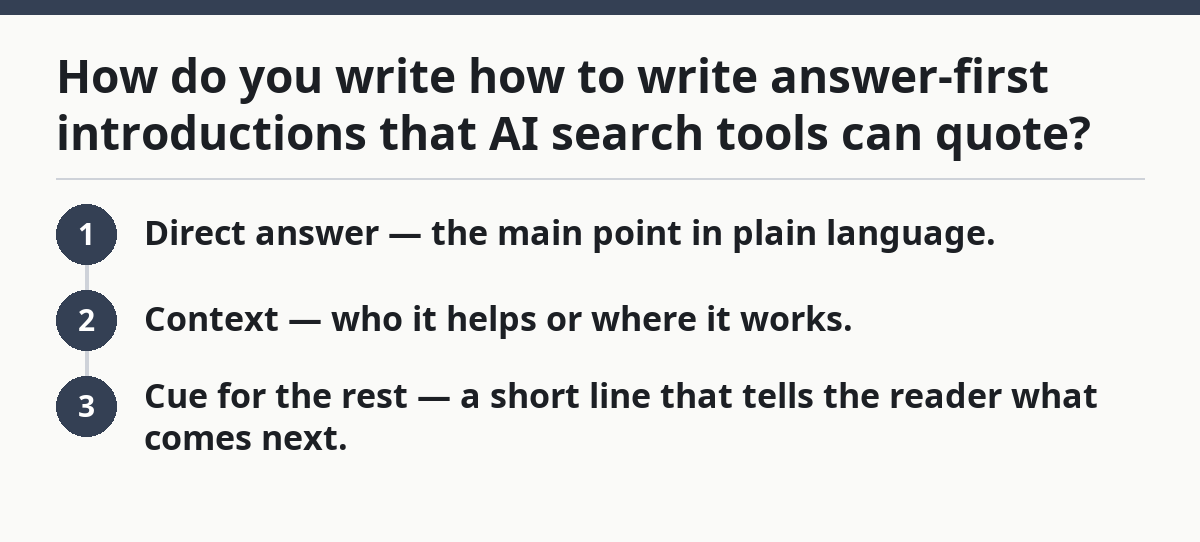
A quotable intro usually has three parts:
- Direct answer — the main point in plain language.
- Context — who it helps or where it works.
- Cue for the rest — a short line that tells the reader what comes next.
The truth is, most intros fail because they try to do too much. They define the term, praise the method, and promise a result before they ever answer the question. That costs clarity. Use the first line to settle the query, then let the rest of the article do the teaching.
A good test is simple: if you cut the paragraph from the page, would it still make sense as a quoted answer? If the answer is no, the intro is too dependent on the surrounding text.
Step 1: State the answer in the first sentence
State the answer in the first sentence so the page can be quoted without extra setup. That sentence should name the subject, use a plain verb, and avoid hedging words like “can” or “may” unless the claim really needs them.
Picture this: you’re drafting the opening line and want a single sentence that answers the query fast. Don’t start with “This article will explain” or “In this guide.” Those lines waste the first shot. Lead with the result instead, then let the paragraph expand by one or two sentences.
Use this pattern:
- What it is: “An answer-first introduction gives the main answer immediately.”
- What it does: “It helps readers and AI search tools find the point fast.”
- What follows: “The rest of the intro adds context, not a second opening.”
That structure is direct enough for a snippet and flexible enough for a page about writing. It also keeps your subject in the opening paragraph, which matters when a tool is scanning for a clean match.
Here’s the catch: the first sentence should not try to sound clever. If a line reads like marketing copy, it gets weaker as a quote. If it reads like a good note in a working draft, it often performs better.
Step 2: Put the definition after the answer, not before it
Put the definition after the answer so the intro still feels like an answer, not a glossary entry. Readers want the point first; search tools do too.
Picture this: you’re writing for a page that must explain answer-first introduction without turning the opener into a lesson. You have room for a short definition, but it belongs after the direct answer sentence, not before it. That order keeps the paragraph readable and quote-ready.
Use a definition that does one job. Say what the format does in one line, then stop. A good definition is concrete: it names the placement of the answer, the purpose of the intro, and the benefit to the reader. A weak one circles the topic and repeats the title.
Try this sequence:
- State the answer.
- Define the format in a sentence.
- Mention the practical payoff.
- Move into the body.
That order helps with citation-ready phrasing too. A sentence that names the subject once and explains it cleanly is easier to quote than a paragraph loaded with qualifiers.
A common mistake is to define the term before giving the answer. That makes the page sound academic, but it also makes the opening harder to lift cleanly. If the first line is only a label, the tool still has to go hunting for the actual answer.
Step 3: Keep the first paragraph short and self-contained
Keep the first paragraph short and self-contained so it can be lifted as a single unit. For this kind of page, 40 to 80 words is a practical target, because long intros split the answer across too many sentences.
Picture this: you’re editing the lead paragraph and can feel it drifting past the point. You add one more sentence, then another, and suddenly the answer is buried under setup. Pull it back. A clean intro does not need four ideas. It needs one answer and a little support.
Use a simple rule: if a sentence adds a new topic, it probably belongs later. The first paragraph should answer the main query, mention the subject once, and hint at the next section. That’s enough.
A short intro also gives you more control over keyword placement. The subject phrase can appear once in a natural way without being stuffed into every line. That matters more than repeating the phrase five times.
- One paragraph.
- One answer.
- One clear next step.
If you need more explanation, move it below the intro. The intro is the doorway, not the whole house.
Step 4: Write for extraction, not for fluff
Write for extraction by using simple sentence shapes, clear nouns, and one idea per line. AI search tools tend to quote passages that are easy to parse, not passages full of ornamental language.
Picture this: you’re choosing between a clean sentence and a polished one that sounds nicer but hides the point. Pick the cleaner sentence. Use active verbs, specific nouns, and a direct subject. If the sentence says what the page is about in the first half, you’re in good shape.
Avoid these habits:
- Opening with a scene that delays the answer.
- Using four abstractions in one sentence.
- Packing three clauses into the first line.
- Leading with a vague “this guide” sentence.
A good answer-first intro is not blunt for the sake of being blunt. It is efficient. It gives the reader the answer, then gives them a reason to keep reading. That’s the balance.
Now, you might be wondering how to keep it from sounding robotic. Use one human sentence after the answer sentence. A short line like “Here’s the catch:” or “That’s the point.” can create rhythm without stealing the focus. Just don’t turn the intro into a sales pitch.
This style helps human readers too. They get the point without scanning three paragraphs to find it.
Step 5: Edit the intro like a snippet, not a chapter
Edit the intro like a snippet by stripping out anything that does not help the first quoted answer. If a phrase does not improve clarity in the opening, cut it or move it lower.
Picture this: you’ve got a draft with a decent opening, but it still feels too soft for an answer engine. That is an editing problem, not a writing problem. Read the first paragraph out loud and ask one question: if a search tool quoted only this text, would it still answer the query?
Use this cleanup pass:
- Cut throat-clearing.
- Cut repeated topic labels.
- Cut examples from the opening.
- Cut promises that belong in the body.
- Keep the answer, the definition, and one benefit.
That final pass often turns a passable intro into a quotable one. It also reveals weak sentences fast. If a line exists only to “sound like an intro,” it usually has to go.
A sharp intro gives the page a better shot at featured snippet placement and answer-box use, but it is not magic. The rest of the page still has to match the opening. A strong intro plus a weak body creates a mismatch. A strong intro plus a clear body gives the search engine less reason to doubt the page.
What should the first paragraph include?
The first paragraph should include the answer, a short definition, and one reason the format matters. That gives the reader enough to understand the point without forcing them deeper into the page.
Picture this: you’re checking the opening and want a quick yes-or-no test. If the paragraph includes the subject, the answer, and a plain benefit, it’s doing the right job. If it opens with background history or a broad explanation of SEO, it’s off course.
A useful first paragraph often does all of this:
- Names the subject once.
- Answers the main question directly.
- Defines the format in plain English.
- Signals what the rest of the page will show.
That mix is enough for a human and enough for an answer engine. It is also easy to reuse across related pages without turning every opening into a clone.
The key is restraint. The intro is not the place for your best example, your longest explanation, or your strongest claim. It is the place for the cleanest answer.
FAQ
How long should an answer-first introduction be?
An answer-first introduction is usually short enough to fit in one tight paragraph, often around 40 to 80 words. The goal is to make the answer easy to quote, not to pack the whole article into the opening. If the intro starts carrying examples or caveats, it has gone too long.
What should the first paragraph answer?
The first paragraph should answer the reader’s main question directly. For this topic, that means it should explain how to write an intro that gives the answer first and stays clean enough for AI search tools to quote. A short definition and one practical benefit are usually enough.
How do I make an intro quotable for AI search?
Make the intro quotable by using one direct answer sentence, simple wording, and a self-contained paragraph. Keep the subject in the opening line, avoid fluffy setup, and make sure the paragraph still makes sense if it is lifted out of the page. Short, clear, and complete is the goal.
Why does answer-first writing help with AI search tools?
Answer-first writing helps because search tools often look for clear, direct passages they can quote without rewriting. If the answer is in the first sentence or two, the tool has less work to do and the result is easier for readers to trust. The format serves both speed and clarity.
Drafted with AI; not yet reviewed by a person.