AI Search Visibility Diagnostics: The Complete Guide
Last updated: November 19, 2026
Key Takeaways
- AI visibility checks show whether search and answer engines can find, trust, and reuse your pages.
- A page can rank in Google and still fail in AI search because AI systems often prefer concise, source-rich passages with clear entities and low ambiguity.
- You diagnose AI search visibility by checking crawl access, indexation, entity clarity, source strength, and answer presence in that order.
- The most important signals are crawlability, indexation, entity clarity, authority, and answerability.
AI search visibility diagnostics — The Complete Guide tells you why your brand shows up, gets cited, or gets ignored in AI answers, and what to fix first.
Quick Answer: in most cases, the first pass is 5 checks: crawl access, indexation, entity clarity, source strength, and answer presence.
This guide shows the checks that matter, the signals that matter most, and how to read the results without guessing.
What AI search visibility diagnostics actually measure
AI search visibility diagnostics measure whether search engines and answer engines can find, trust, and reuse your pages. They look at crawl access, indexation, entity clarity, source authority, and how your brand appears in AI-generated answers.
Therefore, a strong page can still miss AI citations if one layer fails. Picture this: you publish a strong page, but a chatbot cites a competitor instead. You need to know if the problem is crawling, weak signals, or plain lack of authority. This is diagnostics, not vibes.
Here’s the catch: AI visibility is not one metric. It’s a stack of 5 signal groups that can fail separately.
- Discovery: can bots reach the page?
- Indexing: did the engine store the page?
- Understanding: does the page clearly state who, what, and why?
- Authority: does the web back up the claim?
- Selection: does an AI system choose your page as a source?
A generic SEO audit often stops at rankings. That misses the new failure mode. You can rank in organic search and still lose citations in AI answers if your page is vague, thin on entity clues, or buried under stronger sources.
One more thing: AI visibility diagnostics should separate page-level problems from brand-level problems. A single article may be fine while your site as a whole lacks the trust signals AI systems tend to reuse. For example, one page may be indexed while the brand still lacks consistent external references.
Why your pages can rank but still stay invisible to AI answers
A page can rank in Google and still fail in AI search because AI systems often prefer concise, source-rich passages with clear entities and low ambiguity. That means “good SEO” is not enough on its own.
Because of that, a ranking page can still miss citations. Picture this: your article is indexed, gets clicks, and still never appears in a cited answer. The missing piece may be entity confidence, not traffic. That’s the trap.
The main reason is simple. AI systems do not just ask, “Is this page relevant?” They also ask, “Can I quote this with confidence?” That shifts the diagnostics from classic keyword matching toward three extra questions:
- Is the page easy to extract a clean answer from?
- Does the site look like a real authority on this subject?
- Do other pages on the web reinforce the same claim?
A page with one strong heading, a precise definition, and supporting references often has an edge over a longer page that rambles. The same goes for brand pages. If your name, category, and location or niche are unclear, the model may choose a competitor with cleaner signals.
Use these checks first:
- Page title and H1: do they state the topic plainly?
- Opening paragraph: does it answer the query in one or two sentences?
- Schema: is the structured data present and valid?
- Internal links: do related pages point to this page with consistent labels?
- External mentions: do other sites describe you the same way?
The truth is, AI visibility usually fails in boring places. Broken canonicals, lazy page copy, weak headings, and inconsistent brand names cause more pain than most teams expect.
How do I diagnose AI search visibility step by step?
You diagnose AI search visibility by checking crawl access, indexation, entity clarity, source strength, and answer presence in that order. Skipping one layer makes the rest noisy and hard to trust. If you need help interpreting the results, consult a qualified SEO or search specialist and use Google Search Central as a reference for crawling and indexing behavior.
Picture this: you open analytics and see impressions but no AI citations. You don’t need a hundred theories. You need a 7-step sequence that tells you where the chain breaks.
Before you start, keep the audit small enough to read cleanly. One homepage, one money page, and one supporting article are usually enough for a first pass.
- Confirm crawl access. Check robots.txt, noindex tags, canonicals, and server responses. If a page returns a 4xx or gets blocked, nothing else matters.
- Check indexation. Search the exact URL and the page title. If the page is not in the index, AI systems usually won’t use it.
- Inspect the snippet. See what search engines think the page is about. If the snippet misreads the topic, your page may be too ambiguous.
- Read the first 150 words. Can a model quote the answer cleanly from that text?
- Audit entity cues. Make sure the page names the brand, product, service, or topic in plain language.
- Review supporting evidence. Look for citations, author bios, about pages, and consistent references across the site.
- Check answer presence. Search the topic in AI tools and note whether your page, brand, or competitors appear in the response.
A useful note: do not confuse “appearing in an answer” with “driving traffic.” Sometimes the AI cites you but sends few clicks. Sometimes it never cites you but still scrapes your language into summaries. Those are different outcomes, and they need different fixes.
What signals matter most in an AI visibility audit?
The most important signals are crawlability, indexation, entity clarity, authority, and answerability. If those five are weak, AI visibility usually stays weak no matter how much content you publish.
Because the order matters, start with access, then move to meaning, then to trust. Picture this: you have a 20-page content hub, but every page uses fuzzy terms, thin intros, and different names for the same thing. AI systems hate that. They want clean signals, not creative drift.
1) Crawlability
If the page cannot be fetched, it cannot be used. Check the basics: robots.txt, meta robots, canonicals, redirects, and HTTP status. A page that’s blocked or canonicalized away often disappears from both search and AI systems. Google Search Central documents these crawling and indexing basics, and Schema.org documents structured data conventions.
2) Indexation
A page can be crawlable and still absent from the index. That often happens when the content looks thin, duplicate, or unhelpful. Use Search Console or a similar tool to confirm whether the URL is indexed. If it is not indexed, AI reuse is unlikely.
3) Entity clarity
AI systems need to know what the page is about in the first few lines. Use one primary topic per page, plain names, and consistent terminology. If your page is about “AI search visibility diagnostics,” say that early and clearly. For example, naming the brand and the service in the first paragraph lowers ambiguity.
4) Authority
This is where many teams underinvest. Author bios, organization pages, references, citations, and external mentions help AI systems trust the source. A lone page with no surrounding proof has a harder time winning citations. In practice, one supported claim beats five unsupported ones.
5) Answerability
Can the page be quoted? Can a system lift a 2-3 sentence answer without losing meaning? If not, rewrite the intro, headings, and key paragraphs. A short answer that states the point in plain words often performs better than a long paragraph.
These signals are testable without guesswork. You do not need a magic AI dashboard to start. You need a structured review and a willingness to fix what the system already shows you.
Which tools should you use for diagnostics?
Use search console data, crawl tools, analytics, and direct AI query checks together. One tool alone will miss part of the picture.
Therefore, do not rely on a single dashboard. Picture this: a dashboard says visibility is down, but you don’t know if that means ranking loss, citation loss, or a crawl problem. The fix is to combine 4 tool types and compare the results.
The tools that matter
- Search Console or Bing Webmaster Tools: indexation, queries, snippets, and URL inspection.
- A site crawler: crawl depth, canonicals, status codes, duplicate paths, and internal linking.
- Analytics: page traffic, landing page behavior, and conversion drops.
- AI query checks: direct prompts in answer engines to see who gets cited.
What each one tells you
Search tools show whether the page is eligible to appear. Crawlers show whether the site structure helps or hurts discovery. Analytics show whether people still land on the page. AI queries show whether the model prefers you or a rival.
What to watch for
- Indexed page, but no AI citation: usually authority or answerability.
- No indexation: usually technical blocking or weak page quality.
- Citation without traffic: likely answer extraction without strong click incentive.
- Traffic without citation: classic ranking, but weak AI reuse.
The honest limitation: no tool can tell you the full truth by itself. AI systems do not publish a complete scorecard for visibility. That means diagnostics always require judgment, not just reports.
One authoritative source worth keeping handy is Google Search Central, which documents how indexing and crawling work. For structured data rules, the Schema.org documentation is also useful.
How should you read the results without fooling yourself?
Read the results as a pattern, not as one-off wins or losses. One cited answer does not prove strong visibility, and one missed query does not prove failure.
Because AI results shift, your reads should too. Picture this: your page appears in one AI response and disappears in the next. That’s normal. The model, prompt, and source pool can all shift. The mistake is treating one result like a final verdict without checking the broader pattern.
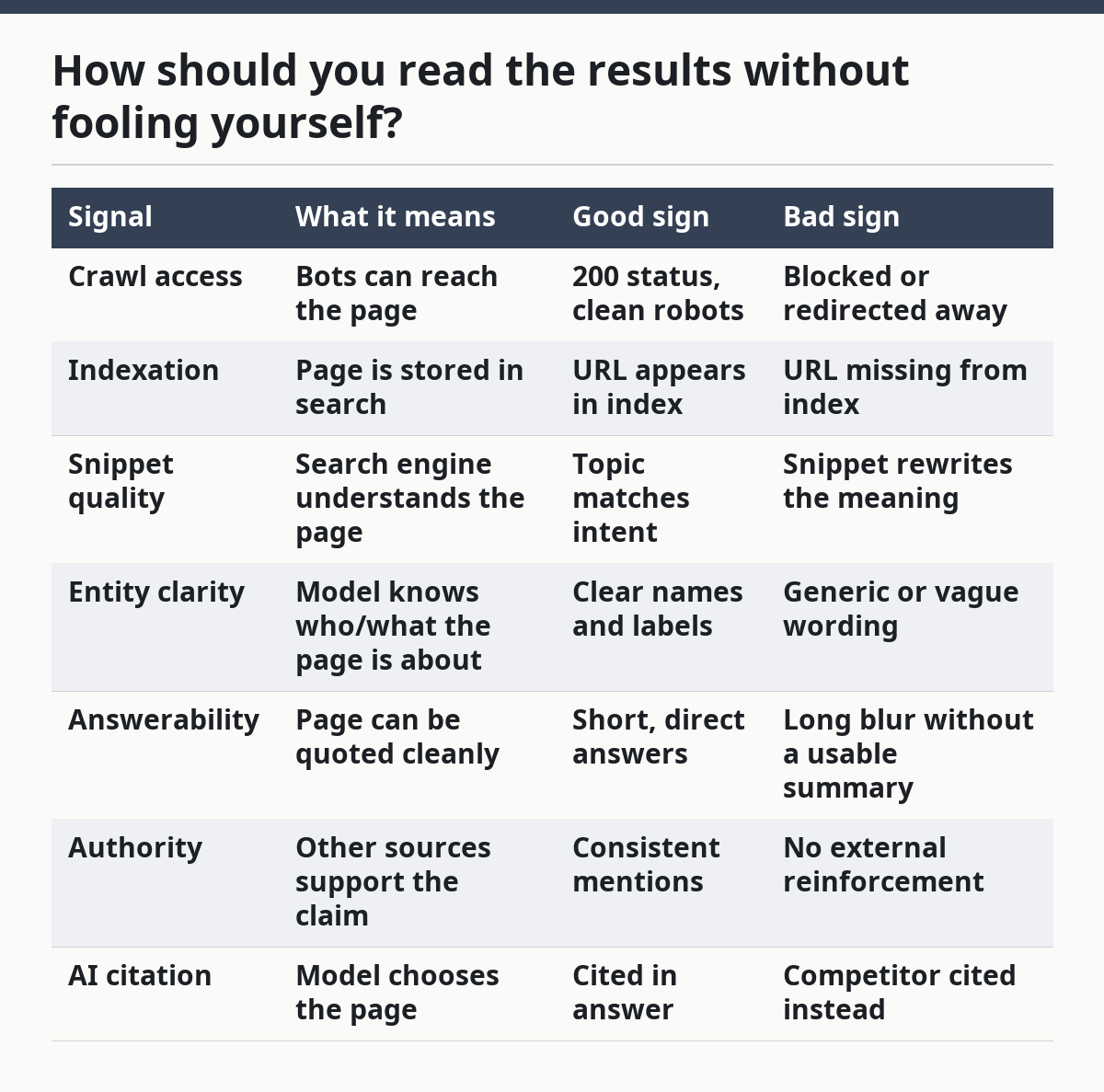
Use this lens instead:
| Signal | What it means | Good sign | Bad sign |
|---|---|---|---|
| Crawl access | Bots can reach the page | 200 status, clean robots | Blocked or redirected away |
| Indexation | Page is stored in search | URL appears in index | URL missing from index |
| Snippet quality | Search engine understands the page | Topic matches intent | Snippet rewrites the meaning |
| Entity clarity | Model knows who/what the page is about | Clear names and labels | Generic or vague wording |
| Answerability | Page can be quoted cleanly | Short, direct answers | Long blur without a usable summary |
| Authority | Other sources support the claim | Consistent mentions | No external reinforcement |
| AI citation | Model chooses the page | Cited in answer | Competitor cited instead |
Now, you might be wondering what counts as “good enough.” The answer depends on the query type. For a brand query, you need stronger control over your own name and facts. For a broad informational query, you need more external authority and cleaner explanatory copy.
A common mistake is reading AI visibility like rank tracking. That fails because AI systems can summarize several sources at once, then cite only one. Your page may still shape the answer even when it is not named.
The fix list: what to change first
Fix the page structure first, then the site signals, then the off-site proof. That order usually gives the fastest lift.
So, if time is tight, start where the model reads first. Picture this: you have limited time and a pile of broken signals. You can’t fix everything at once, so the order matters. Start with the pieces that help a model understand and trust the page in under 30 seconds.
First-pass fixes
- Rewrite the title so the topic is plain.
- Put the direct answer in the opening paragraph.
- Use one H2 per subtopic, not ten near-duplicates.
- Add author and organization details where they belong.
- Tighten internal links so related pages point to the right hub.
- Add references or citations where the claim needs support.
- Make sure the page is indexable and canonicalized correctly.
Why this order works
Structural fixes change what the crawler and parser see immediately. Off-site proof takes longer to build, but it often decides whether your page gets reused in AI answers. A brilliant article on a weak site still struggles.
What not to do
- Do not stuff the page with every related keyword.
- Do not hide the answer below long filler.
- Do not publish ten thin pages on the same subtopic.
- Do not chase AI visibility with copied summaries and empty headings.
The better move is boring and effective: make the page easier to parse, easier to trust, and easier to quote. That is the shape AI systems reward.
When should you ignore the AI visibility problem?
Ignore it only when the page has no real search demand or when the topic is too niche to justify a diagnostic effort. In those cases, a full audit can waste time.
Because demand matters, not every page deserves the same effort. Picture this: you’re spending hours chasing AI citations for a page that gets almost no interest. That’s not a visibility problem. That’s a demand problem.
Cases where diagnostics may not be worth the effort
- No search demand: if almost nobody searches the topic, AI visibility won’t matter much.
- Temporary page: event pages, one-off notices, and short-lived promotions rarely need deep diagnostics.
- Duplicate intent: if another page already owns the same query and this one is only a variant, consolidation may beat optimization.
- Low-stakes content: not every informational page needs AI answer exposure.
This is where a lot of teams overwork the wrong thing. They keep polishing pages that should be merged, retired, or rewritten from scratch.
The better question is not “Can this page rank in AI?” It’s “Does this page deserve to exist as a distinct answer source?” If the answer is no, diagnostics should end with a content decision, not a repair list.
The verdict: what a good diagnostic program looks like
A good AI search visibility diagnostic program checks technical access, page clarity, authority, and AI answer presence in one pass, then fixes the weakest layer first. That is the simplest path to cleaner citations and better control.
Ultimately, the sequence is about priority. Choose technical checks first if pages are missing from the index, blocked, or canonicalized incorrectly. Choose entity and authority checks first if the page is indexed but rarely cited. Choose content consolidation if several pages chase the same query. Neither if the topic has little demand or the page should not exist as a standalone asset.
The clean rule is this: if the system cannot find you, fix access; if it can find you but won’t cite you, fix trust and clarity.
AI search visibility diagnostics FAQ
How is AI search visibility different from SEO?
AI search visibility is about whether answer engines and AI summaries can find, trust, and reuse your page. SEO is broader and usually focuses on rankings, clicks, and organic traffic. A page can do well in one and poorly in the other.
Do I need special tools to diagnose it?
No, not at the start. Search Console, a crawler, analytics, and direct AI query checks are enough for a first diagnostic pass. Special AI visibility platforms can help later, but they do not replace the basics.
Why does my page rank but not get cited?
Usually because the page is weaker on answerability, entity clarity, or authority than the pages AI systems prefer. Ranking proves relevance; citation requires a cleaner, more trustworthy source package. The model is choosing the easier source to quote.
What is the first thing I should fix?
Fix crawl and index problems first if the page is missing from search. If the page is already indexed, rewrite the opening so the answer is direct and the topic is unmistakable. That gives the fastest diagnostic signal.
Can one page improve the visibility of the whole site?
Yes, but only partly. A strong hub page can help establish topic authority, yet the site still needs consistent naming, internal links, and supporting pages. One good page won’t cover for a weak site structure.
Drafted with AI; not yet reviewed by a person.