Why AI Search Tools Won’t Cite Your Page
Last updated: November 19, 2026
Key Takeaways
- The usual cause is simple: the page is not eligible to serve as a source.
- An indexed page can still be a weak source if the engine cannot extract the claim cleanly.
- Yes, they can block or blur citation, but not in the same way.
- At that point, the problem may be sitewide architecture, duplicated source signals, or a retrieval system that prefers a different source class.
AI search tools are not citing your page because they may not find it, may not extract it cleanly, or may not think it is the best source to quote. How to diagnose why a page is not being cited by AI search tools starts with checking indexation, robots rules, and whether the page’s main answer is easy to pull into a snippet.
The steps below sort out the cause without guessing.
Before you chase wording changes, speak to a qualified SEO or technical webmaster if the page sits on a site with health, legal, or other high-stakes claims.
AI search citation diagnostics: who this applies to
This applies if you already have a live page, know the query you want it to answer, and want to figure out why AI search citation diagnostics are failing on that page. It assumes you can check Google Search Console, inspect the page source, and read basic robots.txt rules.
Picture this: you’ve published a page, it ranks or at least exists, and Perplexity, ChatGPT, Bing, or Google Search still skip it when they cite sources. The problem may be the page, the site, or the answer engine’s own source rules. That is why diagnosis has to start with the page itself.
This is not the right guide if you need a checklist for an entire site, a plan to improve visibility, or a method for measuring citation share. Those are different jobs. Here, the question is narrower: why this page is not being cited.
A good first pass also means knowing the page’s role. If the page is an opinion piece, a thin update, a login-gated resource, or a near-duplicate of another URL, citation failure may be expected. If the page contains medical or legal material, the bar is higher and a qualified review matters more than a quick tweak.
The page has to be findable, readable, and quotable.
Why page citation usually fails
The most common cause is simple: the page is not eligible to be used as a source. That can happen even when the page looks fine in a browser. AI systems depend on crawl access, index access, and extractable text, not just a visible layout.
The truth is, citation problems usually fall into four buckets. One bucket is discovery: the page is not indexed, blocked, or buried behind parameters. Another is extraction: the main answer is hidden in script, tabs, accordions, or images. A third is source quality: the page is too thin, too vague, or too close to other pages. The last is answer-engine preference: the tool found a stronger source.
Here’s the catch: if the page is not in Google’s index, that does not always mean every AI tool will ignore it, but it is still a major warning sign. Google’s own crawl and index systems remain a baseline for many discovery paths, and Bing matters too because some tools rely on its index or retrieval stack. According to Google Search Central, indexing is separate from crawling, and search systems can still exclude pages after crawl. See Google Search Central and Bing Webmaster Guidelines for the underlying rules.
A working diagnosis starts with one question: can a crawler reach the page and identify the main claim in plain text? If the answer is no, the rest of the fixes are noise.
Eligibility comes first.
What to check first, in order
Picture this: you open Search Console, search for the exact URL, and then compare what Google sees with what the browser shows. That single pass often tells you whether the failure is at the crawl stage, the render stage, or the source-selection stage.
Therefore, begin with the checks that are quickest to verify and most likely to explain the missing citation.
- Check the index status. Use Google Search Console’s URL Inspection for the exact URL, and verify whether the page is indexed, excluded, or blocked from indexing. If it is excluded, that is the first problem; if it is indexed but not selected, you move on. A problem shows up when the page is “Crawled – currently not indexed,” “Discovered – currently not indexed,” or blocked by a directive.
- Review robots.txt and meta directives. Confirm the page is not blocked by robots.txt,
noindex, or an HTTP header such asX-Robots-Tag. If one directive says “don’t index,” AI tools that rely on indexed sources are less likely to cite it. If the page is allowed in the browser but blocked for bots, that mismatch is the problem. - Inspect the canonical tag. Check whether the page points to itself or to a different URL. A canonical that favors another page tells search engines which version to trust. If the canonical points elsewhere, the page may not be treated as the source of record; if the setup is high stakes, consult a qualified SEO or technical webmaster and review Google Search Central’s canonical guidance.
- Look at renderable text. View the source and the rendered page. Make sure the main answer appears in HTML text, not only in JavaScript, an image, or a collapsed block. If the answer is hidden until a user clicks, the crawler may not treat it as the main source; check Google’s guidance on JavaScript and rendered content if the page depends on client-side output.
- Check schema markup. Validate the structured data with Google’s Rich Results Test or Schema Markup Validator. Make sure the schema matches the page type and does not contain false fields. Bad schema does not usually cause a citation ban by itself, but broken or misleading markup can reduce trust.
- Compare against competing pages. Search the same question in Google, Bing, Perplexity, and ChatGPT-style search modes if available. Note which pages get cited instead. If the cited pages answer faster, show a clearer claim, or have stronger authority, the issue may be source quality rather than access.
- Check title, headings, and first screen text. The page should say what it is about within the first visible paragraph, using the same terms a searcher would use. If the page drifts before stating the answer, extraction can fail even when the page is indexed.
- Test for duplication and dilution. See whether another page on the same site targets the same query or same answer. If two URLs compete, answer engines may choose neither consistently. A weak duplicate can flatten both pages.
If the first three checks fail, stop and fix the technical block before touching the wording. If the page passes them, the issue is usually extraction or source strength.
Do not skip the URL test.
Why content extraction fails even when the page is indexed
An indexed page can still be a poor source if the answer engine cannot extract the claim cleanly. That often happens when the main point is scattered across modules, buried in accordions, or split by unrelated copy.
Because of that, a page with a long hero banner, a promo box, three ads, and the actual answer halfway down can be hard for a retrieval system to interpret. A human can scan past the clutter. A retrieval system may not. It often weights the first clear paragraph, the page title, subheads, and link context more than decorative layout.
Two practical problems show up here. First, the page may use JavaScript to inject the answer after load, which can delay or weaken extraction. Second, the page may answer in vague language instead of a direct sentence. “Many factors matter” is not the same as “This page is blocked by robots.txt.” One is hard to cite; the other is easy.
If you want to diagnose extraction, look for these signs:
- The main claim appears only after a click.
- The same answer appears in images or charts without text equivalents.
- The first paragraph is long, cautious, and non-committal.
- The page title is generic and does not match the query.
- The H2s describe sections, but not the question the page answers.
That does not mean every page needs rigid formatting. It means the source has to be quote-ready. AI search tools are more likely to cite pages that state a plain answer in a compact block and then support it with evidence.
Extraction is a text problem.
Do schema markup, robots.txt, or canonical tags block citation?
Yes, they can block or blur citation, but not in the same way. Robots rules can stop crawling or indexing. Canonicals can point the system to a different URL. Schema markup usually helps clarify meaning, but it cannot rescue a page that is blocked or text-poor.
A few technical terms matter here. robots.txt is a file that tells crawlers which paths they may or may not fetch. A canonical tag is a signal that says which version of a page should count as the main one. Schema markup is structured data in code that describes the page’s topic, author, organization, or other entities.
Picture this: your page has strong copy, but the robots file blocks the folder, or the canonical points to a parameterized version that nobody cites. In that case, the problem is not content quality. It is source control.
Use this quick interpretation guide:
- If robots.txt blocks the path, search bots may never fetch the page.
- If the page is noindex, it may be crawled but kept out of the index.
- If the canonical points elsewhere, the wrong URL may get credit.
- If schema is missing or broken, the page may still index, but the machine has less structure to read.
- If schema is accurate but the page body is weak, the markup will not save it.
For verification, Google’s Search Central docs and the Schema.org documentation are the right references to review. They explain how crawlers interpret directives and structured data.
Tags guide the crawler.
When to stop and get help
Picture this: you have checked indexing, robots.txt, canonicals, and visible text, and the page still is not cited. At that point, the problem may be sitewide architecture, duplicated source signals, or a retrieval system that prefers a different source class.
Stop the do-it-yourself pass in these situations:
The page is blocked by a sitewide rule: A folder-level robots directive, security rule, or login wall can keep the page out of crawl paths — get a technical webmaster to inspect the server and headers.
The page uses heavy JavaScript for the main answer: If the core answer only appears after client-side rendering, the bot may miss it — ask for a render audit and server-side or pre-rendered output.
The page has multiple near-duplicate URLs: Competing versions can split signals and confuse source selection — consolidate or canonicalize with help from an SEO specialist.
The page is in a regulated category: Health, legal, or financial claims can be passed over if the page lacks clear authorship, sourcing, or review — have a qualified professional review the page’s content and sign-off path.
The page is cited nowhere, even though rivals are: If Google, Bing, and Perplexity all ignore it while similar pages are cited, the issue is probably authority, structure, or page purpose — use a deeper source-quality review instead of single-page tweaks.
The page changed recently and citations dropped: Recent edits can reset how a page is read, especially if headings, canonicals, or text blocks changed — wait for recrawl and confirm the new version is stable before making more edits.
In these cases, the consequence is wasted time and muddy signals. The fix is a controlled review, not a stack of small edits.
Stop if the system is bigger than the page.
The mistakes that waste the most time
Picture this: you keep rewriting a headline while the real issue sits in a blocked folder, a bad canonical, or a page that never renders the answer in text. That is a common trap, and it burns hours.
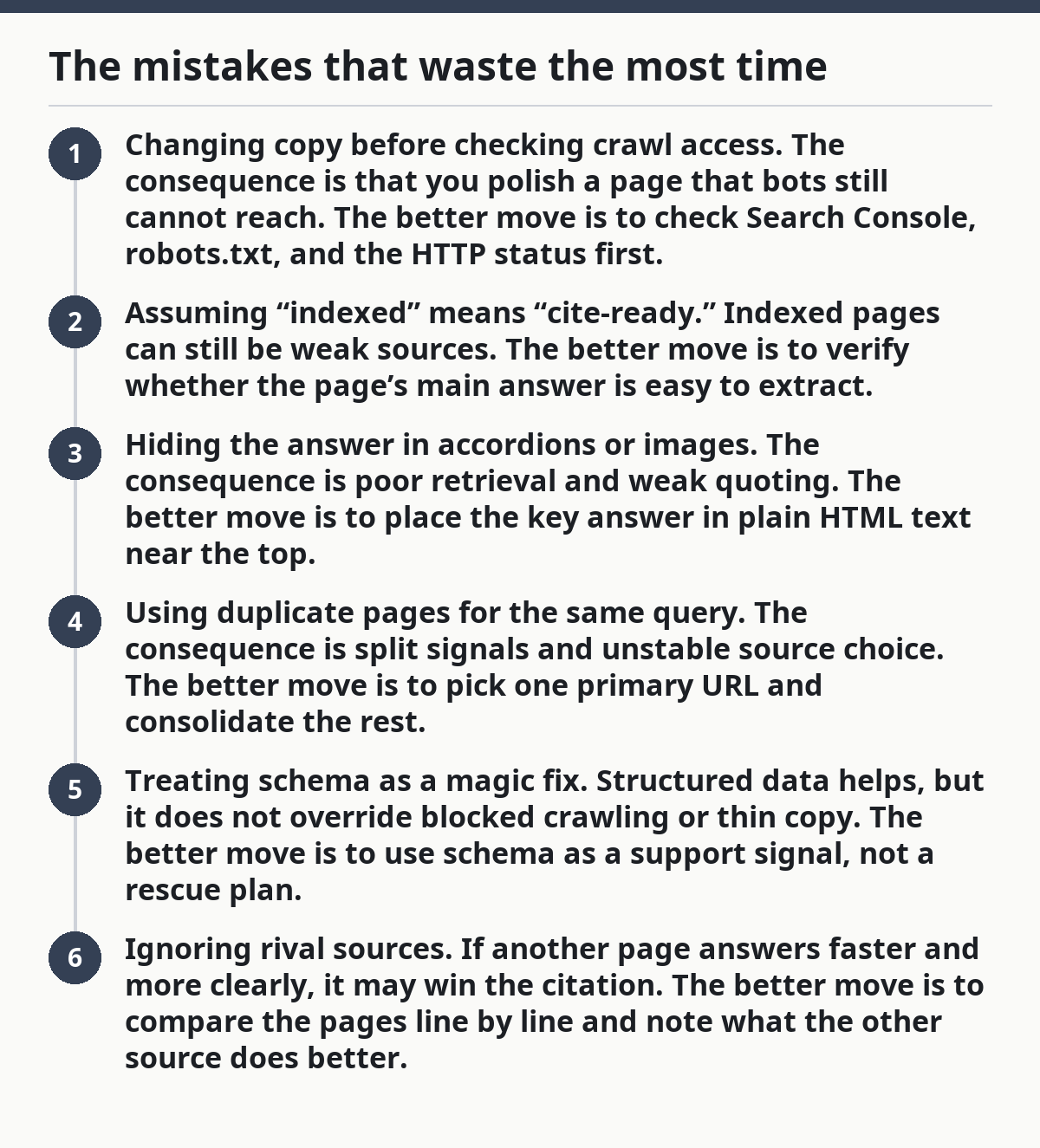
The biggest mistakes are predictable:
- Changing copy before checking crawl access. The consequence is that you polish a page that bots still cannot reach. The better move is to check Search Console, robots.txt, and the HTTP status first.
- Assuming “indexed” means “cite-ready.” Indexed pages can still be weak sources. The better move is to verify whether the page’s main answer is easy to extract.
- Hiding the answer in accordions or images. The consequence is poor retrieval and weak quoting. The better move is to place the key answer in plain HTML text near the top.
- Using duplicate pages for the same query. The consequence is split signals and unstable source choice. The better move is to pick one primary URL and consolidate the rest.
- Treating schema as a magic fix. Structured data helps, but it does not override blocked crawling or thin copy. The better move is to use schema as a support signal, not a rescue plan.
- Ignoring rival sources. If another page answers faster and more clearly, it may win the citation. The better move is to compare the pages line by line and note what the other source does better.
The common thread is that AI search citation is not one switch. It is a chain of signals. Break one link, and the page can disappear from source lists even if it still looks fine to a person.
One bad signal can sink the page.
What a good result looks like
Picture this: the page is indexed, the canonical is clean, the main answer is visible in text, and the page has clear headings that match the query. At that point, the page is not guaranteed to be cited, but it is finally eligible and easy to evaluate.
A good result has a few concrete signs. Google Search Console shows the URL as indexed. Bing can fetch the page. The robots file and meta tags allow crawling. The first paragraph says what the page is about without a long setup. Schema, if used, matches the actual page type. The page also stands apart from its siblings instead of duplicating them.
That is the minimum bar for answer-engine visibility. It does not force a citation, but it removes the most common reasons for failure. If the page still is not cited after that, the issue is usually source authority, page purpose, or the fact that another page answers the same query more directly.
The linked hub on AI search visibility foundations — The Complete Guide can help with the broader framework once this page is technically sound. Here, the job is narrower:
Drafted with AI; not yet reviewed by a person.