How to Check Whether AI Search Tools Can Cite Your Content
Last updated: November 19, 2026
Quick answer: In this guide on How to check whether AI search tools can cite your content, the fastest diagnosis is a 3-step check: confirm the page is indexable, confirm the answer is extractable, and confirm the preferred URL is the one AI tools can retrieve. AI search citation is usually easy to check: ask the tool a question your page should answer, then see whether it pulls your page as a source, quotes a passage, or ignores it because the page is blocked, hard to extract, or missing the signals that make citations possible. This guide is about diagnosis before any rewrite, not about ranking tricks.
What you need before you start
You need one live URL, access to the page’s source or CMS settings, and a way to compare what the page says with what an AI tool can quote. The quickest check uses 3 things: your published page, Google Search or Bing results, and at least one AI search tool such as Perplexity or ChatGPT with browsing enabled.
A page that is already indexed or close to it is the best starting point. If the URL is not in search engines yet, citation checks are mostly noise. AI search tools cannot cite what they do not retrieve. You also need to know the page’s canonical URL, because citation checks often fail when the same content appears on 2 or 3 addresses.
Use the page itself, not a local draft. A draft in a CMS can look perfect and still fail every external check because the crawler only sees the published version. If the page has charts, accordions, tabs, or heavy JavaScript, note that too. Those details matter because many citation systems prefer text they can extract in 1 pass, not content that appears only after a click. For more on crawl and indexing basics, see Google’s Search Central documentation and Bing’s search guidance.
If your site already has technical controls, collect these before you begin: robots.txt, the page’s canonical tag, and the sitemap URL. Those 3 items are enough for a first diagnosis on most sites.
How do I check whether AI search tools can cite my page?
You check it by testing retrieval, extractability, and source attribution in that order. A page can be well written and still fail because one of those 3 layers is broken.
-
Confirm the page is indexable in Google Search and Bing. Search the exact URL or a unique sentence from the page. If either engine shows the page or a close snippet, the page is at least visible to search crawlers. If it does not appear, check
robots.txt, noindex tags, and the canonical tag before you touch the copy.
What success looks like: the URL appears in search results, or the engine shows the title and a snippet that clearly matches your page. -
Open the page source and look for the canonical tag. The canonical should point to the version you want cited, not a parameterized duplicate or printer-friendly copy. If the canonical points somewhere else, AI search tools may treat that other URL as the source of record, though the exact behavior can vary by tool.
What success looks like: one preferred URL is declared, and it matches the address you want cited in AI search. -
Check
robots.txtand any page-level crawl rules. Make sure the page is not blocked by a disallow rule or anoindexinstruction. A page can be visible to users and still be excluded from citation candidates if crawlers are told not to index it. For guidance on crawl directives, consult a technical SEO professional if needed and review Google’s robots.txt documentation.
What success looks like: the page can be crawled and indexed without special exceptions. -
Test the page in Perplexity, ChatGPT, and Bing with a direct question. Ask a query that should lead to your page’s exact topic, then inspect the cited sources. Use a question with 8 to 12 words, not a vague brand search.
What success looks like: the tool cites your page, quotes a passage from it, or shows it in the source list for the answer. -
Compare the quoted text with the page’s visible text. If the tool cites only a homepage, category page, or another site, the issue may be extractability rather than relevance. If the tool quotes your page but the quote is broken or incomplete, the page may be too dynamic or the relevant answer may be buried below the fold.
What success looks like: the AI tool can lift a clean sentence, definition, or list item from the page without guessing. -
Repeat the test with a second wording and one variant search engine. AI citation can change with phrasing, so test one exact-match question and one broader question. Then check Google Search or Bing again to see whether the page appears as a normal source outside the AI interface.
What success looks like: the page shows up consistently enough that citation is not just a one-off artifact.
If the page fails at step 1, do not spend time on formatting. If it fails at step 4 but passes step 1, the problem is usually extractability or source selection, not pure indexing.
What makes a page easy for AI search tools to quote?
A page is easy to quote when one passage answers one question in plain text, near the top, without forcing the crawler to assemble the answer from fragments. That is the basic standard for citation eligibility.
The easiest pages for AI search tools often share 4 traits:
- A visible answer in the first 100 to 200 words
- Headings that label sections clearly
- Plain HTML text instead of text locked inside images or scripts
- A single canonical URL with no duplicates competing for the same content
A page that looks perfect to a human can still be hard to quote if the answer sits inside a slider, tab panel, or app shell. Those elements are common on modern sites, but many search tools may treat them as lower-confidence text because the relevant sentence is not sitting in one straightforward block. If you are unsure how your setup renders, consult a technical SEO professional and compare the page with Google’s guidance on JavaScript SEO.
Content formatting also matters. Short paragraphs, labeled lists, and direct definitions are easier to reuse than long walls of copy. The page does not need to be thin. It needs to be legible. A 2,000-word article with one clearly marked answer section is often easier to cite than a 600-word page that hides the answer in a decorative layout.
Schema markup can help, but it is not a magic key. It tells crawlers what the page is about and can reinforce the page type, yet AI tools still need visible content to quote. Treat schema as a signal, not a substitute for text, and consult a technical SEO professional if you are using schema to diagnose citation problems. The same is true for headings: they organize the page for extraction, but they do not rescue a page that is blocked or duplicated.
If the question is “what makes content easy for AI to quote,” the answer is simple: one clean passage, one preferred URL, and one crawler-accessible version of the page.
Which technical checks tell you the page can be cited?
The technical checks are robots.txt, canonical tags, index status, and duplicate URLs, because those four decide whether the right version of your page is even eligible to be picked up.
Start with robots.txt. A disallow rule can keep search bots away from the page entirely. Next, inspect the canonical tag. If the canonical points somewhere else, AI search tools may treat that other URL as the source of record. Then check for duplicates created by parameters, tracking codes, trailing slashes, mobile subdomains, or printer versions. If 2 URLs serve the same content, citation signals split and the stronger URL may never win.
Use Google Search and Bing as a reality check. If neither engine can surface the URL after the page has been live for a reasonable period, the citation problem is often upstream from the AI tool. AI search systems usually depend on search index data, live retrieval, or both. That means a page that is invisible to normal search will rarely become a reliable citation source by accident.
One useful test is the “unique sentence” search. Copy a sentence from the page that is unlikely to appear elsewhere and search it in quotes. If search engines cannot find it, your indexability is weak or the text is not being rendered in a crawlable way. If they can find it but the AI tool still does not cite it, the issue may be source preference or poor answer formatting.
Do not treat schema markup as a fix for crawl blocks. A page can have Article, FAQPage, or Organization markup and still be uncitable if the crawler cannot fetch the content. The order matters: first make the page crawlable, then make the content readable, then layer markup on top.
Why is my page not cited by AI search tools?
Your page is usually not cited because it is blocked, duplicated, hard to extract, or less authoritative than the sources the tool prefers.
The common failures are predictable:
- The page is excluded by
robots.txtornoindex - The canonical tag points to another URL
- The answer lives in a format the tool does not extract well
- The topic is covered more clearly by another source
- The page lacks obvious authority signals compared with competitors
That last point matters. AI search systems do not cite pages in a vacuum. They compare pages. If your page is thin on source signals, dates, authorship, or references to a well-defined topic, the tool may choose a more established page from a recognized publisher, even if yours is technically indexable. This is where authoritative source signals matter: a clear author line, consistent brand identity, and a page that is obviously about one topic at a time all help.
A generic mistake is to blame “AI” when the real issue is the page itself. If the content is buried below a long intro, broken into tabs, or spread across several near-duplicate URLs, citation systems have too much work to do. Another mistake is to assume that being indexed means being citeable. Indexability is necessary, not sufficient.
A practical way to separate the problems is to ask 3 questions in order: can the page be crawled, can it be extracted, and is it the best source on the topic? If the first answer is no, fix crawlability. If the first is yes and the second is no, fix formatting and rendering. If both are yes and the third is still no, the issue is source strength, not access.
For readers building broader AI search visibility, this diagnostic sequence is the right first step before any content overhaul.
Which citation signals should I check on-page?
The citation signals you should check are visible structure, source clarity, and consistency between the page title, headings, and body text.
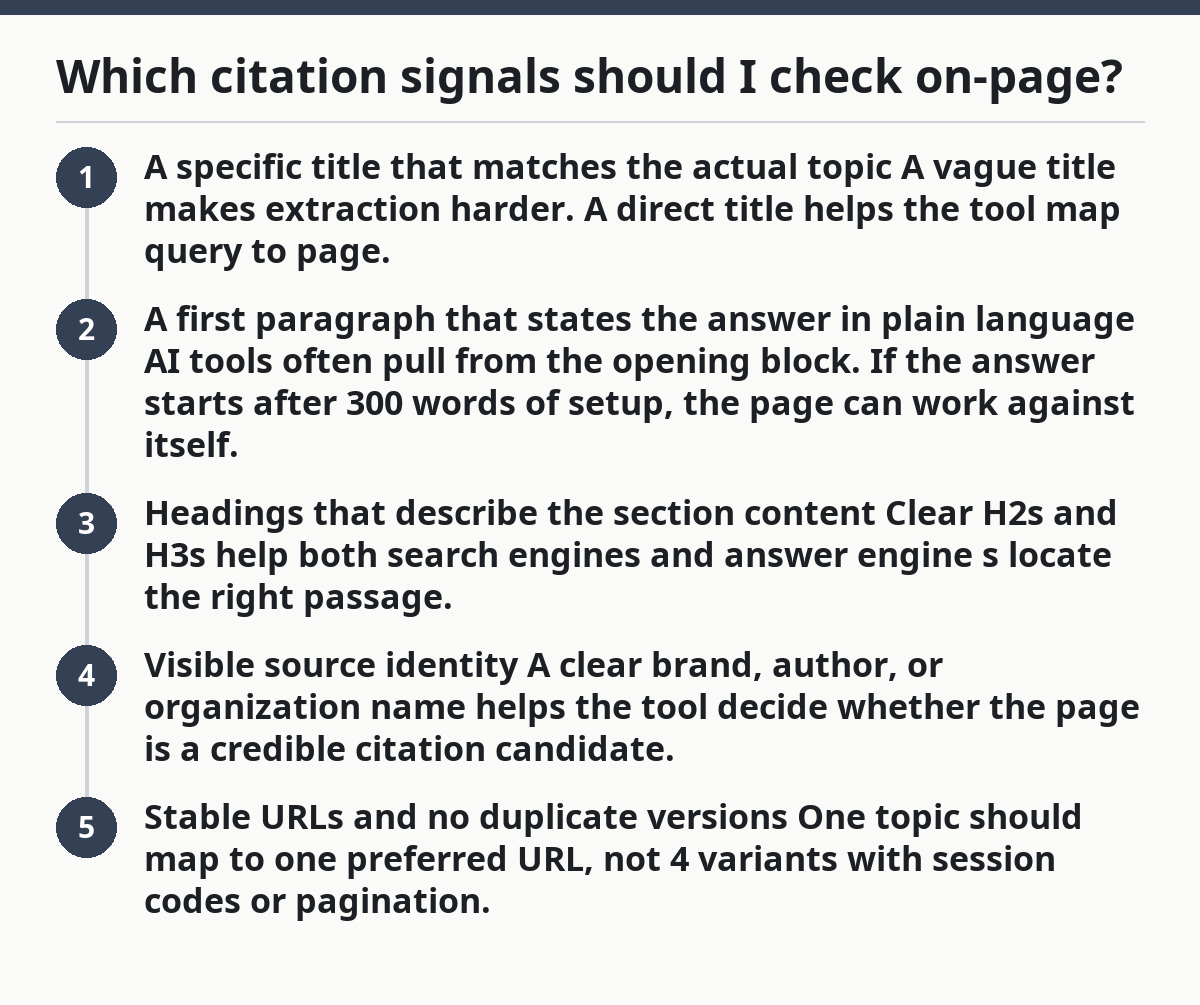
Look for these 5 signals on the page itself:
-
A specific title that matches the actual topic
A vague title makes extraction harder. A direct title helps the tool map query to page. -
A first paragraph that states the answer in plain language
AI tools often pull from the opening block. If the answer starts after 300 words of setup, the page can work against itself. -
Headings that describe the section content
Clear H2s and H3s help both search engines and answer engines locate the right passage. -
Visible source identity
A clear brand, author, or organization name helps the tool decide whether the page is a credible citation candidate. -
Stable URLs and no duplicate versions
One topic should map to one preferred URL, not 4 variants with session codes or pagination.
A page with strong signals can still fail if it hides key text in images or renders content only after interaction. That is why content formatting belongs in the diagnosis. If the answer is available in HTML from the first load, AI search tools have a much better chance of quoting it. If the answer is trapped in a carousel or collapsed panel, the tool may ignore it even when humans can see it.
This is also where many generic guides go wrong: they talk about “quality” without saying what the machine can actually extract. Quality matters, but so does sentence placement. The machine needs a clean path to the passage.
What should I do after the check?
You should classify the page as citeable, partially citeable, or not citeable yet, then fix the bottleneck before changing the copy.
Use this simple outcome map:
- Citeable: the page is indexed, extractable, and appears as a source in at least one AI search tool.
- Partially citeable: the page is indexed but not consistently selected or quoted.
- Not citeable yet: the page is blocked, duplicate, or not retrievable by search tools.
If the page is citeable, keep the structure stable and monitor it after major CMS changes, template updates, or URL migrations. If it is partially citeable, look first at the canonical tag, robots settings, and how the first 150 words are formatted. If it is not citeable yet, do not start with a rewrite. Fix crawlability first. A beautifully written page behind a blocked robots.txt file is still invisible.
The honest limitation here is that citation eligibility is not a promise. AI search tools can change what they retrieve, how they rank sources, and which pages they quote. A page that works in Perplexity may not appear in ChatGPT or Bing the same way on the same day. That is normal. The useful question is not “Can I force citation?” The useful question is “Can the tool see, extract, and prefer my page if it wants to?”
Key Takeaways
- Check crawlability before you touch the copy.
- A page must be indexable, extractable, and clearly preferred by its canonical URL.
robots.txt, canonical tags, and duplicate URLs can block citation without changing the page text.- AI search tools quote clean, visible HTML more easily than content buried in scripts, tabs, or images.
- Perplexity, ChatGPT, Google Search, and Bing can all give different citation results, so one test is never enough.
- If the page is not cited, first diagnose access and source clarity, not “content quality” in the abstract.
How do AI answer engines choose sources?
They usually choose sources that are accessible, relevant to the question, and easy to quote. That means the page must be retrievable, readable, and clearly about the topic. A source that is technically indexed but hard to extract may lose to a cleaner page, even if both cover the same subject. Exact behavior varies across Perplexity, ChatGPT, and Bing.
Why is my page not cited by AI search tools?
Your page is usually not cited because it is blocked, duplicated, hard to extract, or weaker than competing sources. Check robots.txt, the canonical tag, and whether the answer is visible in plain text within the first screen or two. Also compare search results across Google and Bing before assuming the issue is the AI tool itself.
Drafted with AI; not yet reviewed by a person.