How to Use AI Content Briefs for Topical Authority
Last updated: November 19, 2026
Quick Answer: Use 1 pillar page plus 3 to 7 related support pages. This guide on How to Use AI Content Briefs to Build Topical Authority: related questions shows how to turn one broad topic into a planned set of pages, related questions, and clear coverage gaps. Start with one core subject, group the questions people ask around it, then use each brief to assign one page a single job.
Key takeaways
- A good AI brief does not just list keywords; it tells each page what to cover, what to skip, and which question it must answer first.
- Topical authority grows faster when the brief plan covers 1 main page plus related pages that answer the next 3 to 7 questions a reader has.
- The strongest briefs are usually narrow. If one page tries to answer 10 different intents, it often ranks for none of them.
- AI helps with structure and gap-finding, but a brief still needs human judgment on overlap, order, and search intent.
- If a topic is sensitive, regulated, or tied to money or health, treat AI output as a draft outline, not a final answer, and consult a qualified professional before publishing; Google’s guidance on Creating helpful, reliable, people-first content supports that approach.
What should an AI content brief do first?
An AI content brief should define one page’s job before it lists sections or questions. If the brief starts with keywords only, the article usually becomes a pile of phrases instead of a page that answers a real search.
Begin with the search intent, the audience, and the page type. For example, a brief for “how to use AI content briefs to build topical authority” is informational, not transactional, and it needs to answer process questions in plain language. Google’s own guidance on helpful content and basic SEO, such as the Creating helpful, reliable, people-first content page and the SEO Starter Guide, points in the same direction: make each page useful for people first.
Use AI to draft the shape of the page, not to decide the page’s purpose. If the topic is broad, the brief should say which part belongs on this page and which part belongs on a separate page. That is how you avoid two articles chasing the same query and splitting the signal.
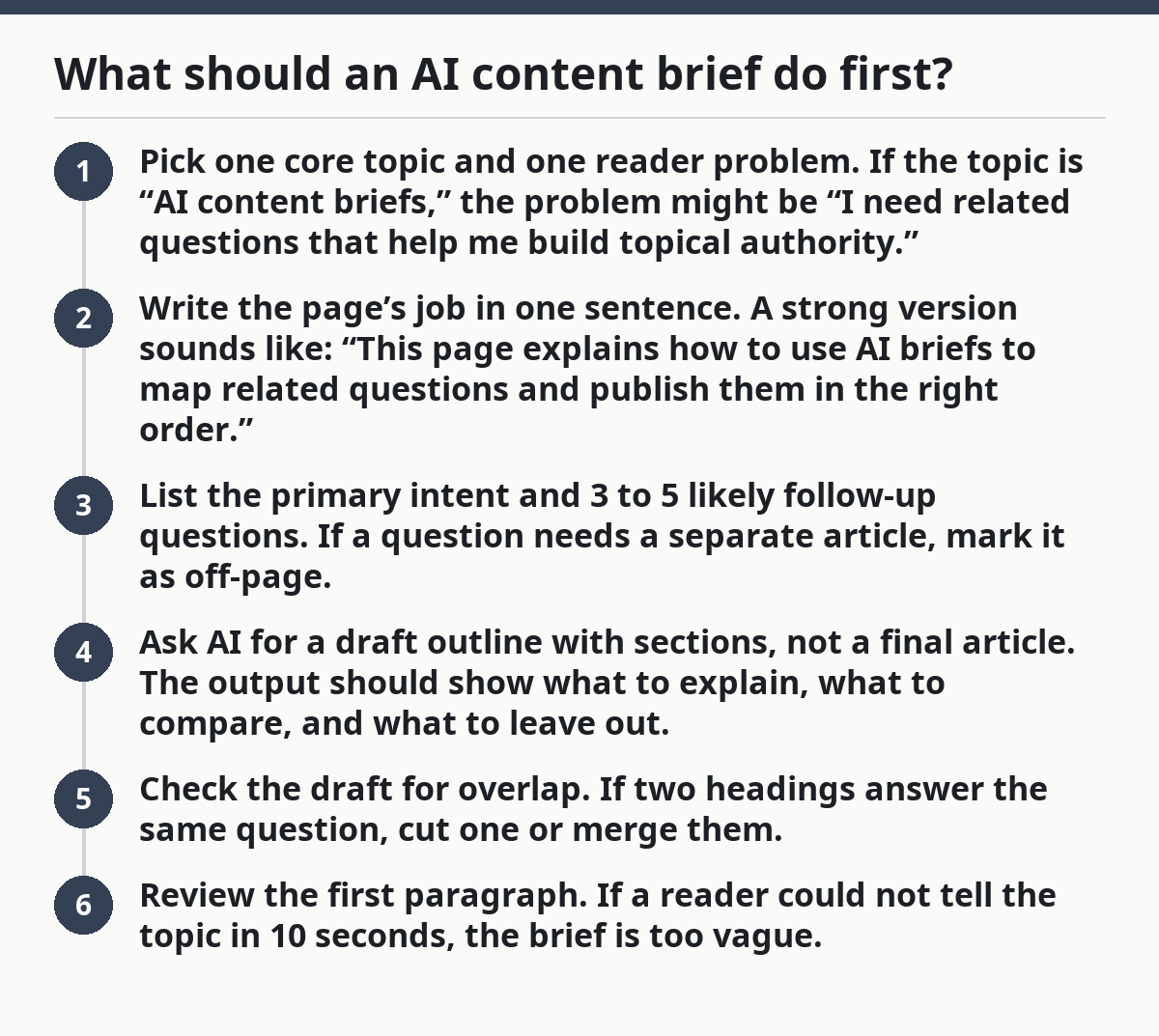
- Pick one core topic and one reader problem. If the topic is “AI content briefs,” the problem might be “I need related questions that help me build topical authority.”
- Write the page’s job in one sentence. A strong version sounds like: “This page explains how to use AI briefs to map related questions and publish them in the right order.”
- List the primary intent and 3 to 5 likely follow-up questions. If a question needs a separate article, mark it as off-page.
- Ask AI for a draft outline with sections, not a final article. The output should show what to explain, what to compare, and what to leave out.
- Check the draft for overlap. If two headings answer the same question, cut one or merge them.
- Review the first paragraph. If a reader could not tell the topic in 10 seconds, the brief is too vague.
Quick check: if your brief does not name one page goal, 3 to 5 related questions, and one clear intent, it is not ready yet.
How do related questions build topical authority?
Related questions build topical authority by proving that your site covers a subject from multiple angles, not just one keyword. If a reader lands on a page about AI content briefs and can then move to closely related questions, the site looks organized and complete.
This works best when the questions form a real cluster. One page might answer the main how-to question, while the next pages handle “How many supporting pages do I need?”, “What should an AI brief include?”, and “How do I stop pages from overlapping?” A brief can help you spot those branches before you write them.
Here is the simple rule: if the related question changes the answer, it deserves its own page or its own section; if it only adds a sentence, keep it in the same brief. That rule matters because topical authority is hurt by thin near-duplicates. Two pages that say almost the same thing do not look like depth; they look like waste.
| Situation | Best Path | Why Other Options Fail |
|---|---|---|
| One broad topic with 1 main search intent | Build 1 pillar page and 3 to 7 related support pages | Putting everything on 1 page makes it hard to rank for any one question |
| Two questions with the same intent and same audience | Keep both inside the same brief as sections | Splitting them into separate pages creates overlap and weakens focus |
| Questions with different intent or audience | Make separate briefs and separate pages | One page cannot serve two different jobs well |
| Existing pages already cover the topic | Update the weakest page first and merge duplicates | Publishing another page often adds cannibalization, not authority |
A useful brief should also show internal link direction. If one page is the main explainer, the related pages should point back to it, and the main page should point out to the support pages. That helps readers and search engines see the structure.
Quick check: if your related questions can be grouped into 1 pillar and a small set of support pages, you are on the right track.
What should the brief include?
The brief should include the page goal, audience, question set, section order, target depth, and what the page must not cover. If any of those pieces are missing, AI usually fills the gap with fluff.
A solid brief for topical authority is more specific than a normal content brief. It needs the main question, the related questions, the search intent, the page’s angle, and the boundaries. For example, a brief for this topic should not drift into tool reviews unless the page is about tool choice. It should stay on process and planning.
If the brief is for a cluster, ask AI to produce the same structure for each page: one primary question, 3 to 5 subquestions, and one “do not cover” list. That keeps the pages distinct. It also makes it easier to see where a question is missing, which is often more useful than adding another keyword.
- Write the main question in plain language.
- Add the 3 to 5 related questions that a careful reader would ask next.
- Set the page angle, such as beginner guide, decision guide, or troubleshooting page.
- List the 5 to 8 points the page must cover in order.
- Mark the 2 to 4 topics that belong somewhere else.
- Give the writer one hard constraint, such as “no tool roundup” or “no strategy advice outside briefs.”
That last step matters. A brief without limits invites broad, vague writing. A brief with limits produces cleaner pages and fewer duplicates.
Quick check: if your brief can be handed to a writer and still keep the page narrow, it is doing its job.
When does AI help and when does it hurt?
AI helps when the task is finding structure, not when the task is deciding truth or priority. If you already know the topic space, AI can speed up question mining, grouping, and outline drafting. If you do not know the topic space, AI may produce a polished outline that misses the real search problem.
The main risk is false completeness. AI often gives you 8 neat headings when the topic really needs 4, or it gives you 4 headings when the reader still has 6 unanswered questions. That is why the brief needs a human pass after the draft. The human job is to ask, “What would a reader still wonder after this section?”
Use AI for the first pass, then compare the result against real search pages, forum questions, and your own site’s content map. If the AI brief repeats a heading you already have, cut it. If it invents a section that no reader actually needs, remove it even if the wording looks good.
How do you stop briefs from overlapping?
You stop overlap by assigning one unique question to each brief and refusing to let two pages chase the same intent. If two briefs both want to answer “how to use AI content briefs to build topical authority,” one of them is too broad.
The cleanest way is to sort every question into one of three buckets: main page, support page, or not now. Main pages answer the core question. Support pages answer one related question in more depth. “Not now” keeps the cluster from becoming a dump of half-finished ideas.
Use this order when overlap is a risk:
- List all related questions in one sheet.
- Tag each question by intent: learn, compare, fix, or choose.
- Assign each question to one page only.
- Remove any question that repeats the same answer twice.
- Check whether the remaining pages still form a logical path.
- Publish the strongest page first if the cluster is small.
This is where many generic content plans fail. They confuse “more pages” with “more authority.” If the pages do not add new answers, more pages just create noise.
Quick check: if you can point to one question and one page for that question, your cluster is probably clean enough.
What if the topic is small or highly specialized?
A small topic or a specialized topic needs fewer pages, tighter briefs, and more careful ordering. If only 2 or 3 real subquestions exist, do not force a 10-page cluster. That usually creates weak pages that never deserved to exist.
For a narrow topic, the brief should lean on depth, not volume. One page may carry the whole subject if the search space is small. In that case, use related questions as sections inside the article instead of spreading them across separate URLs. The goal is not to look large; the goal is to look complete.
Specialized topics also need more exact wording. A brief for a legal, health, or finance-adjacent topic should avoid loose AI phrasing and should flag where expert review is needed. If the topic can affect money or health, keep the brief conservative and send the final draft through qualified review before publishing.
Quick check: if the topic has only a few real subquestions, a single strong page may beat a cluster of thin ones.
What are the edge cases that break the normal rules?
These 5 cases break the normal rules because the search space, risk level, or site history changes the brief. If any of them apply, the standard “one pillar plus support pages” plan may not fit.
-
The site already has similar pages.
What changes: the risk is cannibalization, not missing coverage.
What to do instead: merge or rewrite before you add another page. -
The topic mixes beginner and advanced intent.
What changes: one brief cannot satisfy both readers cleanly.
What to do instead: split the beginner explainer from the advanced workflow. -
The query has strong commercial intent hiding inside it.
What changes: the reader may want a tool, not a method.
What to do instead: keep this page informational and build a separate comparison page if needed. -
AI keeps generating the same outline for different questions.
What changes: the model is flattening distinctions.
What to do instead: force the brief to list one unique job, one unique audience, and one unique next question. -
The page must rank in a very crowded topic.
What changes: generic coverage will not stand out.
What to do instead: make the brief narrower and more exact, then support it with related questions that show depth.
Quick check: if your topic has overlap, mixed intent, or high risk, the brief needs stricter boundaries than usual.
What do the related questions actually look like?
The related questions should sound like real follow-ups, not keyword fragments. If a reader would never say it out loud, the brief is probably too stiff.
For this topic, the useful follow-ups are the ones that change the plan: “What should go in the brief?”, “How many related questions are enough?”, “When should a question become its own page?”, and “How do I keep pages from competing?” Those are better than vague filler like “best practices” because they force a concrete answer.
If the brief is built right, the related questions become the outline for the next 2 to 5 pages on the site. That is the real value: the brief is not just a writing aid; it is a map of the topic. For examples of how that mapping works, compare it with our content strategy basics page.
FAQ
How many related questions should an AI content brief include?
An AI content brief should include enough related questions to cover the reader’s next step, not every possible angle. For most informational pages, 3 to 5 related questions is enough to expose the structure without turning the brief into a dump of topics.
Should every related question become its own article?
No, only the questions that change the intent or need real depth should become separate articles. If the answer is short and fits naturally inside the main page, keep it there.
Can AI write the whole brief for me?
AI can draft the outline, but a human should still decide what belongs in the brief. A human still needs to decide which questions are duplicates, which ones are missing, and which ones should be cut.
What is the biggest mistake people make with AI content briefs?
The biggest mistake is letting the brief cover too much ground. When one brief tries to satisfy too many questions, the final page loses focus and the site ends up with overlapping content.
How do I know the brief is good enough to publish from?
A brief is good enough when it has one clear page goal, a short list of related questions, and a clean boundary around what it will not cover. If a writer can follow it without guessing, the brief is ready.
Drafted with AI; not yet reviewed by a person.