Compare AI Search Visibility Without Rankings
Last updated: November 19, 2026
How to compare AI search visibility across competitors without comparing rankings starts with citation share, source overlap, and answer inclusion, not classic blue-link rankings. This guide shows how to measure that across competitor pages, Perplexity, ChatGPT, Google, and Bing. It also shows which signals matter, and which ones waste your time.
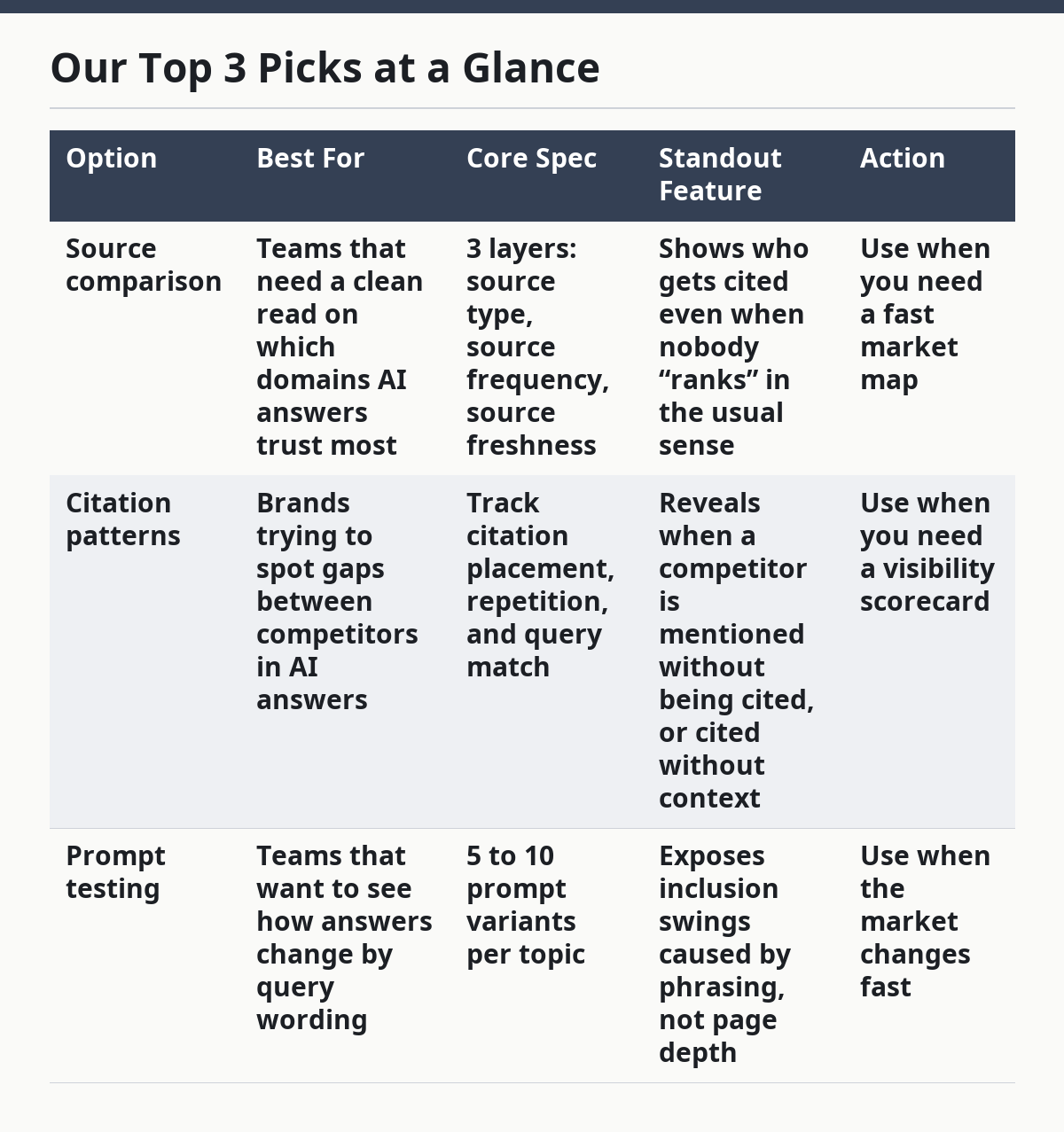
Our Top 3 Picks at a Glance
| Option | Best For | Core Spec | Standout Feature | Action |
|---|---|---|---|---|
| Source comparison | Teams that need a clean read on which domains AI answers trust most | 3 layers: source type, source frequency, source freshness | Shows who gets cited even when nobody “ranks” in the usual sense | Use when you need a fast market map |
| Citation patterns | Brands trying to spot gaps between competitors in AI answers | Track citation placement, repetition, and query match | Reveals when a competitor is mentioned without being cited, or cited without context | Use when you need a visibility scorecard |
| Prompt testing | Teams that want to see how answers change by query wording | 5 to 10 prompt variants per topic | Exposes inclusion swings caused by phrasing, not page depth | Use when the market changes fast |
What should I compare instead of rankings?
You should compare answer inclusion, citation share, and source mix instead of rankings, because AI tools often build one answer from several pages and may not show a normal list of results. That means a page can shape the answer without “winning” a position. It also means a top-ranked page in Google may be ignored by Perplexity or ChatGPT.
Picture this: you’re watching three competitors answer the same query, and none of them hold a neat position 1, 2, or 3. One brand gets cited twice, one gets named but not cited, and one never appears at all. That gap is the real market signal.
Here’s the catch:
- Answer inclusion means your brand or page is actually used in the generated response.
- Citation share means how often your domain appears as a source across a set of prompts.
- Source mix means which domains the AI keeps choosing: competitor pages, news sites, forums, product docs, or your own site.
A useful comparison starts with the same 10 to 20 prompts across each competitor set. Use the same wording in Perplexity, ChatGPT, Google, and Bing, then record whether each brand appears in the answer, in citations, or nowhere. If you only look at rankings, you miss the parts that AI systems expose and search engines hide.
Build one comparison sheet that shows the whole market
You can compare competitive AI search visibility with a simple sheet that logs query, answer, citation, and source type for each competitor. This works better than a rank tracker because the unit of value is not “position,” it’s whether the model used the page at all.
Picture this: you have five competitors, four AI surfaces, and 15 prompts. The page that looks weakest in classic SEO may show up in every answer because it has clean source language or strong entity signals. The sheet makes that visible in about 30 minutes of manual work per query set, depending on how many prompts you run.
Use these columns:
- Prompt text — keep the exact wording.
- Platform — Perplexity, ChatGPT, Google, or Bing.
- Answer includes brand? — yes/no.
- Citation present? — yes/no.
- Cited source domain — competitor page, your page, third party, or unknown.
- Answer role — primary source, supporting source, or named but uncited.
- Brand mention tone — neutral, favorable, or unclear.
That structure lets you compare competitor pages without pretending every system works the same way. One platform may cite the source directly. Another may paraphrase it. A third may ignore it and still use the idea. You need all three signals on the sheet.
Do this in order
-
Pick 10 core prompts for one topic cluster.
Choose queries that differ by intent, such as “best,” “how to,” and “compare.” You want a small set you can repeat weekly, not a giant list that breaks after one review cycle. -
Run the same prompts on 4 platforms.
Keep the wording fixed for each platform. The result should show where the same competitor appears in Perplexity but disappears in ChatGPT, or shows up in Google AI results but not Bing. -
Record source domains, not just brand names.
A brand mention without a source is weak evidence. A citation to the competitor’s own page, a product doc, or a third-party article tells you something different about trust and inclusion. -
Tag the answer role.
Mark whether the competitor was the main source, a side source, or only named in passing. That split matters more than a binary yes/no. -
Count source overlap across competitors.
If the same 3 domains keep appearing for all brands, the market is converging on a shared source set. If one competitor owns a unique source, that is a visibility edge. -
Repeat the same test after a content change.
Run the same 10 prompts again after a page update or new press mention. A change in citation pattern is the signal you care about, not a single snapshot.
This is the part most teams skip. They collect screenshots, then argue about “visibility” without a common file. A spreadsheet gives you something a product manager, SEO lead, and content lead can read in 5 minutes.
How do I compare my AI visibility to competitors?
You compare it by measuring share of cited answers, share of prompted inclusion, and share of source domains across the same query set. That gives you a competitor view without relying on rank order, which AI answers often do not expose.
Picture this: your brand appears in two prompts on Perplexity, four on Bing, and none on ChatGPT. A competitor appears in all three places, but only as a cited source, not as a named brand. That is not the same performance, and it should not be scored the same way.
Use this simple scoring frame:
- Inclusion: did the brand appear in the answer?
- Citation: was the brand’s page or domain cited?
- Persistence: did it appear across several prompts, not just one?
- Source type: was the source the competitor’s own page, a review site, or a directory?
- Prompt sensitivity: did a small wording change remove the brand?
A practical rule: compare a competitor only against the same 10 prompts, the same platform, and the same date window. If one brand gets cited in 7 of 10 prompts while another gets cited in 2 of 10, the first has stronger AI visibility on that topic. If the second brand appears only when the query is phrased with a product name, it has narrower visibility.
That matters because AI search is query-sensitive. A page can be invisible on broad prompts and prominent on narrow ones. A classic rank report will not tell you that.
Use this comparison matrix
| Signal | What it tells you | Good sign | Weak sign |
|---|---|---|---|
| Answer inclusion | Whether the brand enters the response | Appears across multiple prompts | Appears only once |
| Citation share | Whether the source is trusted enough to reference | Cited on multiple platforms | Uncited or inconsistent |
| Source overlap | How much the market relies on the same pages | Distinct sources by brand | Everyone cites the same handful of pages |
| Prompt sensitivity | How stable visibility is | Small wording changes still keep inclusion | Visibility drops on slight rewrites |
Which signals matter more: citations, mentions, or inclusion?
Citations matter most when you want to compare AI search visibility across competitors, because they show which pages the system used to form the answer. Mentions matter next. Inclusion without citation is still useful, but it is harder to trust and harder to repeat.
Picture this: a competitor is mentioned in the answer, but the source is a forum post or a third-party roundup, not the competitor’s own page. That tells you the brand is visible in the model’s memory, but not necessarily authoritative in the source layer. On the flip side, a cited page with no brand mention may still be shaping the answer behind the scenes.
A clean way to judge the signal stack:
- Citation first for source trust.
- Inclusion second for answer presence.
- Mention third for brand awareness.
- Rank last if you are only using it as a cross-check.
This order can help because AI tools do not always surface the same kind of evidence. Perplexity often exposes sources clearly. ChatGPT may show different response styles depending on the mode. Google and Bing can mix generative output with search links or citations in ways that look similar on the surface but mean different things under the hood.
The trade-off is simple: citation-led analysis takes more manual review, but it gives you a better read on which competitor pages are actually feeding the answer. Rank-led analysis is faster, but it can tell you the wrong story.
How do AI answer sources differ by competitor?
AI answer sources differ by competitor because each system pulls from a different blend of pages, citation rules, and response formats. That means the same query can produce different source sets in Perplexity, ChatGPT, Google, and Bing.
Picture this: you ask the same question in four places and get four source maps. One system leans on competitor pages and product docs. Another prefers high-level explainers. A third adds branded links only when the query gets specific. That is why source comparison beats rank comparison.
Use this quick read:
- Perplexity often makes source tracing easier because citations are visible and central to the interface.
- ChatGPT may include source links or not, depending on the mode and prompt.
- Google can blend AI results with its broader search system, so the answer layer may not match the classic organic list.
- Bing may surface citations and search results together, which makes answer inclusion useful but not identical to ranking.
That difference is not a bug. It is the point. Each platform has its own threshold for what counts as a good source. If competitor A shows up in Perplexity but not ChatGPT, the problem may be source format, not topic authority. If competitor B appears everywhere but only through third-party pages, the brand may have broad visibility but weak direct source control.
A good comparison table should separate where the answer came from from who got mentioned. If you collapse both into one score, you lose the mechanism.
What common mistakes distort the comparison?
The biggest mistake is treating AI visibility like classic SEO and then calling the result “competition analysis”; if you are making business decisions from that data, consult an SEO or analytics professional and use a source-led method such as Google’s Search Central guidance on structured data and Google’s Generative AI Search experience documentation. That usually hides the real differences in source selection, prompt phrasing, and platform behavior.
Picture this: you compare five competitors, but you only use one query and one tool. The report may look neat, yet it says almost nothing. A single prompt can make one brand look dominant and another invisible. That is noise, not analysis.
Common mistakes:
- Using only one platform. A brand can look strong in Google and weak in Perplexity.
- Changing prompts mid-test. That breaks the comparison and hides pattern shifts.
- Counting every mention equally. A cited source and a casual mention are not the same.
- Ignoring source domains. If a competitor wins through third-party pages, that means something different from winning through its own site.
- Skipping repeat tests. AI answers can change with model updates, freshness, or new source material.
The fix is plain: keep the prompt set small, the platform list fixed, and the scoring rules boring. That is how you get a comparison you can defend in a meeting.
What should the final comparison tell me?
The final comparison should tell you which competitor owns the most reliable citation share, which one shows the widest answer inclusion, and which source types keep repeating. That is the useful output, not a fake rank ladder.
Picture this: one competitor wins because its own pages are cited often. Another wins because other sites quote it everywhere. A third shows up only on branded prompts. Those three patterns call for different actions, and a rank report would flatten them into one line.
A good summary usually falls into one of these buckets:
- Direct-source leader: the competitor’s own pages are cited often.
- Third-party leader: other domains keep citing the competitor.
- Prompt-specific leader: visibility is strong only on narrow queries.
- Missing brand: the competitor barely appears, which is also a signal.
That last bucket matters. If a competitor is absent from a high-value topic, the gap may not be ranking—it may be source eligibility, entity clarity, or answer fit. This page does not cover how to fix that gap on your content, and it should not pretend to. The next step is to use the findings inside the broader AI search visibility foundations — The Complete Guide.
Key Takeaways
- Compare citations, inclusion, and source mix before you think about rankings.
- Use the same prompts across Perplexity, ChatGPT, Google, and Bing.
- Track source domains and answer role, not just brand names.
- Repeat the test after a content or media change to see what moved.
- A competitor can win in AI search without owning the classic organic result.
How do I compare my AI visibility to competitors?
Compare your brand by looking at how often it appears in answers, how often it gets cited, and which platforms surface it. Use the same 10 to 20 prompts for each competitor and each platform. Then compare the share of inclusion and citation, not just rank positions, because AI systems often skip a normal result list.
What should I track in competitor AI visibility?
Track answer inclusion, citation presence, source domain, answer role, and prompt sensitivity. Those five items show whether a competitor is actually feeding the answer or just being mentioned.
Drafted with AI; not yet reviewed by a person.