AI SEO Refresh Planning: The Complete Guide
Last updated: November 19, 2026
AI SEO refresh planning is the process of deciding which pages to update, which to rewrite, and which to leave alone so they stay useful in AI-assisted search. It works best when the goal is not “make everything AI-friendly” but “protect the pages that already earn traffic and improve the ones that have gone stale.” For background on Google’s quality expectations, see Google Search Central’s Creating helpful, reliable, people-first content and its Search Essentials.
Key takeaways
- Refresh planning starts with a page list, not a writing spree.
- The best pages to refresh are usually the ones with existing links, impressions, or clear search intent.
- Not every page should be “AI optimized”; some need a light edit, some need a full rebuild, and some should be retired.
- A good refresh plan pairs content fixes with evidence checks, structure changes, and a date for review.
- The biggest mistake is treating AI search as a content style problem instead of a page quality problem.
What does AI SEO refresh planning mean?
AI SEO refresh planning means choosing how to update pages so they remain useful to search engines, AI answers, and human readers. It is a planning task first and a writing task second, because the wrong pages refreshed in the wrong order waste time.
The point is simple: a page that answered a query well 18 months ago may now be thin, outdated, or too generic for today’s search results. AI systems do not reward a page just because it exists. They still need clear intent, useful detail, and content that matches the current question.
A good refresh plan usually sorts pages into three buckets: keep as is, refresh, or rewrite. That sounds basic, but many teams skip the decision step and start editing the loudest pages on the site. That usually leads to scattered fixes, mixed standards, and a lot of work with little gain.
This guide is for the reader who has a set of older pages, some AI content in the mix, and a simple problem: which pages deserve attention first, and what should change on each one?
Why should you refresh pages instead of starting over?
Refreshing pages usually wins because it protects the value already built into them. If a page has links, age, or a history of impressions, a careful update often keeps that equity while fixing the parts that no longer serve the query.
Starting over is only the better move when the page’s structure is wrong, the topic has changed, or the current version is too shallow to rescue. A rewrite is not a failure. It is the right call when the old page forces too many compromises.
The real trade-off is time versus certainty. A refresh can be faster, but it only works when the core page still matches the search intent. A rewrite takes more effort, but it gives a clean structure and a better chance to cover the subject fully. Google’s guidance on helpful content is relevant here: the page should serve people first, not just fill space with search terms.
Here is the practical rule: refresh when the page is directionally right and the gaps are fixable; rewrite when the page is structurally wrong; retire when the page has no clear purpose and no realistic path to usefulness. That last case is common on older sites with dozens of near-duplicate articles.
Which pages should be refreshed first?
The first pages to refresh are the ones already close to winning. Pages with steady impressions, strong links, or clear intent deserve priority because small improvements can have a real effect on visibility.
A page that already ranks on the second page of results is usually a better candidate than a brand-new page with no demand. The same is true for pages that answer a narrow question cleanly but lack current examples, updated terminology, or enough depth. These pages do not need a total rebuild; they need a sharper answer.
I would put pages into four priority groups:
- Pages with existing traffic and stale details.
- Pages with strong intent match but weak structure.
- Pages that overlap heavily with another URL.
- Pages that have no meaningful demand and no clear role.
Group 1 and Group 2 get the first pass. Group 3 needs a decision about consolidation. Group 4 often needs to be removed, redirected, or left alone if it still serves internal users. A content calendar that ignores this ranking usually spends the most time on the least valuable pages.
How do you know a page is worth saving?
A page is worth saving when the search intent is still valid and the topic still matters. If the page answers a question people still ask, and it already has some discovery value, it is usually worth refreshing before you consider a rewrite.
The warning signs are easy to spot. The intro may be too broad, the headings may not match the query, the examples may be old, or the page may repeat the same point in three sections. If the core idea still works, those are repairable problems.
The harder call is on pages that were written for an old version of search behavior. A piece built around broad keyword stuffing or thin AI output may still have a URL worth keeping, but the copy itself may no longer deserve to survive. That is when a refresh plan turns into a rewrite plan.
What should a refresh plan include?
A refresh plan should include the page, the problem, the action, the owner, and the review date. Without those five items, the plan is just a list of opinions.
The page name identifies the asset. The problem tells you why the page needs attention, such as stale facts, weak intent match, thin structure, or duplicate coverage. The action tells you whether the fix is light editing, full rewriting, consolidation, or removal. The owner makes the task real, and the review date keeps the project from drifting.
For AI SEO work, the plan should also note whether the page needs:
- a stronger answer in the first screen,
- cleaner section headings,
- current terminology,
- source checks,
- or a more explicit point of view.
That level of detail matters because AI search and classic search both rely on clarity. A page that hides the answer in paragraph five is a poor candidate for either. A page that says too little in too many words is also weak. The plan should make these problems visible before writing starts.
Should you refresh or rewrite?
Refresh wins when the page is already close; rewrite wins when the structure is broken. That is the cleanest way to choose, and it keeps the team from over-editing pages that need a reset.
| Criteria | Light refresh | Full rewrite | Winner for this condition |
|---|---|---|---|
| Existing intent match | Strong | Weak or mixed | Light refresh if the query is still well covered |
| Current links or age | Useful enough to keep | Not enough value to save the structure | Light refresh if equity matters |
| Page structure | Mostly sound | Confusing or repetitive | Full rewrite if headings do not support the query |
| Depth of coverage | Missing a few sections | Missing core explanations | Full rewrite if the gaps are large |
| Duplicate overlap | Minor overlap | Heavy overlap with another page | Full rewrite if consolidation is needed |
| Update burden | Small factual fixes | Major reorganization | Light refresh if the edits are local |
| Reader frustration | Low to moderate | High | Full rewrite if the page keeps missing the point |
| Risk of losing value | Low | High | Light refresh if the page is already performing |
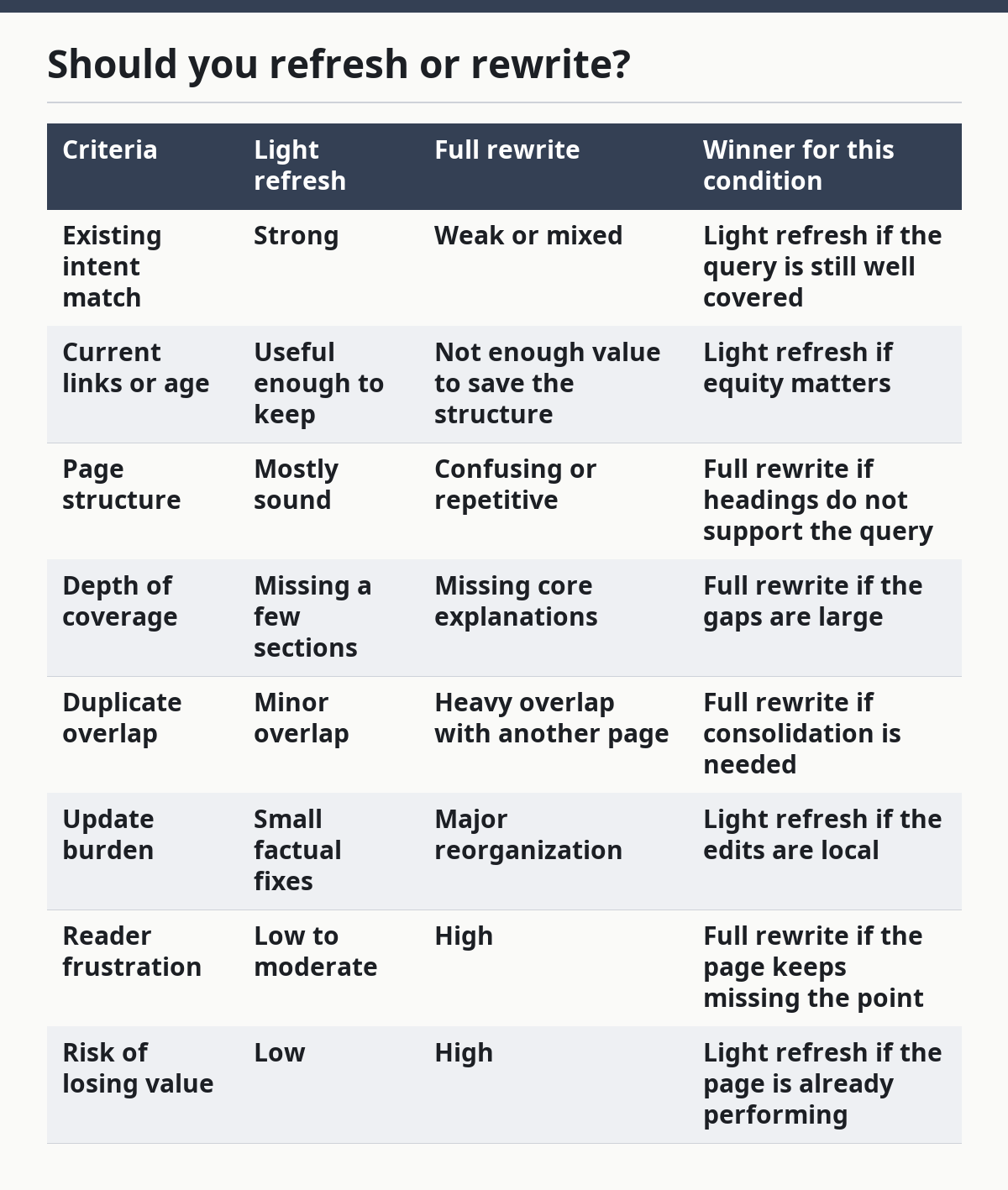
The table sounds simple because the decision should be simple. If the page already works, do not break it. If the page only works after major surgery, rebuild it.
A light refresh is the better choice for pages with good intent match and mostly current structure. A full rewrite is better when the intro, heading flow, or topic coverage is fighting the query. The wrong move is the middle path: rewriting half the page, keeping the bad structure, and hoping AI search will forgive it. It usually does not.
What changes matter most in AI search?
The changes that matter most are answer clarity, topical depth, and page structure. AI search systems still need a page that is easy to parse and easy to trust.
Answer clarity means the main question is answered early and plainly. If the page is about how to plan a refresh, the opening should say exactly what a refresh plan does and why it matters. This is where many pages fail. They start with a broad definition, a trend paragraph, or a weak setup sentence that could belong to any SEO topic.
Topical depth means the page covers the real sub-questions, not just the headline term. For this topic, that means page selection, refresh versus rewrite, update order, quality checks, and timing. A page can mention all five and still be thin if it only gives one vague sentence on each. Depth comes from useful distinctions, not from word count.
Structure matters because AI systems and human readers both reward clean sectioning. Short, clear headings help the page make sense. So do lists, tables, and direct explanations that do not bury the answer.
A refresh plan should ask one more question: does this page still deserve to exist as a standalone URL? Some pages should be merged because they split one idea across too many similar posts. AI search does not need five nearly identical pages fighting each other for the same query.
How do you score pages before you refresh them?
A simple scorecard works better than a long debate. Score each page on intent match, current usefulness, structural quality, and business value, then sort the list from highest to lowest priority.
A practical scoring method can use four checks:
- Does the page still answer a real query?
- Does the page need a light edit or a rebuild?
- Does the page have any existing value worth keeping?
- Does the page support the site’s current topic focus?
The score does not need to be numeric to be useful. Even a basic high, medium, or low label can prevent bad decisions. The point is to compare pages against each other, not against memory or habit.
The best part of scoring is that it exposes hidden waste. A page may feel important because someone on the team remembers writing it, but if it has poor intent match and no traffic signal, it may not deserve the first round of work. That is often the page that eats the most time.
A refresh plan also needs a cutoff. If a page falls below the line on several checks, do not keep polishing it just because it exists. The right answer may be to merge it with another page or retire it entirely.
What are the most common mistakes?
The most common mistake is refreshing too many pages at once. A huge batch of edits usually makes quality control worse, not better. It is easier to miss broken links, weak intros, or duplicate headings when the work is spread across a large list.
The second mistake is treating AI content like a special category that needs its own rulebook. In practice, the same core standards still apply: useful answer, clear structure, accurate detail, and a reason for the page to exist. A page does not become better because it mentions AI. It becomes better because it answers the query more directly.
The third mistake is updating only the surface text. Swapping a few words, adding a heading, and calling it done leaves the underlying structure unchanged. That is a weak fix for a page that is already out of step with the query.
The fourth mistake is ignoring overlap. When two pages chase the same search intent, both can weaken each other. A refresh plan should flag overlaps before editing begins, because consolidation is often the cleaner move.
The last mistake is skipping the review date. A page that was refreshed in one month can become stale again in six or twelve months. Without a schedule, the site slowly returns to the same problem it started with.
When should you stop refreshing and start pruning?
You should start pruning when a page has no clear purpose, no meaningful demand, and no route back to usefulness. A page with no audience is a liability, not an asset.
Pruning can mean removing the page, redirecting it to a better match, or merging it into a stronger URL. The right choice depends on whether the page contains anything worth keeping. Some pages have one useful section and four weak ones. Others are just thin, repetitive text that never should have been published.
This is the point most teams resist, because deletion feels like loss. In reality, pruning often strengthens the site. It reduces overlap, cuts noise, and makes the remaining pages easier to trust.
The cleanest pruning candidates are pages that:
- duplicate another page almost line for line,
- cover a topic the site no longer wants to own,
- have no traffic or link value,
- or were written for a keyword that no longer fits the site’s direction.
If a page is merely old, refresh it. If it is structurally wrong but still useful, rewrite it. If it serves no clear purpose, cut it.
How does a refresh plan look in practice?
A useful refresh plan is a short working document, not a presentation deck. It should fit on one screen or one page and point directly to the next action.
A simple plan can list:
- URL or page title,
- current issue,
- action type,
- key sections to keep,
- key sections to change,
- source or fact check needed,
- and a review date.
For example, a page about AI SEO planning might need a new opening, a clearer section on refresh versus rewrite, and a cleanup of overlapping advice. Another page might need consolidation because it repeats the same points as a more useful guide. A third might only need a date update and a source check.
The practical benefit is speed. When the plan is clear, editing stops being a vague content task and becomes a sequence of decisions. That matters on larger sites, where dozens of pages can compete for attention.
A refresh plan also keeps teams honest about scope. If a page needs six new sections, it is not a refresh anymore. It is a rewrite. Calling it a refresh just to save time usually creates more work later.
What should happen after the refresh goes live?
After the refresh goes live, the page should be checked again on a set schedule. The goal is not instant perfection. The goal is to see whether the update improved the page’s usefulness and discoverability.
The first check should confirm that the new version still answers the original query. The second check should look for broken links, missing headings, or accidental duplication. The third check should compare the page with nearby pages so the site does not create a new overlap problem while solving the old one.
A review cycle also protects against drift. AI SEO changes fast enough that a page can go stale even after a careful update. New terminology, new search behavior, or new content on the same topic can all weaken a page that was fine a few months earlier.
Do not wait for a full performance report before making a second pass. A fresh look at structure and intent often catches problems long before rankings move. That is especially true for pages that were edited quickly under deadline pressure.
What is the best way to keep the plan useful over time?
The best way to keep the plan useful is to make it repeatable. A refresh plan that works once but lives in one person’s head will not help the next batch of pages.
The plan should use the same criteria every time. That means the same questions, the same priority logic, and the same thresholds for refresh, rewrite, or prune. If the standard changes every month, the team will spend more time debating than editing.
It also helps to keep the plan close to the content calendar. If a page is due for a refresh every 6 or 12 months, put that date beside the URL from the start. That makes the work visible and prevents the site from drifting into long-term neglect.
The final test is simple: does the plan help the next editor make a better choice in less time? If not, it is too vague. A good AI SEO refresh plan is not a theory document. It is a decision tool.
What is the clearest verdict?
Choose a light refresh if the page still matches the search intent, already has some value, and only needs tighter structure or fresher detail. Choose a full rewrite if the page’s structure is broken, the overlap is heavy, or the current version cannot answer the query cleanly. Neither if the page has no clear purpose and no realistic path back to usefulness.
This is not a call to refresh everything. It is a call to protect the pages that still deserve help and stop spending time on the ones that do not. That judgment is what separates a useful content program from a busy one.
What are the exception scenarios?
The overall verdict flips in a few cases. If a page has strong links but weak copy, a refresh may be safer than a rewrite because the existing URL still matters. If the page is part of a cluster that all chase one query, consolidation may beat both options because the issue is overlap, not prose.
The verdict also flips when the page belongs to a topic the site is no longer trying to own. In that case, even a good rewrite may be wasted work. A redirect or prune decision can be smarter than a content overhaul.
A final exception appears when the query itself is narrow and the page is already close. In that case, a small structural fix and a source update may do more than a long rewrite. The right choice depends on the gap, not the urge to improve everything at once.
FAQ
How often should AI SEO pages be refreshed?
Pages should be reviewed on a regular cycle, but the right interval depends on how fast the topic changes. A fast-moving topic needs more frequent checks than a stable one, and a page with high visibility should be watched more closely than a low-value archive page.
Is a refresh the same as an update?
No, a refresh is broader than a quick update. An update may change a date, swap a fact, or fix a link, while a refresh usually changes the structure, the answer quality, or the way the page matches the query.
Should old AI-written pages always be rewritten?
No, not always. A page that is thin or repetitive may need a rewrite, but a page with a strong topic fit can often be repaired with better structure, more specific detail, and a clearer opening answer.
Can a page be too short to refresh?
Yes, if the page is too short to cover the query in a useful way. At that point, adding a few lines will not solve the problem, and a rewrite or consolidation is usually the better move.
What is the biggest sign that a page should be pruned?
The biggest sign is the absence of purpose. If the page does not serve a reader, does not support the site’s topic focus, and does not have enough value to preserve, pruning is usually the cleanest choice.
Drafted with AI; not yet reviewed by a person.