
AI Content Governance and Quality: The Complete Guide
Last updated: November 19, 2026
Quick answer: a basic AI content governance and quality program can be built around 5 controls—allowed uses, forbidden uses, review ownership, traceability, and escalation rules.
In short: AI content governance is the system of rules, review steps, and ownership that keeps machine-generated copy accurate, compliant, on-brand, and traceable. AI content quality is the result of that system working well: clear intent, verified facts, consistent voice, and a documented way to catch errors before publication. In AI content governance and quality — The Complete Guide, the point is not just to write faster; it is to publish with controls that can be defended later.
Key Takeaways
- Governance sets the rules for AI use, review, and recordkeeping.
- Weak systems fail in four common areas.
- Short policies work best when they are specific.
- Layered review is more reliable than a single heroic editor.
If a team publishes AI-assisted drafts without governance, the failure usually is not “bad writing.” It is unowned risk: made-up facts, copyright exposure, privacy leakage, inconsistent claims, and a review process no one can audit later. I write about editorial process, risk controls, and search-quality standards because those are the places where AI-assisted publishing succeeds or breaks. AI content governance and quality becomes practical only when the process assigns ownership, sources, and sign-off.
What AI content governance actually covers

AI content governance is the set of policies and controls that decides who may use AI, for what purpose, with what review, and with what recordkeeping. Quality is only one outcome. Governance also covers legal review, data handling, brand safety, human accountability, and the decision to reject a draft even when it reads well.
The useful way to think about it is this: quality asks, “Is this article good?” Governance asks, “Can the organization stand behind it six months from now if a customer, regulator, or editor questions it?” That distinction matters because polished prose can still be wrong, stale, infringing, or misleading.
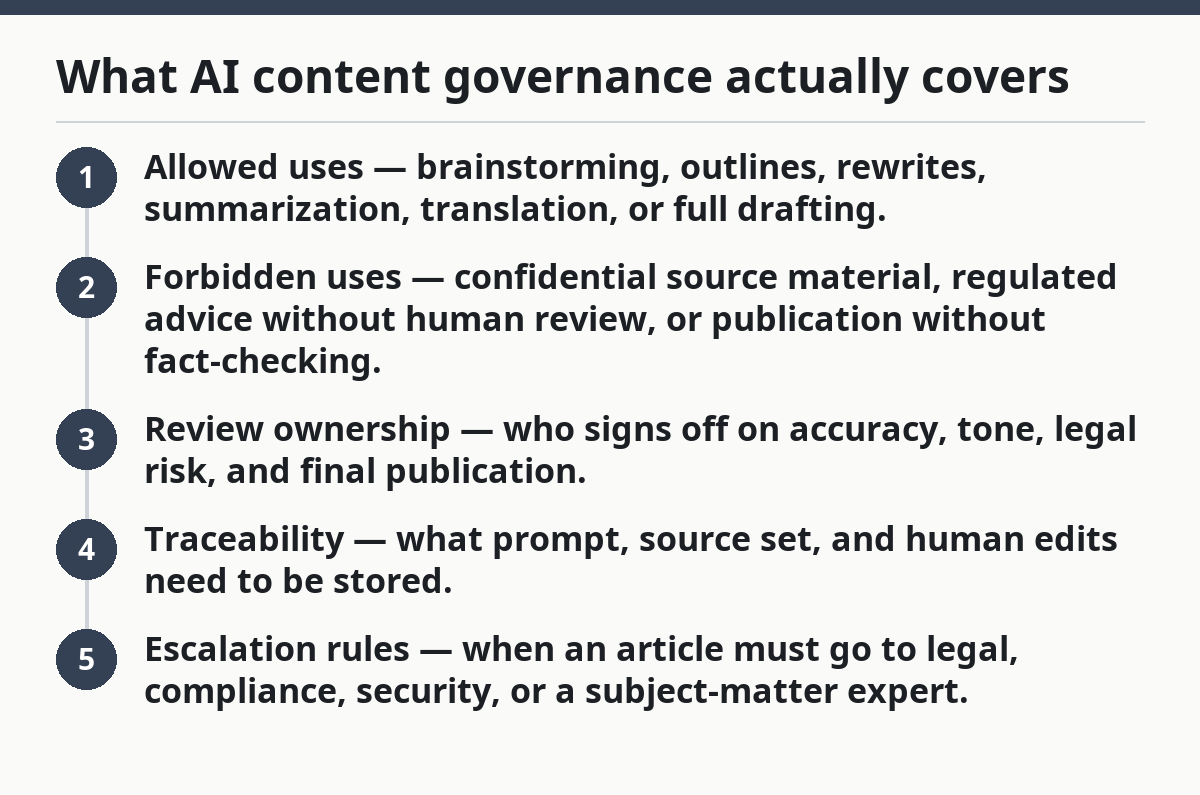
A practical governance program usually defines five things:
- Allowed uses — brainstorming, outlines, rewrites, summarization, translation, or full drafting.
- Forbidden uses — confidential source material, regulated advice without human review, or publication without fact-checking.
- Review ownership — who signs off on accuracy, tone, legal risk, and final publication.
- Traceability — what prompt, source set, and human edits need to be stored.
- Escalation rules — when an article must go to legal, compliance, security, or a subject-matter expert.
That last point is the one generic articles miss. A governance policy is not a writing style guide with extra paperwork. It is a control system. It should make risky cases slower and low-risk cases faster. In practice, the controls in AI content governance and quality should reduce uncertainty, not add noise.
A strong external reference point is the NIST AI Risk Management Framework 1.0, which frames AI work around govern, map, measure, and manage. The OECD AI Principles make the same point from a policy angle: organizations need accountability, transparency, robustness, and human-centered safeguards. Those two documents are worth reading because they force the conversation away from “Can the model write?” and toward “Can the institution safely use what the model wrote?” For implementation guidance, see the NIST AI Risk Management Framework and the OECD AI Principles.
Why quality fails when governance is weak
Weak governance usually fails in predictable ways, and the failures tend to cluster around the same 4 areas.
First, factual accuracy slips. Large language models can produce plausible but false statements, especially when asked for citations, dates, laws, medical guidance, or product specifications. A draft can sound confident and still be unusable. That is not a rare edge case; it is the default failure mode when prompts ask for specificity without source control. In one widely cited 2023 Stanford HAI study, GPT-4 gave incorrect legal answers 69% of the time on one benchmark, which shows why governance has to verify claims rather than trust fluency alone.
Second, the organization loses voice consistency. One article sounds like the brand. The next sounds like a generic tech blog. Over time, the archive becomes noisy. Readers stop trusting that the same name means the same editorial standard.
Third, compliance risk grows quietly. AI drafts can drift into regulated claims, hidden endorsements, copyrighted phrasing, or privacy problems. If a model is fed confidential meeting notes, customer records, or unpublished research, the problem is no longer copy quality. It is data handling. The concern is not theoretical: the New York City chatbot case in 2023 produced policy advice errors within weeks, showing how quickly an uncontrolled system can create user-facing risk.
Fourth, editors become the bottleneck. Without a defined process, every draft gets re-litigated. Senior people spend time fixing easy mistakes because the workflow never blocks them earlier. A team may publish less, not more, after “adding AI.” That is why AI content governance and quality should be designed around the review path, not just the model output.
The right response is not “ban AI” and it is not “publish faster.” The right response is to define where AI is allowed to help and where only human judgment counts. That depends on the risk level of the page, the audience, and the consequence of being wrong.
For many teams, the dividing line is simple:
- Low risk: ideation, internal summaries, first-pass outlines, headline variants.
- Medium risk: marketing pages, educational explainers, social copy, product descriptions.
- High risk: legal, medical, financial, HR, safety, policy, and anything with material factual claims.
A generic article will say “always fact-check.” That guidance is too weak to be useful on its own. The real question is which facts must be checked, by whom, and before which stage. If a team cannot answer that, it is still building process, not yet managing AI content governance and quality in a meaningful way.
What a good governance policy should say

A good policy is short enough to use and specific enough to enforce. A 12-page document no one reads is not governance. A one-page memo with no decision rights is not governance either.
At minimum, the policy should answer these questions in plain language:
- What counts as AI-assisted work?
- Which tools are approved?
- What data may never be entered into a model?
- Which outputs need human review before publication?
- Who owns factual accuracy?
- Who owns compliance review?
- What is the escalation path for uncertainty?
- How are prompts, sources, and revisions recorded?
It should also name the standard for acceptance. “Looks good” is not a standard. “Matches the source pack, uses approved terminology, and contains no unsupported claims” is a standard. That makes AI content governance and quality easier to train, audit, and repeat.
Here is a simple model many teams can adapt:
- Tier 1: No-risk assistance. Brainstorming, summarizing public text, rephrasing approved material. Human review by the assigned editor.
- Tier 2: Controlled drafting. Marketing copy, explainers, knowledge-base articles. Human review plus fact-check against source notes.
- Tier 3: Restricted drafting. Claims-heavy or regulated material. Subject-matter review, legal/compliance review when required, and explicit sign-off.
- Tier 4: Prohibited use. Anything involving confidential data, confidential strategy, or final advice in a regulated domain without specialized oversight.
That tiering is useful because it stops the false debate about “AI yes or no.” The better question is: what level of review is proportionate to the risk?
A common mistake is to make the policy about tools instead of outcomes. A tool list changes every quarter. The real durable rules are about data sensitivity, claim verification, and sign-off. If the policy centers on one model name or one vendor, it will age badly.
The policy should also define recordkeeping. For example, keep the final prompt, the source documents used, and the human reviewer’s approval note for a defined retention period. The exact duration depends on industry and legal exposure, so this is a place to ask counsel or compliance for a local rule. That record does not need to be fancy. It needs to exist.
How to review AI drafts without slowing the team to a crawl
The next step after policy is the review path, and the best review process is layered rather than heroic. One person should not be responsible for catching every error type. That is how bad copy ships and good editors burn out.
A usable workflow has four steps:
- Source lock: Collect the facts before drafting. Use approved links, internal notes, product specs, interview transcripts, or primary documents.
- Draft generation: Use AI for structure, compression, or wording, but not as the source of truth.
- Verification pass: Check claims line by line against the source set.
- Publication sign-off: Confirm that the final page matches the approved angle, legal limits, and brand voice.
The verification pass is where most teams underinvest. They let a smart draft create the illusion that the work is nearly done. It is not. A 1,200-word article with six factual claims still needs six checks, even if the prose is excellent. In AI content governance and quality, the number of claims matters more than the confidence of the draft.
A practical review rubric can score each draft on five dimensions:
- Accuracy: Are claims supported by sources?
- Completeness: Does it answer the user’s actual question?
- Clarity: Does it explain without confusion or jargon overload?
- Voice: Does it sound like the brand?
- Risk: Does it include anything regulated, sensitive, or misleading?
That rubric works because it separates writing quality from risk quality. A draft can be vivid and still fail on accuracy. It can be correct and still fail on voice. The reviewer needs a reason to send it back that is sharper than “I don’t like it.”
One of the most useful controls is the “no-source, no-claim” rule. If a sentence names a number, a standard, a requirement, a date, or a comparison, it should be traceable. If the writer cannot show where it came from, it should be softened or cut.
A second control is claim classing. Label claims as:
- Plain language
- Interpretive
- Regulated
- Quantified
- Comparative
The more the claim can hurt someone if wrong, the more review it needs. That is simple, but it changes everything in practice. It also gives AI content governance and quality a practical way to separate routine copy from higher-risk drafting.
What separates good AI quality from polished junk?
Good AI quality is not just grammar. It is whether the page behaves like a reliable article of editorial work.
A strong article usually has six traits:
- It answers the search intent early.
- It uses concrete nouns and verbs.
- It makes one clear promise and keeps it.
- It avoids fake precision.
- It cites the right level of evidence for the claim.
- It sounds like one human wrote it with a point of view.
Polished junk does the opposite. It is smooth, broad, and forgettable. It may have no errors you can spot at a glance, but it also has no useful edge. Readers leave because nothing in it forces a decision.
The issue is especially visible in AI-assisted SEO pages. A generic draft often repeats the query, pads each section, and hides the answer behind a wall of “best practices.” That style can satisfy a template but fails the reader. It says “here are some considerations” when the user wants “what should I do now?”
Quality also depends on source discipline. If the article uses only model-generated text, it tends to flatten nuance. Real quality comes from combining the draft with source materials: product docs, policy docs, standards, expert notes, interview transcripts, or primary research. The model can organize those materials. It should not replace them.
The best editorial teams use a “truth stack”:
- Primary source
- Internal subject-matter review
- Editorial rewrite
- Final compliance or legal review where needed
That stack is slower than raw generation and much faster than fixing a problem after publication. It also protects the archive. A strong archive compounds; a sloppy one becomes expensive to maintain because every old article becomes a liability.
This is where many organizations need to hear a blunt truth: if a page carries material risk, the goal is not speed. The goal is defensible speed. Those are not the same thing. AI content governance and quality improves when the organization accepts that some articles need more review than others.
The standards and controls worth anchoring to
Good governance gets easier when it borrows language from recognized standards instead of inventing its own vocabulary.
The NIST AI Risk Management Framework is useful for process design because it makes governance a continuous activity, not a one-time checklist. Its language around govern, map, measure, and manage helps teams think about lifecycle controls instead of isolated approvals. The framework is public and maintained by the U.S. National Institute of Standards and Technology.
The OECD AI Principles are useful for policy alignment because they emphasize human-centered values, transparency, robustness, and accountability. They are broad, but broad is useful at policy level.
For organizations that need a security lens, the ISO/IEC 27001 mindset matters even when the team is not formally certified. The lesson is simple: control access to sensitive inputs, know who can approve what, and keep records. AI governance fails quickly when everyone can paste anything into any tool.
For a publishing team, the standards do not need to be copied line by line. The point is to borrow the habits:
- assign ownership,
- document inputs,
- manage risk by category,
- and audit the process.
If the organization works in health, finance, employment, or legal services, the standard should be stricter still. The closer the page is to regulated advice, the less tolerance there should be for vague language or unsourced claims. In those cases, the appropriate next step is often not another prompt. It is a review by qualified counsel or a licensed professional. For context on model behavior, see the Stanford HAI 2023 legal benchmark discussion and the New York City chatbot rollout reporting.
A practical operating model for teams that publish every week
The operating model that works best is the one the team can repeat every Monday, not the one that looks elegant in a slide deck.
A straightforward setup looks like this:
- Editor: defines intent, audience, and angle.
- Writer or AI operator: generates the first draft from approved sources.
- Subject-matter reviewer: checks factual accuracy and missing context.
- Compliance or legal reviewer: reviews only the flagged cases.
- Publisher: confirms the final version and keeps the record.
This keeps accountability visible. It also reduces the temptation to ask one person to do three jobs badly.
A team should also maintain a source pack for common article types. For example, an explainer on a product category might include:
- approved product descriptions,
- pricing caveats,
- legal disclaimers,
- brand terminology,
- and a list of forbidden claims.
That pack is more valuable than any prompt library. Prompts change. Facts do not. A source pack also makes it easier to update an article later without re-deciding the same questions.
The better teams run spot audits. That means reviewing a sample of published articles every month or quarter and asking:
- Were the claims supported?
- Did the article answer the right question?
- Did the draft introduce any unsupported language?
- Were review steps actually followed?
A governance system that is never audited usually degrades quietly. People skip steps once, then twice, then permanently. In AI content governance and quality, the audit cadence matters because it tells the team whether the process still works.
When this approach is the wrong choice
This approach is wrong for teams that want automation without ownership. If no one is willing to sign off on accuracy, do not put AI in the publication path.
It is also wrong for organizations that cannot separate public material from sensitive material. If source files contain personal data, client-confidential information, or strategy notes, the risk of misuse is too high until the data model is cleaned up.
And it is wrong for any team that treats AI as a substitute for subject-matter knowledge. A model can rearrange words. It cannot bless a claim. If the subject requires technical judgment, the human reviewer has to be more than a rubber stamp.
The biggest mistake is using AI to create volume before the review system exists. That produces a backlog of questionable articles and a governance problem that gets harder every week. If the team cannot review ten drafts now, it should not be generating fifty.
What changes the verdict in real organizations
There are a few exception scenarios where the usual governance answer flips.
-
High-volume, low-risk publishing. If the article type is repetitive, public, and low-stakes — such as short product summaries or internal knowledge articles — a lighter workflow can work. The condition is that source material is locked and claims are limited.
-
Highly regulated claims. If the draft touches health, finance, safety, or employment, the process must become stricter, not looser. In these cases, a generalist editor is not enough. A licensed or qualified reviewer may be required.
-
Distributed teams with no central editor. If no single owner controls standards, the system will fragment. In that case, centralize governance first or stop publishing AI-assisted articles until ownership is clear.
-
Sensitive data in the source set. If the organization cannot guarantee that confidential or personal data stays out of prompts and logs, the risk flips against using AI in the drafting workflow at all.
Those cases matter because they stop the guide from sounding like a universal yes. It is not. Governance is a fit question.
The Verdict: what to choose and why
Choose a tiered governance model if the team publishes regularly, has more than one reviewer, and needs a repeatable way to approve low-, medium-, and high-risk drafts. Choose a stricter review model if the pages contain regulated claims, sensitive data, or anything that could harm a reader if wrong. Neither if the organization cannot name an owner for accuracy, compliance, and recordkeeping.
That is the cleanest call. A tiered system wins because it matches review effort to risk, which is the only way to keep quality high without freezing production. A stricter model wins when the consequence of error is real and the source material is sensitive enough that loose drafting is not acceptable. If the team has no owner, no source discipline, and no sign-off path, the right answer is not to improvise. It is to pause publication until the controls exist.
What should a basic AI content governance policy include?
A basic policy should define approved uses, forbidden uses, review ownership, source handling, and recordkeeping. It should also say who approves publication and what types of claims need extra review. A policy that only says “use AI responsibly” is too vague to enforce. For teams focused on AI content governance and quality, that policy is the baseline control.
How do I keep AI from making factual mistakes?
Use source-controlled drafting and a verification pass. The article should be checked against primary documents, approved notes, or subject-matter sources before publication. If a sentence contains a date, number, standard, comparison, or regulated claim, it should be traced to a source or rewritten as a general statement.
Do I need legal review for every AI-assisted draft?
No, not for every article. Legal review is most useful when the page contains regulated advice, public claims, privacy issues, or language that could create liability. For routine educational or marketing copy, editorial and subject-matter review are usually the first line of defense.
Can AI content be high quality without human editors?
No, not in any serious publishing environment. A model can draft and rephrase, but it cannot own accuracy, brand judgment, or legal risk. Human editors are what turn a plausible draft into something the organization can stand behind.
What is the biggest mistake teams make?
The biggest mistake is treating AI as a speed tool before building a review process. That creates more output, but not more trustworthy output. The second biggest mistake is using one review step for every risk level, which either slows everything down or lets risky articles slip through.
Drafted with AI; not yet reviewed by a person.