
How to Use AI to Find Weak Sections in an Outdated Article
Last updated: November 19, 2026
Key Takeaways
- AI should flag sections that drift from search intent, repeat a point, or add too little value.
- AI can score page sections if you give it a fixed rubric and clean input.
- A weak section often misses the query, repeats a heading, stays broad, skips a key subtopic, or looks stale.
- AI can identify the weakest sections fastest when you run it in a fixed order.
Your outdated article has weak sections, and AI can flag them before you touch the draft. Use AI to score each page section for relevance, thinness, and update priority. The steps below show how to diagnose content sections without guessing.
What AI should look for first in an outdated article

How to use AI to identify the weakest sections in an outdated article starts with sections that drift from search intent, repeat the same point twice, or say too little to earn their place. If you open a 1,200-word article from 2021 and half the headings still talk around the topic instead of answering it, section diagnosis starts there.
The first pass can be simple: feed the model the article, the target query, and the current page sections. Ask it to compare each heading against the search intent and mark the weakest one first.
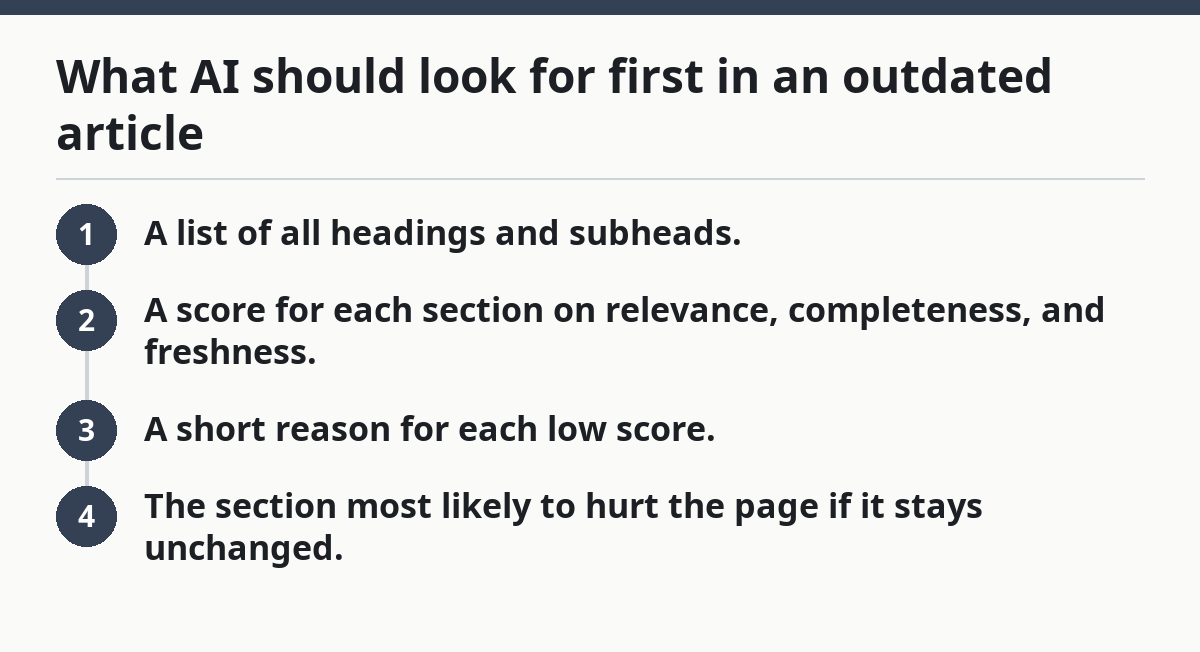
Use a prompt that asks for:
- A list of all headings and subheads.
- A score for each section on relevance, completeness, and freshness.
- A short reason for each low score.
- The section most likely to hurt the page if it stays unchanged.
That first pass should not try to rewrite anything. It should only separate strong sections from weak ones. If you jump to editing too early, you hide the real diagnosis behind polished prose.
How do I ask AI to score page sections?
AI can score page sections if you give it a fixed rubric and a clean input. If you paste an article into ChatGPT and ask, “What’s bad here?” you’ll get loose opinions. Ask for section scoring against a rubric, and you get something you can use.
A practical scoring prompt keeps the numbers small and the labels plain. I use a 1-to-5 scale for each section, with 1 meaning weak and 5 meaning strong. Keep the criteria the same every time so you can compare sections across different drafts.
Try this structure:
- Paste the title, target query, and full outline.
- Ask AI to score each section for alignment with search intent.
- Ask it to flag sections with stale examples, vague claims, or duplicate points.
- Ask for one sentence on why the section is weak.
- Ask it to rank the top 3 sections that need work first.
The output should look more like an audit sheet than a rewrite. If a section gets a low score but the reason is fuzzy, ask a second pass: “Name the exact sentence type that makes this section weak.” That pulls the model away from vague praise and toward diagnosis.
Which signals make a section weak?

A weak section usually shows one of five signals: it misses the query, repeats another heading, stays too broad, ignores a key subtopic, or looks stale. If one heading says “Tips for better content,” but the search query is about content refresh, that section is weak before you read a single paragraph.
Here’s the catch: a section can be well written and still be the wrong section for the page. AI is useful because it can spot mismatch, not just bad style. It can also spot when two headings say nearly the same thing, which is a common problem in older articles with hand-built outlines.
Watch for these signs:
- The heading sounds generic and could fit any article.
- The section repeats the same point in a different shape.
- The section has no fresh data point, example, or method.
- The section does not answer the user’s likely follow-up.
- The section takes 4 paragraphs to say what 2 would do.
If AI keeps flagging the same section for “low relevance” and “thin support,” that is usually your update target. Because it is noticing the gap your eyes skim past.
A simple workflow for content section diagnosis
AI can identify the weakest sections fastest when you run it in a fixed order. If you have one article, 7 headings, and a half hour before the meeting where someone asks what needs editing first, you do not need a full rewrite. You need a triage pass.
Use this 5-step workflow on every outdated article:
- Paste the title, target query, and current headings into ChatGPT.
- Ask for a section-by-section score on relevance, depth, and freshness.
- Mark any section that scores low on two or more checks.
- Ask AI to compare the weak section against the strongest section in the same article.
- Sort the weak sections by update priority, not by page order.
That last step matters. A section buried near the end may be more urgent than the intro if it holds the main answer. On the flip side, a weak intro can still cost you if it frames the page badly.
Keep the prompt tight. If you ask for “all possible improvements,” AI will wander. If you ask for “the weakest section and why,” it will usually give you a better diagnosis in one pass. The output should end with a short action label: cut, rewrite, expand, or keep.
How do I tell whether a section is thin or just short?
A section is thin when it adds little value for its length, not when it has few words. One 90-word section can give a clean answer with one example, while a 220-word section can circle the same point three times. The longer one may be the thinner section.
AI helps here by separating length from usefulness. Ask it to judge whether each section has a clear point, enough supporting detail, and a reason to exist on the page. A short section with one sharp answer can be stronger than a long section full of blur.
Use this check:
- Does the section answer one question or try to answer five?
- Does it add a fact, a step, a rule, or a boundary?
- Could the same idea be removed without hurting the page?
- Does it bring new value beyond the heading before and after it?
If AI says a section is thin, ask what is missing: an example, a definition, a comparison, or a step. That matters more than word count. A 150-word section can be fine if it gives the reader a complete move. A 300-word section can still be weak if it just spins.
How do I use AI to rank update priority?
AI can rank update priority by combining weakness score, page role, and search intent fit. If three sections all need work, but only one sits under the main answer the reader came for, that section goes first, even if another one looks uglier on the surface.
Ask AI to rank each weak section against three questions:
- Does this section support the page’s main promise?
- Does this section answer a likely next question?
- Does this section carry outdated or repetitive material?
Sections that score badly on all three are your first edits. A section that is merely thin but still aligned may wait. A section that is off-topic but well written should move up the list, because polish won’t fix the mismatch.
This is where update prioritization beats simple rewriting. You are not trying to make every section equal. You are trying to protect the page’s main job. If the article is a guide, the lead sections usually matter more than a side note. If it is a comparison, the decision sections matter most.
Common mistakes when using ChatGPT for section diagnosis
ChatGPT fails most often when the prompt is too vague, the article is pasted without headings, or the task asks for rewriting before diagnosis. If you tell the model, “Tell me what to improve,” it gives you copy edits instead of a section audit. That wastes time.
The biggest mistake is asking for a full rewrite when you only need a weak-section map. Another is feeding AI a messy blob of text with no headings. A section diagnosis only works if the model can see the structure. It also helps to name the target search intent, not just the topic.
Avoid these traps:
- Asking for “SEO improvements” without saying you want section diagnosis.
- Hiding the headings inside long paragraphs.
- Letting the model rewrite before it scores.
- Ignoring duplicate sections because they sound decent.
- Treating every low score as a must-fix item. If a section affects medical, legal, financial, or safety advice, consult a qualified professional before acting on the score.
A better habit is to run one diagnosis prompt, then one follow-up prompt on the bottom 2 sections. That gives you a cleaner read and stops you from over-editing sections that are already doing their job.
What a good AI prompt looks like for weak-section checks
A good prompt names the article, the goal, the headings, and the scoring rules. If you want AI to judge a 900-word article, not invent a new strategy for it, a tight prompt gets you a usable answer in one round.
Use a prompt like this shape:
- “Here is the article title, target query, and outline.”
- “Score each section from 1 to 5 for relevance, depth, and freshness.”
- “Flag the weakest section first.”
- “Say whether each weak section should be cut, expanded, or rewritten.”
- “Do not rewrite the article yet.”
If you want better results, add the page stage and the reader stage. For example, say the article is outdated and meant to support a how-to workflow. That helps the model judge whether a section is too broad for the job.
The best prompts also ask for evidence inside the article. Ask AI to point to the exact heading, repeated idea, or stale phrasing that caused the low score. That is the part you can act on.
For a broader workflow that sits above this step, see the hub on AI-assisted content refresh workflows and the related guide on content audit prompts. This page stays focused on section diagnosis, not the full refresh process.
FAQ
How do I find weak sections in a blog post?
AI can find weak sections by scoring each heading against the search intent and the article’s main promise. Start with the outline, not the full rewrite. Then ask which sections are too thin, repetitive, off-topic, or stale. The section with the lowest mix of relevance and depth is usually the first one to fix.
Can AI tell which parts of a page need updating?
Yes, AI can point to the parts most likely to need updating if you give it the article, headings, and target query. It works best as a triage tool, not a final editor. Ask for a section-by-section score and a short reason, then review the bottom-ranked sections first.
What makes a section weak for SEO?
A section is weak for SEO when it does not help the page answer the searcher’s question, repeats another section, or adds little new value. Thin support, stale wording, and fuzzy headings are common signals. A section can be polished and still be weak if it misses the reader’s intent.
Drafted with AI; not yet reviewed by a person.