
How to Use AI to Standardize SEO Content Handoffs Between Teams
Last updated: November 19, 2026
Quick Answer: AI can turn an SEO content handoff into one consistent packet in 8 fields that a writer, editor, seo specialist, and content manager can all read the same way. The best use of AI for how to use AI to standardize SEO content handoffs between teams is not “let AI write everything”; it is using AI to normalize the brief, surface missing requirements, and format revision requests against the same review checklist every time.
What an AI-standardized SEO content handoff actually fixes
AI standardizes the handoff by forcing the same information into the same order, language, and level of detail every time. That matters because most revision loops start when one person means “target phrase,” another means “search intent,” and a third means “must include in the first 150 words.” A handoff template removes that drift before the draft starts.
The primary entity here is the SEO content handoff: the transfer point where strategy becomes a draft, and draft becomes edits. If that transfer is inconsistent, the writer works from one set of assumptions, the editor reviews against another, and the seo specialist may ask for changes that were never visible in the first place. AI helps by rewriting freeform notes into a fixed structure: audience, query, angle, required terms, internal links, title direction, and approval criteria.
The useful standard is not a magical model output. It is a repeatable format that the team can scan in under 2 minutes. If a handoff takes 20 minutes to decode, it is already too loose. If the same 8 fields appear every time, each role knows where to look first.
This is also where AI earns its keep on revision requests. A revision note like “make it more SEO-friendly” is useless. A revision note that says “add the exact phrase in H2 2, tighten the intro to 120–150 words, and answer the searcher’s task in the first paragraph” is actionable. The goal is fewer back-and-forth rounds, not more machine-generated text.
If this page belongs in a broader system, it supports the hub on AI SEO content operations, but the focus here is the handoff itself, not the full workflow around it. For a related process, see our guide to AI SEO content operations and the SEO content brief template.
What should be in the handoff before AI touches it?
A handoff should already contain the source facts, the SEO requirements, and the decision owner. AI can clean it up, but it cannot infer what was never supplied. A good minimum set is a 1-page brief with 8 fields: target query, audience, search intent, primary angle, required terms, sources, tone, and approval criteria.
Start with the inputs that should not be negotiated later. If the seo specialist wants a comparison angle, that belongs in the brief. If the content manager needs the article delivered in 1,200–1,500 words, that belongs in the brief. If the editor wants no speculative claims and no passive voice in the intro, that belongs in the brief too. AI is strongest when it formats these items, not when it invents them.
A clean handoff also needs one person to own the final call. Without a single decision owner, AI can make the packet look polished while the team still argues over which note wins. That is how revision loops expand: the writer follows one instruction, the editor applies another, and the seo specialist adds a third.
Use a fixed checklist with plain labels instead of a paragraph of freehand notes. For example:
- Query and intent: one primary query, one intent.
- Audience: who the article is for and what they already know.
- Angle: the specific promise of the article.
- Required terms: exact phrases that must appear.
- Editorial constraints: tone, banned claims, length range, and structure.
- Review criteria: what counts as approved.
- Revision rules: what can be changed without asking.
- Owner: who resolves conflicts.
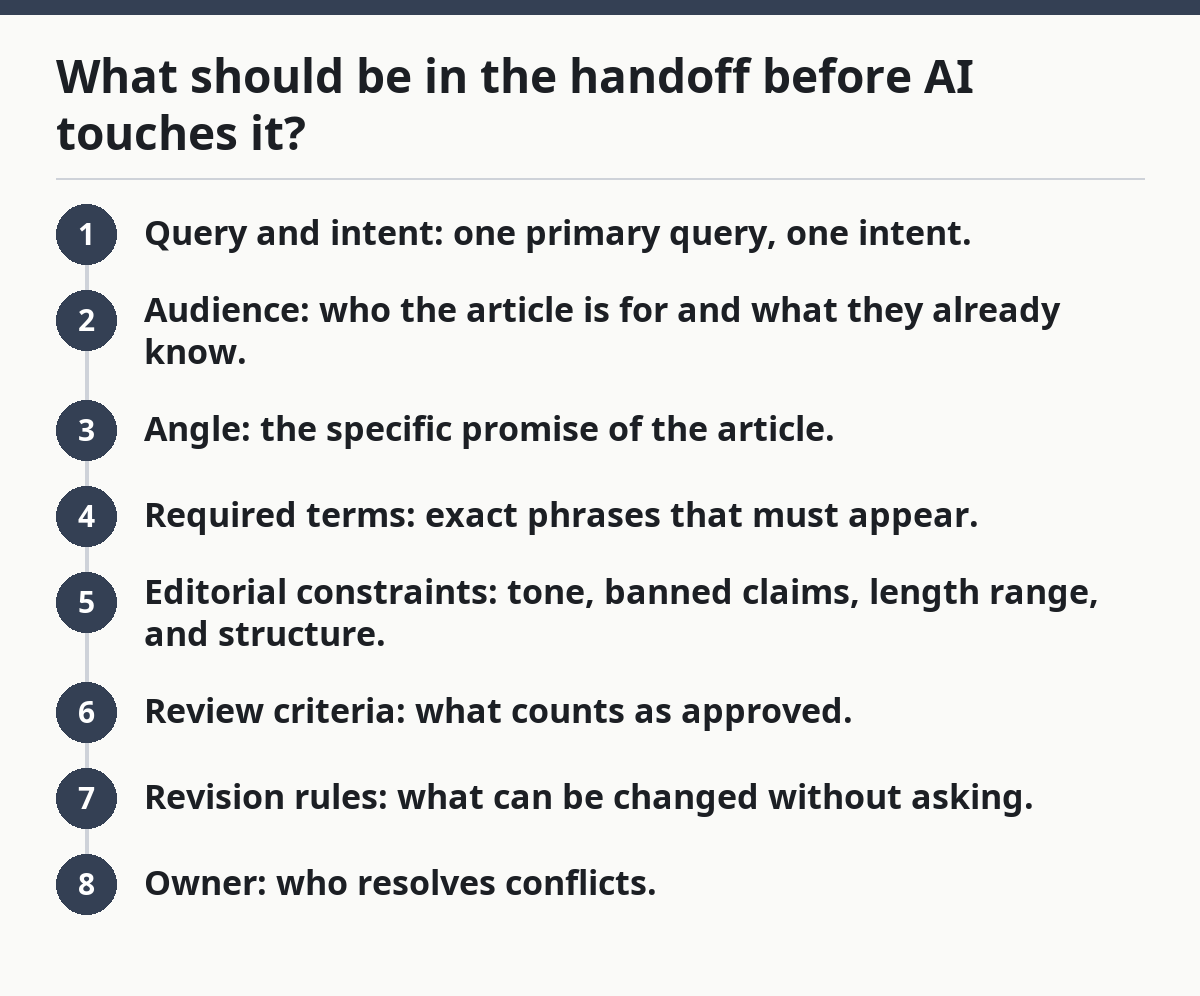
If that checklist can be read in 30 seconds, the handoff is working. If it still needs interpretation, the template is not standardized yet.
How do you use AI to turn messy notes into a standard handoff?
You use AI to rewrite the notes into a fixed template, then you verify the fields before anyone starts drafting. The best output is a structured brief that every team member can read the same way, whether it came from a Slack thread, a doc comment, or a meeting recap.
Follow this order:
- Gather the raw notes from the seo specialist, editor, and content manager in one place, even if they live in separate tools. The result should be a single input block, not three disconnected messages.
- Prompt AI to extract only the handoff fields into a fixed schema with headings like query, intent, audience, angle, H2 plan, editor notes, and approval criteria. The result should be a draft brief with the same sections every time.
- Ask AI to flag gaps and conflicts by comparing the notes against the schema. The result should be a short list such as “missing approval criteria” or “tone note conflicts with the requested audience.”
- Normalize the wording so one field uses one term. For example, choose “required phrase” instead of alternating between “keyword,” “term,” and “SEO phrase.” The result should be language that the whole team can reuse without confusion.
- Compress the brief into a writer-facing version with the non-negotiables at the top and the optional guidance below. The result should be a handoff that a writer can start from immediately.
- Save the final version as a template so the same structure appears on the next assignment. The result should be less editing on the brief itself the second time around.
A useful prompt does not need to be fancy. A plain instruction like “Rewrite these notes into a standard SEO content handoff with exactly 8 sections, surface missing information, and do not add recommendations that were not in the source notes” is usually enough. The point is control, not creativity.
When this step works, the handoff reads like a completed form instead of a conversation transcript. The writer can see the assignment, the editor can see what was promised, and the seo specialist can see which requirements are locked.
One caution: AI will happily smooth over contradictions if you let it. If one note says “keep it concise” and another says “cover 6 examples in detail,” the model may disguise the conflict instead of highlighting it. That is why the gap-check step matters. If the conflict involves legal, medical, or other high-stakes guidance, consult a qualified professional before treating the AI summary as a requirement, because automated wording can miss context and there is no authoritative source for that judgment here.
Standardizing editor notes and revision requests with AI
AI standardizes editor notes by converting comments into named buckets: structural changes, SEO changes, fact checks, and approval blockers. That makes revision requests easier to action because the writer can see what is mandatory, what is optional, and what is just preference.
The biggest failure in handoffs is vague feedback. “Needs more depth” can mean add 2 paragraphs, change the outline, or explain the search intent more clearly. AI can rewrite that into a specific request: “Add one example under the first H2 and expand the section on approval criteria.” That is the difference between a note and a task.
A strong revision request should include four things:
- What changed: one sentence.
- Where it changes: section, heading, or paragraph.
- Why it changes: SEO, clarity, accuracy, or brand fit.
- What good looks like: the expected outcome.
That structure keeps the review checklist usable. It also reduces the chance that the writer overcorrects and damages the draft elsewhere.
This is also where you want AI to be strict about terminology. If the team has agreed on “editor notes,” do not let revisions arrive as “comments,” “suggestions,” and “redlines” in different places unless the team explicitly distinguishes them. A standard handoff should use the same label for the same kind of instruction. That small choice saves time in every review cycle.
The trade-off is obvious: standardized notes can feel less flexible. A senior editor may dislike being forced into a form. But the form is not there to reduce judgment; it is there to make judgment visible. If an editor wants to override the structure, that should be a conscious exception, not an accidental rewrite hidden in prose.
A good benchmark is whether a writer can complete the next draft from the revision packet alone without needing a live clarification meeting. If the answer is yes more often than not, the notes are standardized enough.
How to build approval criteria that AI can check without guessing
AI can help create approval criteria by turning fuzzy goals into pass/fail checks, but the criteria still need human ownership. Approval criteria should say exactly what must be true before an article moves from draft to publish: required phrase placement, section coverage, source usage, tone, and formatting.
The simplest way to do this is to make the review checklist mirror the handoff template. If the brief says the article needs an intro, 4 body sections, and a conclusion that answers the main question, the approval criteria should check those same items in the same order. That keeps the editor from reviewing one set of goals and the writer from drafting against another.
Use AI to draft the checklist in language that is easy to verify:
- The primary query appears in the opening paragraph.
- The first 2 H2s address the reader’s immediate task.
- The required phrase appears naturally, not in a stuffed list.
- The draft includes the agreed source types.
- The conclusion resolves the main question, not a side topic.
Those are concrete enough to check in a 10-minute edit pass. They also help the content manager see why an article is blocked without reading every line.
One useful rule: approval criteria should be specific enough that two different editors would reach the same decision most of the time. If a criterion depends on mood or taste, it does not belong in the standard handoff. Put it in a note, not in the gate.
This approach is especially useful for SEO requirements that often get lost in translation. A seo specialist may care about intent match, heading order, or exact phrase placement, while the writer cares about readability. AI can hold both in one checklist, but only if you define the check in plain language and keep the list short. Ten checks are usually easier to use than 30.
If an article still bounces between publish and revise after the checklist is in place, the issue is probably not the draft. It is usually a hidden approval rule that never made it into the template.
Common mistakes that make AI handoffs worse
AI makes bad handoffs look organized, which is why the most common mistakes are dangerous. A polished template can hide missing instructions just as easily as a rough note can. The fix is to watch for the places where standardization turns into false precision.
First, do not ask AI to “improve” the handoff without a source of truth. If the original brief is vague, the model will often fill the gaps with plausible guesses. That costs time later because the writer may treat those guesses as requirements. Use AI to structure the brief, not to invent strategy.
Second, do not let every team member edit the template fields directly. If the writer, editor, and seo specialist each change the same section, the standard stops being standard. The cost is repeated clarification meetings. The fix is one owner for the master brief and comment-only access for everyone else.
Third, do not put revision requests and approval criteria in the same unlabeled paragraph. That blurs “needs to change” with “must be true by publish time.” A writer then wastes time on optional edits while missing the real blocker. Split them into separate sections every time.
Fourth, do not let AI output jargon that the team does not already use. A phrase like “semantic alignment” may sound sophisticated, but if your team uses “required terms,” the jargon only creates translation work. Standardization should reduce vocabulary, not multiply it.
Fifth, do not skip the human review of the AI-normalized brief. A 2-minute check by the content manager or seo specialist is enough to catch a wrong query, a missing source, or a false conflict. Without that review, the handoff can become consistently wrong faster than the old process.
This is not the right system for a team that changes its editorial rules every week. If the process is still being invented, lock the process first. AI standardization works best when the team already agrees on what “approved” means.
When this approach is worth using, and when it is not
AI standardization is worth using when the team handles recurring SEO assignments and the same handoff problems keep reappearing. If a writer regularly receives vague instructions, if an editor keeps rewriting the same notes, or if a content manager spends time translating between roles, a template-driven AI pass can cut friction fast.
It is not the right tool for one-off assignments with high strategic ambiguity. If the angle is still under discussion, or if the brief depends on a judgment call that the team has not made yet, forcing AI to standardize too early can freeze the wrong version of the plan. In that situation, the team needs a live decision, not a polished wrapper.
It also is not a replacement for editorial judgment. A model can format a handoff, detect missing fields, and rewrite revision notes into cleaner language. It cannot decide whether the underlying strategy is sound. That decision still belongs to the people responsible for the article.
A practical sign that the system is working is simple: the first draft arrives with fewer “what did you mean?” questions, the revision requests are shorter, and the approval conversation is about quality instead of decoding instructions. If that is not happening after a few cycles, the template needs another pass.
The strongest use case is a team that publishes repeatedly and wants the same handoff standard across many articles. The weakest use case is a team that wants AI to substitute for clarity it never built. For broader process design, see the related content workflow template and editorial QA checklist.
Key Takeaways
- AI is best used as a formatting and consistency layer for the SEO content handoff, not as a substitute for strategy.
- A useful handoff template should lock the same fields every time: query, intent, audience, angle, SEO requirements, editor notes, and approval criteria.
- Revision requests work better when AI turns vague feedback into specific, labeled tasks tied to a section and outcome.
- The biggest risk is polished nonsense: AI can make a weak brief look complete unless a human checks for missing
Drafted with AI; not yet reviewed by a person.