Freshness or Intent Shift? How to Decide
Last updated: November 19, 2026
Quick Answer: In the first 5 minutes, decide whether the query still wants the same page type; if it does, update for freshness, and if it does not, rewrite for intent shift. That decision is the difference between a useful revision and a page that keeps missing the mark. This guide on How to decide whether a page should be updated for freshness or intent shift focuses on that choice.
Key Takeaways
- You are fixing a query-page mismatch, not just outdated wording.
- Freshness fixes old details; intent shift changes the answer shape.
- Start by checking the SERP, the promise, and the gaps.
- Competitor pages reveal the current answer shape faster than your analytics do.
This guide settles the call by looking at search intent, serp results, content freshness, page angle, competitor content, content gaps, and revision scope. It also shows when a light refresh is enough and when the page needs a new shape.
What are you actually fixing?
You are fixing a mismatch between the page and the query, not just old wording. A page can be stale and still be the right type of answer, or it can be current and still miss what the searcher now wants.
For example, if a page still ranks but the top results now show comparison guides, templates, or step-by-step instructions, the page may need a freshness update or an intent shift. Those are not the same job.
Here’s the clean split:
- Freshness update: the query still wants the same kind of page, but facts, examples, screenshots, dates, or references have aged.
- Intent shift: the query now pulls a different page type, angle, or depth than your current page offers.
- Both: the result set changed, and the page also carries stale details.
A common mistake is treating every drop as a stale-page problem, so it is worth checking the SERP carefully and, if needed, consulting an SEO professional. Search engines change what they reward, and Google’s own guidance on creating helpful, reliable content is a useful baseline. That wastes time. A page about “email marketing stats” might need new numbers and a new year. A page about “best email marketing tools” might need a full angle change from definitions to comparison intent.
Use this rule: if the page’s promise is still right but the details are old, refresh it. If the promise itself no longer matches the SERP, rewrite it.
A useful check is to compare the page against the current results in 5 minutes, not 50. Open the query, scan the first page, and write down the dominant page types you see.
- Listicle
- How-to
- Definition
- Comparison
- Template
- Product page
- Tool page
If your page’s format is the odd one out, the problem is probably intent, not freshness.
How do you tell freshness from intent shift?
Freshness is about dated details; intent shift is about the shape of the answer. If the ranking page can be repaired by swapping old facts for current ones, that is freshness. If it needs a new page angle, that is an intent shift.
For example, you search the query and see five pages that all answer the same core question in the same way. One of them just has a 2021 screenshot, an old feature name, and a dead link. That is a freshness job. On the flip side, if three competitors now offer checklists and you have a long explainer, you are looking at a shift in intent.
Use these signals:
- The query language changed. If the keyword now includes “template,” “examples,” “best,” “cost,” or “vs,” the page may need a different page angle.
- The SERP format changed. If featured snippets, videos, forums, or shopping modules take over, the searcher may want a different kind of answer.
- Competitor content changed. If the top results now cover a new subtopic or a tighter use case, the market has moved.
- Your page still matches the original promise. If the core answer is intact, freshness is usually enough.
- Your page no longer earns clicks even when it ranks. That often means the title, angle, or format no longer fits the query.
A page with one old statistic is not broken. A page with the wrong job title is.
This is where many teams waste a revision cycle. They add a 2024 label, update a paragraph, and call it done. If the top 10 now favors a different page type, the page will still underperform.
One practical test is to ask whether the page can answer the query in its current form within the first 200 words. If yes, freshness may be enough. If no, the page likely needs a new angle.
The 7-step decision process I use on a live page
The decision comes from a short sequence: compare the SERP, compare the promise, then compare the gaps. You do not need a giant audit to choose between freshness and intent shift.
For a live page, start with one URL, one target query, and a ranking that drifted. You want a fast call, not a theory. The steps below turn that into a yes-or-no decision.
- Open the current SERP. Check the top 10 results, not just the first 3. Note the page types, titles, and repeated angles.
- Write the current page promise in one sentence. If that sentence no longer matches the query, you are likely facing an intent shift.
- Mark dated items only. Look for old stats, screenshots, laws, platform names, years, or pricing references.
- Compare the competitor pattern. If most top results share a format your page lacks, note the gap.
- Test for answer fit. Ask whether the page solves the query as written, without forcing the reader to hunt for the point.
- Measure revision scope. If you can fix it by changing a few sections, it is a freshness task. If you need new sections, a new lead, and a new structure, it is a rewrite.
- Choose one path. Do not mix a tiny refresh with a big intent change unless you have a clear reason.
The key is revision scope. A refresh usually touches a few paragraphs, dates, examples, and links. An intent shift often changes the title, H2s, intro, and closing. That is a different editorial bill.
A good shortcut is to ask: “Can I keep the page angle and fix the page?” If the answer is yes, go for freshness. If the answer is no, the page needs a reframe.
Because search intent is the real test, read the SERP as a report on what searchers reward today. If the SERP says “show me options,” a history-style article won’t fit. If the SERP says “explain the process,” a thin comparison page won’t fit.
What competitor content tells you that your analytics won’t
Competitor content shows the market’s current answer shape faster than page metrics do. Analytics tell you that something slipped. The SERP tells you what replaced it.
For a page that lost traffic over the last quarter while impressions stayed steady, the query may still exist, yet the click target changed. A competitor may have added a clearer page angle, tighter subtopics, or a more direct opening.
Use competitor content as a map, not as a script. Look for these shifts:
- The top ranking pages now start with the answer in the first paragraph.
- They use a different content format, such as a checklist instead of a broad explainer.
- They add one or two subtopics that your page skips.
- They target a narrower audience than your original draft.
- They show clearer proof that the page solves the query.
That last point matters. A page can be fresh and still feel thin if it does not match the depth of the current results. A competitor may not be “better” in the abstract, but it may be closer to the live search intent.
The trap is copying the competitors too closely. If every top result is saying the same thing, your job is not to imitate the crowd line by line. Your job is to see whether your page still earns its spot with a distinct angle that fits the query.
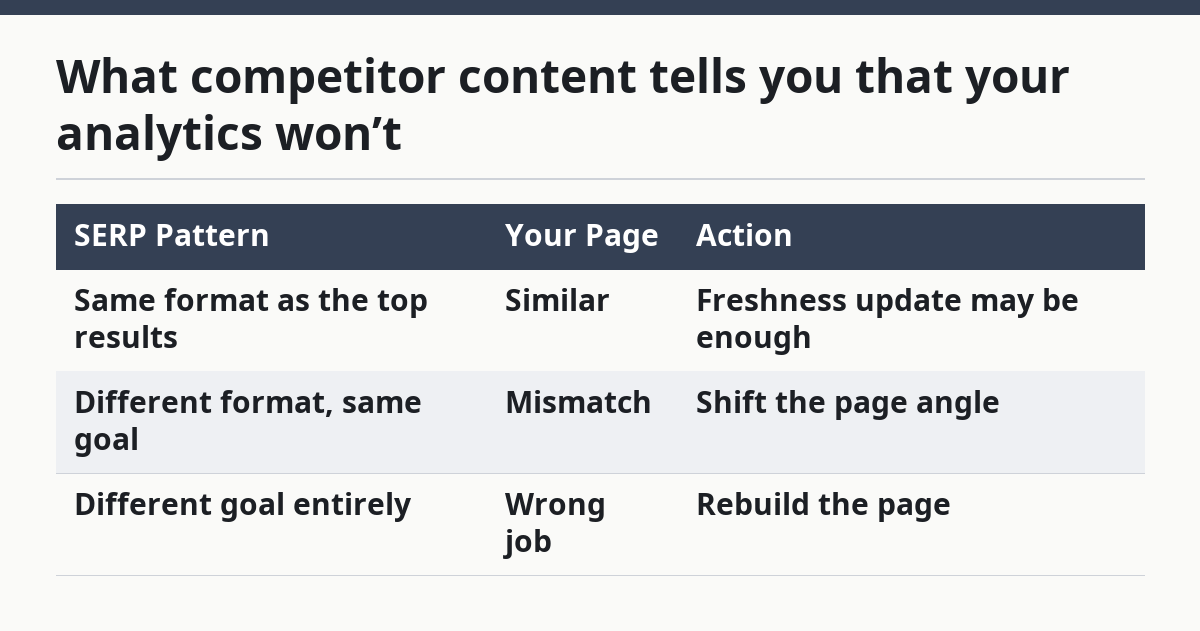
Use a simple 3-column note:
| SERP Pattern | Your Page | Action |
|---|---|---|
| Same format as the top results | Similar | Freshness update may be enough |
| Different format, same goal | Mismatch | Shift the page angle |
| Different goal entirely | Wrong job | Rebuild the page |
If the competitor set is full of FAQ-style results and your page reads like a magazine essay, the problem is usually intent. Not polish.
When a freshness update is the right move
A freshness update is right when the page still fits the query and only the details are old. The core promise stays intact, but parts of the page have gone stale.
For example, the page may still answer the question the same way the current SERP does, but the examples are from 2021, the screenshots are outdated, or the references point to an old product name. That is a refresh task.
A freshness update usually makes sense when you see most of these signs:
- The query still draws the same page type.
- The page still ranks for the intended term.
- The opening answer still works.
- Only certain parts are dated.
- Competitor content has not changed shape in a major way.
In practice, a freshness pass often means changing 5 to 15% of the page, though the exact share does not matter as much as the intent behind it. Update facts, replace dead references, tighten examples, and remove old signals that make the page feel abandoned.
You should also refresh when the page is right in substance but weak in proof. Maybe the facts are current, but the page still mentions an old year in the intro or a dead platform in a list. Those small dates matter because readers use them as trust checks.
A freshness update is not a place to invent a new argument. If you start rewriting the whole piece just to keep it busy, you may be hiding an intent problem.
This is the right move for a page that answers a stable query like a definition, process, or evergreen explanation. It is also the right move when the top results have not shifted away from the original topic.
When the page needs an intent shift
A page needs an intent shift when the SERP wants a different answer than the one you built. That means the query did not just age; the searcher’s need changed.
For example, your page may have been written as a broad explainer, but the current results are all templates, step lists, or comparison pages. You can update the facts all day and still miss the reason people click. That is not a freshness issue.
Common intent-shift signals:
- A new dominant page type appears in the top results.
- The query starts pulling different subtopics than before.
- Competitor pages are narrower and more practical.
- Your page gets impressions but weak click-through from the SERP.
- The opening line sounds right to you, but not to the current searcher.
The fix here is editorial, not cosmetic. You may need a new headline, new intro, new H2s, and a tighter page angle. Sometimes the most honest move is to turn one page into a different job and leave the old job to another URL.
A strong sign of intent shift is when your page still “says the truth” but does not answer the question in the order the reader expects. If the reader wants a step-by-step decision path and you give a conceptual essay, the page misses the search intent even if every sentence is correct.
This is also where content gaps become visible. Not “what can I add to make this longer,” but “what does the current SERP reward that this page does not contain?” That difference drives the scope of the rewrite.
If you keep the old angle in a changed SERP, you usually get a page that is technically current and practically ignored. A bad fit.
What to do after you make the call
Once you decide, stick to that revision scope and do not mix the jobs. A freshness update and an intent shift need different editing plans.
For example, you have decided the page is still the right format, but the details are stale. Or you have decided the page’s angle is out of date. Either way, the next step is to keep the work narrow enough to finish and broad enough to matter.
For a freshness update:
- Replace stale facts, screenshots, dates, and examples.
- Check every claim against the current source or product state.
- Keep the page angle and structure stable.
- Improve the intro only if it has aged.
- Recheck the title for old year signals.
For an intent shift:
- Rewrite the opening so the answer appears fast.
- Rebuild H2s around the current SERP pattern.
- Add or remove sections to match the new job.
- Tighten the page angle to a clearer use case.
- Rework the title and meta copy so they match the new promise.
A good revision plan usually takes 30 to 90 minutes for a refresh and much longer for a rewrite, depending on page length. The exact time depends on how much of the structure changes.
Do not skip the final SERP check. If the page still looks like the wrong type of result after the edit, the decision was off or the rewrite was too small. Either way, the search results will tell you.
The best place to anchor this work is the hub on content freshness and update systems — The Complete Guide. This page exists to make the freshness-versus-intent call; the hub can handle the broader system around it.
How do i know if a page needs a refresh or a rewrite?
A page needs a refresh if the search intent still fits and the details are stale. It needs a rewrite if the current SERP rewards a different page angle, format, or depth than the one you have now. If you can fix the page without changing its job, refresh it. If the job changed, rewrite it.
What is an intent shift in seo?
An intent shift is a change in what searchers want from a query. The query may still look the same, but the top results now favor a different type of page, such as a checklist instead of an explainer or a comparison instead of a definition. That shift changes the page’s best angle.
When should i change the angle of a page?
Change the angle when the top results keep signaling a different answer shape than your current page provides.
Drafted with AI; not yet reviewed by a person.