How to Audit AI Search Visibility by Topic
Last updated: November 19, 2026
Key Takeaways
- A topic-level audit checks whether a page group appears together, unevenly, or not at all in AI answers and search results.
- The cluster, not the page, is the unit of analysis.
- Patterns, gaps, and concentration show whether the topic cluster is balanced or lopsided.
- Google Search Console is the first clean signal for a content set audit: which topic queries reach your pages and which pages match them.
A content set audit for how to audit AI search visibility for a content set by topic, not by page tells you how a topic cluster shows up across AI search, not just how one page ranks. The quickest way is to group pages by topic, compare visibility signals in Google Search Console, Perplexity, and ChatGPT, then mark the patterns. This topic-first audit keeps the focus on the cluster, not the page, and it is the basis for how to audit AI search visibility for a content set by topic, not by page.
What a topic-level AI search visibility audit actually measures
A topic-level AI search visibility audit measures whether a group of pages is showing up together, unevenly, or not at all in AI answers and search results. It looks at the content cluster, the topic cluster, and the queries that sit around them, instead of chasing one URL at a time.
Because this audit is about how to audit AI search visibility for a content set by topic, not by page, the unit of analysis is the cluster, not the page. Picture this: you’re staring at 20 pages about one subject, and each page has its own clicks, impressions, and odd query set. A page audit will miss the shape of the whole topic. A content set audit shows the shape. That matters because AI tools often respond to topical coverage, not a single page in isolation.
The first practical test is simple: if someone asks a topic question in Perplexity or ChatGPT, does your site appear as a named source, a cited page, or a missing voice? That answer becomes your baseline. A blank result is a signal too.
- Group pages into one topic cluster before you measure.
- Track visibility at the cluster level, not just by URL.
- Separate branded queries from topic queries.
- Watch for repeated query patterns across several pages.
- Note where one page is carrying the whole topic.
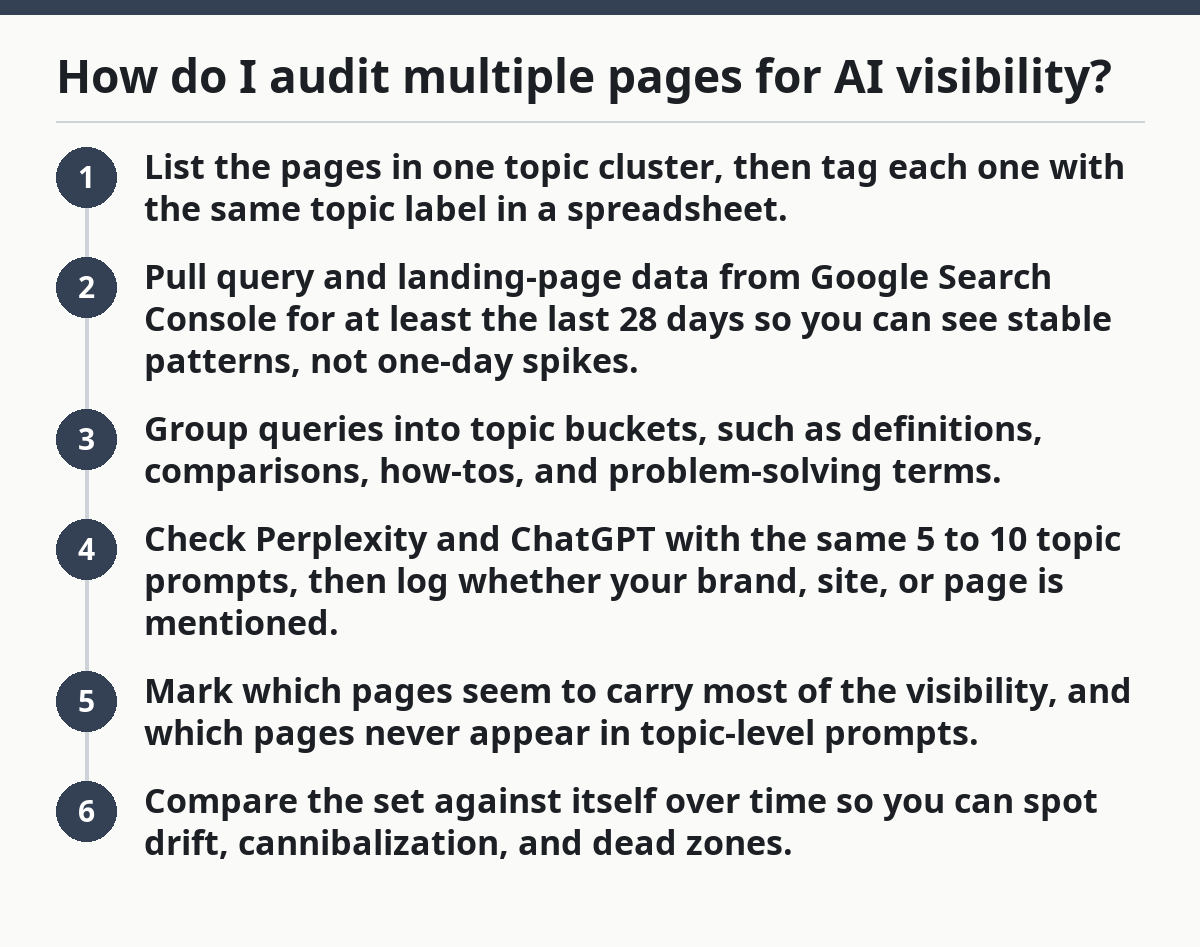
How do I audit multiple pages for AI visibility?
You audit multiple pages for AI visibility by grouping them into page sets, pulling query data for each set, and then comparing how often the same topic shows up across AI tools and search logs. The unit of analysis is the cluster, not the page.
Since how to audit AI search visibility for a content set by topic, not by page depends on shared intent, use any set that shares one topic: a hub and its supporting articles, a product family, or a content cluster with the same audience. If the pages do not share a clear topic, the audit gets noisy fast.
Here’s a practical 6-step procedure.
- List the pages in one topic cluster, then tag each one with the same topic label in a spreadsheet.
- Pull query and landing-page data from Google Search Console for at least the last 28 days so you can see stable patterns, not one-day spikes.
- Group queries into topic buckets, such as definitions, comparisons, how-tos, and problem-solving terms.
- Check Perplexity and ChatGPT with the same 5 to 10 topic prompts, then log whether your brand, site, or page is mentioned.
- Mark which pages seem to carry most of the visibility, and which pages never appear in topic-level prompts.
- Compare the set against itself over time so you can spot drift, cannibalization, and dead zones.
The catch is that GSC shows search behavior, while Perplexity and ChatGPT show answer behavior. Those are related, but they are not the same. A page can earn impressions in search and still vanish in AI answers.
Use a sheet with these columns: topic, page URL, query group, GSC impressions, clicks, AI mention, AI citation, and notes. That structure makes the audit readable in 15 minutes, not 2 hours.
What should I look for in a topic-level AI audit?
You should look for patterns, gaps, and concentration inside the topic, because those three things tell you whether the cluster is healthy or lopsided. A useful audit is less about one score and more about the shape of visibility.
For how to audit AI search visibility for a content set by topic, not by page, a good check is whether three pages on the same topic all get impressions but only one page shows up in AI answers. That can mean the topic is too dependent on one strong URL, or that the other two pages are too thin, too similar, or too far from the core query language.
The strongest signals are plain to see once you know what to mark.
- Coverage gaps: important topic angles with no page in the cluster.
- Cannibalization: two or more pages chasing the same query set.
- Concentration: one page gets almost all impressions or AI mentions.
- Format mismatch: a guide, FAQ, or comparison page that does not fit the query type.
- Source weakness: AI tools use different sources than the ones you expected.
A good way to make this concrete is to compare a topic cluster against a single query family. For example, if a cluster covers “AI search visibility,” “AI search diagnostics,” and “AI answer mentions,” the audit should tell you which of those terms gets the most traction and where the site is silent. If the topic appears in GSC but not in Perplexity, the issue may be source trust, page structure, or query phrasing.
The truth is, topic-level visibility often fails in boring places: titles that are too narrow, pages that repeat the same angle, or a cluster that has no clear lead page. That’s not a content crisis. It’s a structure problem.
How Google Search Console fits into a content set audit
Google Search Console gives you the first clean signal for a content set audit: which topic queries already reach your pages and which pages are tied to those queries. It does not tell you everything about AI answers, but it tells you where the topic already has search gravity.
For how to audit AI search visibility for a content set by topic, not by page, the quickest GSC read is this: you export 1,000 rows and the topic seems to be everywhere. Then you sort by page and see that 80% of the relevant impressions belong to two URLs. That is not broad topic visibility. That is concentration.
Use GSC in three passes.
- Filter queries to the topic terms you care about, then group close variants together.
- Sort by page to see which URLs own the topic.
- Compare clicks and impressions across the cluster to find pages that are seen but not chosen.
A 28-day window is usually enough to see shape without drowning in noise, though you can widen it to 3 months if the topic is seasonal. The point is not to chase one ranking day. The point is to see whether the whole topic is earning stable presence.
So generic advice goes wrong when it treats every page as a separate unit and calls it “optimization.” A topic audit asks a different question. Is the content set teaching search engines and AI tools that this site owns the topic, or is it sending mixed signals?
If the pages all look alike in GSC, that is a warning. If one page holds nearly every impression, that is another. Both tell you the cluster needs clearer roles.
How do Perplexity and ChatGPT change the audit?
Perplexity and ChatGPT change the audit because they reveal whether the topic is being summarized, cited, or skipped when a user asks in plain language. That is different from measuring search clicks, and it needs its own log.
For how to audit AI search visibility for a content set by topic, not by page, picture this: your pages appear in Google Search Console for a topic, but when you ask Perplexity the same question, a competitor’s site gets the credit. That gap is the heart of AI search visibility diagnostics. It means the topic is present in search but weak in answer systems.
Log the same prompt set in both tools. Keep the wording close to how a user would ask it, and keep the set small enough to repeat. Five to 10 prompts is enough for a first pass. Use the same prompts with care, and if the findings affect health, money, or legal decisions, consult a professional and verify them with a source. Write down:
- whether your site is mentioned
- whether a specific page is cited
- whether the answer uses your topic language
- whether a competitor is treated as the main source
- whether the tool invents a summary that ignores your strongest page
Do not treat every AI result as equal evidence. Some answers cite sources; some paraphrase; some hedge. A topic audit cares about the repeated pattern across several prompts, not a single lucky mention.
The strongest signal is consistency. If the same cluster shows up in search but only one page appears in AI answers, the cluster likely needs tighter internal roles, clearer summaries, or better source cues. If none of the pages appear, the topic may still be underrepresented even if the site has good search traffic.
What mistakes distort a topic audit?
The biggest mistakes are mixing page-level and topic-level data, using too narrow a query set, and forgetting that topic clusters can compete with themselves. Those errors make the audit look cleaner than it is, which is worse than having no audit at all.
For how to audit AI search visibility for a content set by topic, not by page, the common trap is this: you sort by URL, celebrate the top page, and miss the fact that four sibling pages are splitting the same intent. The result is a false win. The topic looks healthy on paper and weak in actual visibility.
Common mistakes and what they cost:
- Using only one page: you miss cluster-wide patterns and think a single URL represents the whole topic.
- Using only branded queries: you overstate visibility because brand queries are easier to win.
- Ignoring query groups: you flatten distinct user intents into one bucket.
- Skipping AI prompts: you miss answer-system behavior outside Google.
- Treating one tool as truth: you confuse a search log with a visibility audit; if the choice matters, consult a professional and check a second source.
The fix is simple, but not quick. Build the audit from the topic outward. Start with the content cluster, then the query set, then the AI prompt set, then the notes. That order helps you see whether the topic is missing coverage, suffering from overlap, or simply not being recognized as one connected set.
A good audit should leave you with decisions, not just data. You should know which pages are lead pages, which are support pages, and which are competing with each other.
What should the final audit output look like?
The final audit output should be a one-page topic map with the cluster, the page groups, the main query groups, and the AI visibility pattern side by side. If it takes a deck of slides to explain, it is probably too broad for action.
For how to audit AI search visibility for a content set by topic, not by page, hand a content lead a spreadsheet with 40 rows and no summary, and nothing gets fixed. Hand them a map with the topic, the visible pages, the missing subtopics, and the repeated AI patterns, and the next editorial move is obvious.
A solid output usually has these parts:
- the topic name
- the pages in the cluster
- the query groups attached to each page
- the GSC visibility pattern by page
- the Perplexity and ChatGPT pattern by prompt
- a short note on concentration, gaps, and overlap
Keep the write-up blunt. Say “two pages are competing for the same intent,” not “there may be some duplication.” Say “this subtopic has no visible page,” not “coverage could be improved.” Clear language saves time in the next editorial meeting.
This is also where the hub matters. If you’re building a larger system, the topic audit should point back to the pillar on AI search visibility foundations — The Complete Guide without repeating that guide’s basics. The pillar explains the foundation; this page tells you how to read the cluster.
FAQ
How do I audit multiple pages for AI visibility?
Audit multiple pages by grouping them into one topic cluster, then comparing search and AI signals across the full set. Start with Google Search Console for query and page patterns, then check the same topic prompts in Perplexity and ChatGPT. The goal is to see whether the cluster appears as one topic or as a pile of unrelated URLs.
How do I compare AI visibility across a topic cluster?
Compare AI visibility by using the same prompt set for every page group and logging the same fields each time. Track mentions, citations, and whether the answer uses your topic language. A simple spreadsheet with topic, page, prompt, and result is enough for an honest comparison over a 28-day window.
What should I look for in a topic-level AI audit?
Look for concentration, overlap, and gaps inside the cluster. If one page owns nearly all the visibility, the topic is too dependent on that URL. If two pages chase the same intent, they are competing. If the topic is absent from AI answers but present in GSC, the cluster needs clearer structure or better topic coverage.
Drafted with AI; not yet reviewed by a person.