Build a Better SEO Content Brief With Related Questions
Last updated: November 20, 2026
How to build a better SEO content brief than competitors use with related questions starts with the questions people ask before they are ready to click. Quick answer: a strong brief usually works with 3 to 7 related questions, not a long list, and it gives the writer the exact answer blocks needed so the page can cover the topic in one pass.
Key takeaways
- Related questions are not filler; they are often the fastest way to show a writer what the page must answer first.
- A stronger brief tells the writer which questions belong in the main article and which belong in a FAQ.
- The best briefs usually use IF/THEN rules, not vague notes like “cover the topic well.”
- If a competitor brief stops at keywords, headings, and word count, you can beat it by mapping questions to intent and search stage.
- A brief that solves the reader’s next question usually beats one that only chases the exact query.
What should a better brief include?
A better brief should include the main question, the related questions, and the reason each one belongs on the page. If the competitor brief only lists a keyword cluster and a target word count, the missing piece is the question map that shows what the reader still needs after the first click.
Specifically, start with the searcher’s real problem, not the keyword list. For a page on related questions, that usually means the reader wants to know which questions deserve a section, which belong in a FAQ, and which should be left out because they drift into another article.
For source quality, Google Search Central is a strong official reference to anchor the page’s usefulness rules. Two useful references are Google Search Central’s helpful content page and its documentation on creating useful, people-first pages. You can also use the SERP itself as the source of truth for the questions people keep repeating, and Google Search Console if the site already has impressions for the topic.
If the brief has to work for a writer, each question should do one job. One question might open the article. One might become an H2. One might stay in the FAQ. One might be dropped because it belongs on a different page. That decision is what makes the brief better than a competitor’s.
Quick check: If your brief could be used to write five different articles, it is too vague.
How do you choose the related questions?
You choose the related questions by sorting them into answer, support, and exclusion. If you only collect questions, then the writer gets a pile of clues instead of a plan.
Use this order.
- Pull the seed query and write the exact problem in one sentence. If the seed query is “how to build a better SEO content brief than competitors use,” the problem is not “briefs” in general; it is “how do I make my brief stronger than the ones other sites use?”
- Scan the SERP for repeated questions and note the phrasing that appears more than once. If the same idea shows up in 2 or 3 places, it is probably central to the brief, not decorative.
- Separate informational questions from planning questions. “What is a content brief?” is background. “Which questions should go in the outline?” is the working question.
- Label each question by page role: main section, supporting section, FAQ, or cut. If a question would need its own 800-word page, it probably does not belong in this brief.
- Rank the questions by task order. Put the first decision first. A writer who sees the sequence should know what the reader must understand before the next step makes sense.
- Check for overlap. If two questions ask the same thing in different words, keep the cleaner one and drop the duplicate. The final brief should feel tight, not crowded.
Because the brief is doing the sorting work for the writer, keep a question if it helps decide structure. If it only repeats another question, remove it. If it opens a useful subtopic but does not need a full heading, park it in a notes line under the right section.
Quick check: If you cannot point to the exact section a question belongs in, it is not ready for the brief.
How do related questions beat a competitor brief?
Related questions beat a competitor brief when they turn a flat outline into a decision guide. If the competitor gives the writer a list of headings, your brief gives the writer the order, the intent, and the trade-offs.
| Situation | Best Path | Why Other Options Fail |
|---|---|---|
| Competitor brief has one keyword and 5 headings | Add related questions under each heading and mark the top 3 as must-answer | A plain heading list leaves the writer guessing what the reader still wants next |
| Competitor brief uses only PAA questions | Blend PAA with SERP review and topic gaps from the page | PAA alone can overfit to surface-level phrasing and miss the actual decision path |
| Competitor brief is heavy on keywords | Replace some keywords with question-led sections and answer blocks | Keyword stuffing makes the brief look complete while the article still misses intent |
| Competitor brief is already detailed but still thin | Add exclusion notes and “do not cover here” rules | More notes without boundaries just create longer, messier drafts |
In particular, the real edge is clarity. A writer can turn a question into a paragraph, a heading, a table row, or a FAQ answer. A keyword alone does not tell them which format to use. A related question does.
For example, think in terms of 3 layers: the core answer, the support question, and the follow-up question. That is enough to stop a brief from becoming a list of synonyms.
Quick check: If the writer still has to guess where the question goes, the brief is not better yet.
What should the brief tell the writer to do first?
The brief should tell the writer to answer the main question before anything else. If the brief starts with background, the page will feel polite but slow.
Therefore, begin with the one question the reader typed most likely to be answered in the first 2 or 3 lines. Then tell the writer which related question belongs immediately after it. That often means the first H2 is not “What is X?” but “How does X work?” or “Which option is right for me?” The opening should reduce uncertainty fast.
A strong brief also tells the writer what not to do. If the topic is about related questions, the page should not wander into a full taxonomy of SEO briefs, a long history of search intent, or a tool review unless the SERP clearly shows that need. A brief gets stronger when it cuts dead weight early.
Use short notes like these:
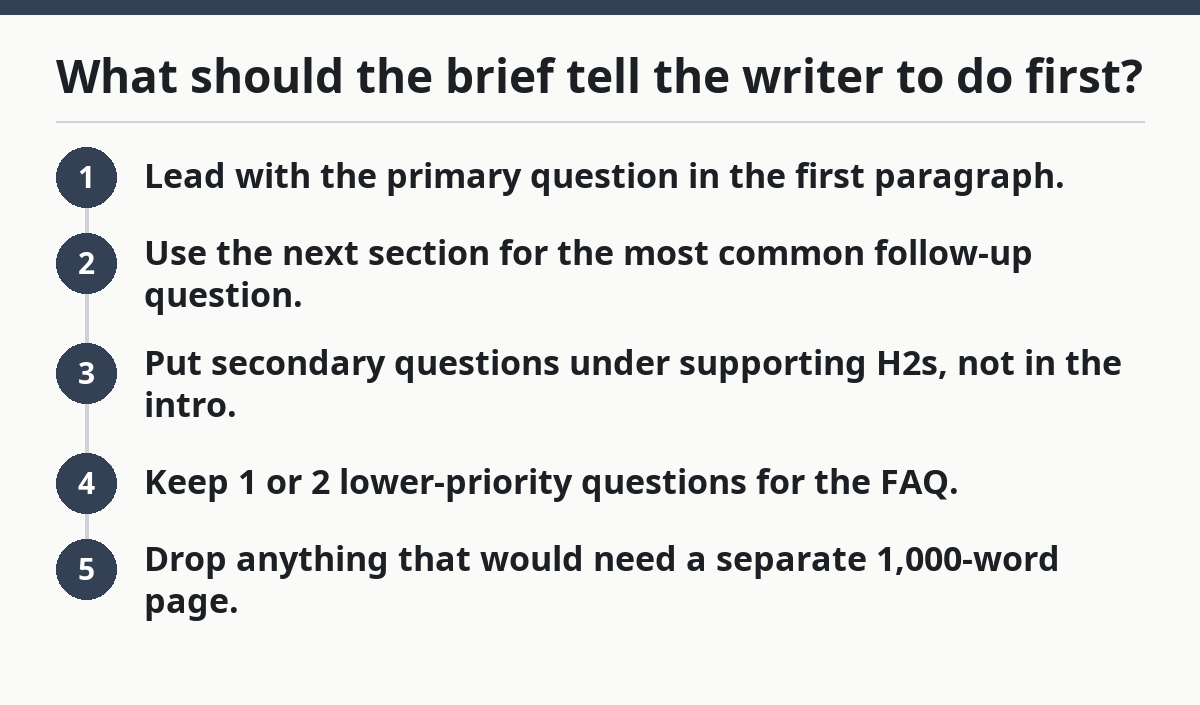
- Lead with the primary question in the first paragraph.
- Use the next section for the most common follow-up question.
- Put secondary questions under supporting H2s, not in the intro.
- Keep 1 or 2 lower-priority questions for the FAQ.
- Drop anything that would need a separate 1,000-word page.
As a result, that structure keeps the page readable on a phone. It also gives the writer a map that can survive a tight edit without losing the point.
Quick check: If the first paragraph answers a side question instead of the main one, the brief is pointing the writer in the wrong direction.
When is the standard advice wrong?
The standard advice is wrong when the SERP is narrow, the topic is technical, or the reader only needs one next step. In those cases, a long list of related questions can hurt more than help.
If the keyword has only a few clear intents, do not force 10 questions into the brief. Use the 2 or 3 that match the real search result pattern and cut the rest. Too many questions can make the outline feel like a dump of ideas instead of a plan.
If the page is for a high-trust topic, such as legal, health, or finance, use related questions carefully and keep the language precise. Those pages often need clearer scope notes than a broad editorial brief. Because these topics can affect decisions, consult a qualified professional and verify claims with a trustworthy source before publishing.
If the site already has a pillar page, a brief for a cluster page should stay narrow. The related questions should answer the slice of the topic that belongs on that page only. A competitor brief that tries to cover everything at once is not a model to copy.
If the page is refresh work, not a new page, the brief should focus on what is missing now. A 2024 page may need only 3 new questions and a tighter order, not a full rebuild. A refresh brief that ignores the current page is doing too much.
Quick check: If adding more questions makes the page less focused, the standard advice does not fit this query.
What edge cases break the normal rules?
When the search intent is mixed, the result set is unstable, or the topic is so small that the SERP changes fast, the normal rules break. In those cases, the brief needs guardrails, not a bigger question list.
-
Situation: The SERP is dominated by forums or videos.
What changes: Searchers may want examples or proof more than definitions.
What to do instead: Put example-driven questions in the brief and keep the answer blocks short, around 1 screen on mobile. -
Situation: People Also Ask repeats the same wording in different forms.
What changes: The SERP is hinting at one real question with several phrasings.
What to do instead: Keep one clean version in the brief and note the alternates in parentheses, not as separate sections. -
Situation: The topic sits inside a bigger pillar page.
What changes: The page should stay narrow or it will compete with its own parent page.
What to do instead: Use related questions that stay inside the subtopic and flag anything broader as off-limits. -
Situation: The query is about a tool, template, or workflow.
What changes: Readers want steps and output, not theory.
What to do instead: Make the brief lead with action questions like “What goes first?” and “What should the reader see when it works?” -
Situation: The page is meant to rank for review AI content for originality.
What changes: Originality and distinct angle matter more than broad coverage.
What to do instead: Choose related questions that force fresh framing, not recycled definitions.
A brief that handles edge cases well usually has one extra note line at the top: “What this page is not.” That line saves time later and stops the writer from chasing the wrong branch of the topic.
Quick check: If the page is too broad, too thin, or too similar to a sibling page, you are in an edge case.
What tools help build the brief faster?
The fastest usable brief often comes from a 20-minute pass through the SERP, not from one giant tool. If the competitor brief was built from a single keyword export, you can improve it by adding manual judgment in a small loop.
Use Google Search results first, because the live SERP shows what Google is surfacing now. Then check Google Search Console if the site already has impressions for the topic, since that tells you which question variants are already pulling attention. If the page is new, use the search results and PAA as the starting point instead.
A simple workflow looks like this:
- Open the target query in Google.
- Copy the first 5 to 10 repeated question patterns.
- Mark which ones are answerable in the main article.
- Mark which ones need a separate FAQ answer.
- Remove any question that belongs to a different intent.
That is enough for most briefs. A fancy tool can save time, but it cannot decide what the page should refuse to cover. The refusal is often what makes the brief better than the competitor’s.
For source quality, Google Search Central remains the safest official place to anchor the page’s usefulness rules, and Google Search Console can show whether the topic already has impressions. If you need another stable reference, use schema or documentation from a standards body only when the page actually needs it.
Quick check: If your tool does the sorting for you, but you still do not know why each question is there, the brief is not ready.
FAQ
How many related questions should go in one SEO brief?
As many as the page can answer without drifting into a different article. For a focused page, 3 to 7 well-chosen questions is often enough to show the shape of the content, but the exact number depends on intent and scope.
Should every related question become a heading?
No. Some questions should become H2s, some should become short answer blocks, and some should stay in the FAQ. If every question becomes a heading, the page can feel chopped up and harder to scan on a phone.
What is the biggest mistake when using related questions in a brief?
When every question looks equally important, the biggest mistake is treating every question as equal. The brief should rank them by importance, then show which ones drive the main answer and which ones only support it. For a deeper framework on topic prioritization, see Google Search Central and the Nielsen Norman Group guidance on scan-friendly content.
Can a brief be better without using related questions at all?
Yes, but only when the topic is narrow and the intent is obvious. For most competitive SEO topics, leaving out related questions makes the brief weaker because the writer has to guess what the reader will ask next.
Drafted with AI; not yet reviewed by a person.