
How to Write SEO Articles with AI Without Losing Your Voice
Last updated: November 19, 2026
Quick Answer: AI-assisted SEO article writing works best when AI handles the first pass and you make the final voice, judgment, and facts yours. Use AI for outlines, rough sections, and search-term coverage; then edit for brand voice, accuracy, and the kind of sentence rhythm your readers recognize.
AI-assisted SEO article writing works best when you plan the article first and use AI to draft within that plan. Use AI for outlines, rough sections, and search-term coverage; then edit for brand voice, accuracy, and the kind of sentence rhythm your readers recognize.
What AI should do first in an SEO article
AI should start with structure, not with polished prose. If you ask it for a finished article on the first prompt, you usually get generic language, soft claims, and a tone that could belong to any site in any industry.
Begin with a short brief that includes the target query, the reader, the article length, the main subtopics, and 3 to 5 terms that must appear naturally, such as “SEO article,” “brand voice,” “outlines,” and “fact checking.” Then ask for an outline with 6 to 8 headings, each one tied to a real job the article must do. A useful outline shows the path the reader will take, not just a list of headings. If the outline cannot answer, “What does the reader learn in step 3 that they did not know in step 1?” it is too flat.
The first good sign is specificity. A workable outline will mention concrete moves like “draft the intro in 2 versions,” “add on-page SEO terms in section 4,” or “mark claims that need sources before publishing.” A weak outline will give you labels like “Introduction,” “Benefits,” and “Conclusion,” which tell you almost nothing.
This is also the stage where the page’s job needs to stay narrow. If the article is meant to teach AI-assisted SEO article writing, do not let the model wander into tool comparisons, pricing, or product reviews. That kind of sprawl makes the article compete with sibling pages and blurs the reader’s next step.
How do you keep brand voice when using AI?

You keep brand voice by giving AI examples, rules, and limits before you ask for prose. A brand voice is not a vague mood; it is a repeatable set of choices about sentence length, vocabulary, point of view, and how direct the writing feels.
A quick way to lose voice is to treat AI like a ghostwriter with no briefing. A reliable way to keep it is to hand over a voice sheet. That sheet can be 1 page long. It should include:
- 3 to 5 adjectives for the tone, such as plainspoken, precise, or measured
- words the brand uses often
- words it avoids
- preferred sentence length
- whether contractions are allowed
- examples of headlines or paragraphs that sound right
Then give the model a sample paragraph from the site and ask it to mirror the cadence, not the wording. A paragraph that sounds like your site usually has a recognizable mix of short and medium sentences, a particular level of formality, and a consistent way of making claims. AI tends to flatten all three. Your job is to restore them.
Because of that, a practical check helps here: read the draft out loud for 60 seconds. If the writing sounds like a polished brochure, it has drifted. If every paragraph feels equally smooth, it has drifted too. Real voice has edges. It may use a blunt sentence after a longer one, or a specific noun instead of a general one. That variation is part of the signature.
This step is where many generic guides fall short. They tell you to “add personality,” which is useless. Personality is not a garnish. It comes from repeated choices that stay stable across a 900-word or 1,500-word article. If you do not define those choices up front, AI will make them for you, and it will pick the safest, blandest path.
Write the outline so search intent and voice work together
A good outline lets search engines and readers find the same answer in the same order. That means the structure should follow the question a person actually has, not the order of an SEO template.
For this topic, the outline should move from the problem to the process:
- State the answer in one direct paragraph.
- Show how AI should be used first.
- Explain how to preserve brand voice.
- Lay out the drafting workflow step by step.
- Cover on-page SEO without stuffing keywords.
- Show how to edit for facts, tone, and repetition.
- End with the limits and trade-offs.
That order matters because readers who search for a how-to are usually trying to finish a task, not read a theory. They want the sequence. If the outline starts with a long explanation of what AI is, you have already lost momentum.
A good outline also keeps each section doing one job. If a section has to explain both voice and fact checking, it will usually do neither well. Split them. A section should answer one question or complete one subtask. That is especially important on an SEO article, where headings often become the page’s internal map.
One concrete way to test the outline is to compare it against the final target length. For a 1,500-word article, 6 to 8 sections usually means about 150 to 250 words per section, with some room for a short intro and FAQ. If one heading needs 600 words to make sense, the outline is carrying too much weight. Break it apart before drafting.
The outline also helps avoid a common AI failure: repetition disguised as completeness. Models often restate the same advice in slightly different words. A tight structure gives each section a distinct role, which cuts that habit off early.
The step-by-step workflow for AI-assisted SEO drafting

The cleanest workflow is to draft in 5 passes: brief, outline, rough draft, voice edit, and fact check. Each pass should produce a visible result before you move on.
- Write a 5-line brief that names the query, reader, tone, length, and required terms. When this works, the prompt stops being vague and the draft stops drifting off topic.
- Ask for a 6- to 8-part outline with one sentence under each heading. When this works, each section has a clear job and the article stops feeling like a pile of disconnected paragraphs.
- Generate the rough draft one section at a time, not all at once. When this works, the language stays closer to the outline and you can stop repetition before it spreads.
- Rewrite the draft in your own cadence: shorten inflated lines, swap generic verbs for exact ones, and cut phrases that sound like AI defaults. When this works, the article sounds like a person who knows the subject, not a template.
- Run fact checking on every specific claim, name, and recommendation. When this works, the article can be published without weak or unsupported lines that make the whole article feel untrustworthy.
- Finish with on-page SEO: one clear H1, descriptive H2s, natural keyword use, and an opening that answers the query in plain language. When this works, the article reads normally while still signaling topic and intent.
This sequence matters because it separates invention from judgment. AI is useful when it fills a blank page with options. It is less useful when it is asked to decide what is true, what sounds like your brand, and what deserves to stay out.
If the article is for a site with editorial standards, this is where those standards should enter. Check sentence length, claim strength, and source quality against the house style before publication. A style guide does not need to be long to be useful. Even a short rule set about tone, terminology, and sourcing can help prevent the last 10% of editing from becoming a rescue job.
What should you edit by hand before publishing?
You should edit the voice, the facts, and the transitions by hand before publishing. Those are the parts AI most often makes generic.
Start with the opening paragraph. It should say the subject plainly, in a sentence a real person would use. If the opening could belong to an article about anything, rewrite it. The reader should know within the first 40 words that this is about writing SEO articles with AI without losing voice, not just “using AI for content.”
Next, look for filler and duplicated points. AI drafts often repeat the same advice in different clothing: “be authentic,” “stay consistent,” “keep your tone.” One is enough. Replace the rest with something specific, such as how a paragraph should sound after editing, or what a strong outline should include.
Then check every line that sounds confident but vague. Phrases like “high-quality content,” “better engagement,” or “more effective writing” are not useful unless the article says what those terms mean in practice. A better line names the exact change: a shorter intro, a sharper H2, a clearer source, or a paragraph that matches the site’s usual cadence.
Fact checking needs special attention because AI can produce plausible nonsense. If a claim is not something you already know or can verify, mark it and verify it before publication. That is especially true for dates, statistics, tool features, and standards. If you cannot verify a claim quickly, either remove it or soften it into a general statement.
A good hand edit also fixes transitions. AI often moves too abruptly from one idea to another or uses the same bridge over and over. Vary the movement between sections so the article feels written, not assembled.
This is the point where a generic article would usually stop and say “just edit carefully.” That is too vague. The real work is knowing what to cut first: repeated advice, lifeless openings, unsupported claims, and lines that sound interchangeable with any other site.
On-page SEO without sounding stuffed
On-page SEO should support the article, not announce itself. The point is to make the page easy to understand without turning the copy into a keyword list.
Use the main query in the H1 and echo it naturally in the opening. Then place related terms where they fit the meaning, not where a keyword map tells you to force them. In this article, “SEO article,” “brand voice,” “outlines,” and “fact checking” belong because they are part of the topic, not because they fill a quota.
Headings matter more than density. A clear H2 tells the reader and the crawler what the section does. That is why question headings work well for how-to pages. They match how people search and how they scan. Keep them specific. “How do you keep brand voice when using AI?” is better than “Best practices.”
Internal structure matters too. Paragraphs should be short enough to scan, but not chopped into fragments. A useful range is 2 to 5 sentences per paragraph, with a mix of short and medium lengths. That rhythm helps the voice survive after SEO edits. If every paragraph is the same length, the article feels machine-made.
The main trade-off here is that stronger SEO often tempts writers to repeat key terms too often. That usually hurts both voice and readability. A better approach is semantic coverage: explain the same idea with related language and examples instead of repeating the exact phrase four times.
For readers who want the broader context of the category, this page supports the hub on what AI content writing tools are, but it stays focused on the drafting process and editorial control. That focus is a feature, not a limit.
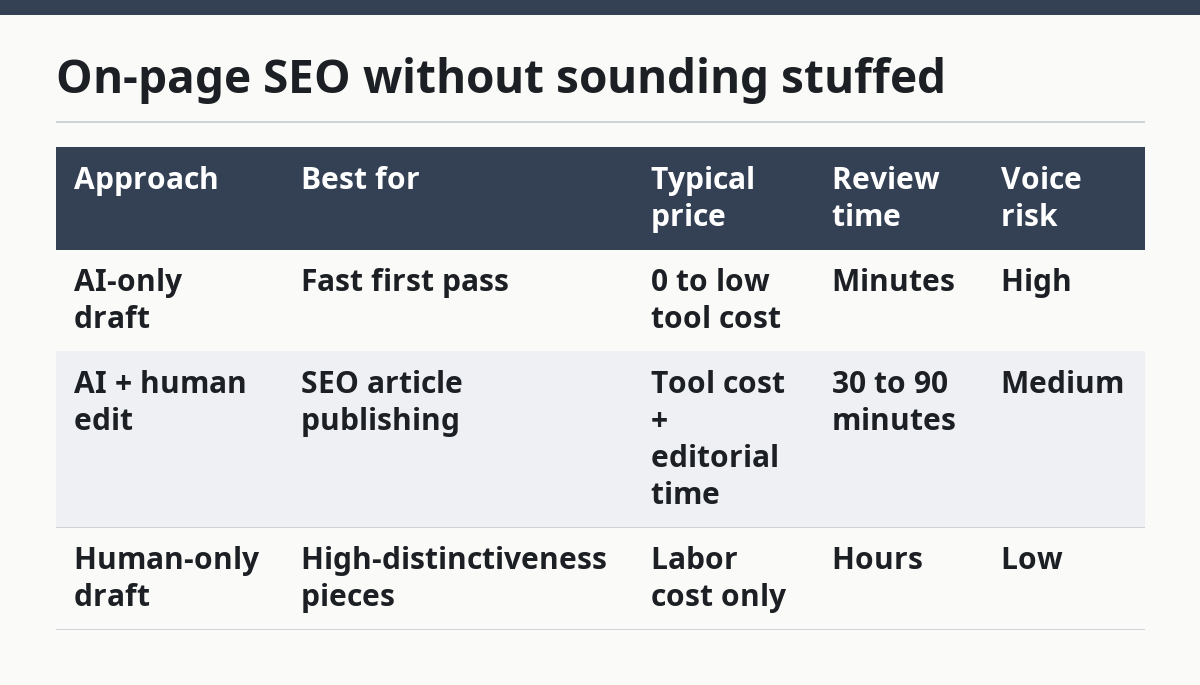
| Approach | Best for | Typical price | Review time | Voice risk |
|---|---|---|---|---|
| AI-only draft | Fast first pass | 0 to low tool cost | Minutes | High |
| AI + human edit | SEO article publishing | Tool cost + editorial time | 30 to 90 minutes | Medium |
| Human-only draft | High-distinctiveness pieces | Labor cost only | Hours | Low |
When AI is the wrong tool for the first draft
AI is the wrong first-draft tool when the article depends on a distinct point of view, specialized facts, or a highly regulated claim. In those cases, AI can help with structure or cleanup, but it should not be the source of truth.
A voice-heavy editorial piece needs a human lead because tone is part of the argument. A technical explanation with exact terminology needs a human who can judge whether the model is using the right term or just a nearby one. And any article that could mislead readers if a detail is wrong needs stricter fact checking than a quick prompt can provide.
There is also a simple brand reason to avoid over-automation: if every article begins to sound the same, the site loses the memory it has built with readers. Voice is not decoration. It is part of recognition. A reader should be able to tell, in 2 or 3 paragraphs, whether the page belongs to the site they meant to open.
The honest limit is this: AI can speed up production, but it cannot replace judgment. If the goal is to publish more words with less oversight, the result will usually be flatter copy and more cleanup later. If the goal is to preserve voice while cutting drafting time, AI is useful. That is the right use case.
Key Takeaways
AI helps most when it handles structure, not final authority. A brief, outline, rough draft, human edit, and fact check workflow keeps the process controlled.
Brand voice survives when you define it with examples, tone rules, and a sample paragraph before drafting starts. Without that, AI defaults to generic prose.
On-page SEO should shape the article’s structure and headings, not force awkward repetition. Clear sections, natural keyword use, and careful editing usually beat dense keyword stuffing.
Some articles still need a human first draft or a stricter review than AI can provide. The more the article depends on nuance, originality, or accuracy, the less you should trust the machine to finish it alone.
How do you keep brand voice when using AI?
You keep brand voice by giving AI a written voice guide and a sample paragraph before it drafts anything. The guide should name tone, sentence length, vocabulary, and words to avoid. After drafting, rewrite any line that sounds generic or too polished.
Should AI write the whole article?
AI should not write the whole article when voice, accuracy, or editorial standards matter. It can draft sections and speed up outlining, but a human should make the final call on tone, claims, and structure. Full automation usually makes the article less distinctive.
How much editing does AI content need?
AI content usually needs enough editing to remove repetition, repair tone, and verify facts. The exact amount depends on the topic, but the final pass should check the opening, every specific claim, and the overall rhythm of the article. If it still sounds machine-made aloud, it needs more work.
Sources
- Nielsen Norman Group: Writing for the Web
- Google Search Central: Creating helpful, reliable, people-first content
Drafted with AI; not yet reviewed by a person.