
How to Create an SEO Content Intake Process for New Topics
Last updated: November 19, 2026
Quick Answer: A strong SEO content intake process for new topics usually works best with 10 fields, 4 scoring criteria, and 5 workflow statuses. It gathers the right details, routes requests clearly, and keeps the editorial calendar from filling with vague or duplicate ideas.
A content intake process is the front door for new SEO topics: it collects ideas, filters bad fits, and hands clean requests to the people who brief and write. In this guide to how to create an SEO content intake process for new topics, the goal is to make the request step clear, consistent, and usable. In short: if the intake step is weak, the editorial calendar fills with vague ideas, duplicate pages, and topics no one can prioritize.
What the intake process needs to do first
The intake process needs to capture the right information the first time and route each request to a clear yes, no, or later. A good content intake process does three jobs before anyone starts a brief: it standardizes the request, checks whether the topic deserves work, and gives the SEO team and marketing team enough detail to score it without a back-and-forth thread.
Start with a topic request form. Keep it short enough that people will actually submit it, but specific enough that it is useful in 5 minutes instead of 50. A practical form usually asks for the proposed topic, target audience, business goal, primary keyword idea, supporting pages or products, and the person requesting it. If the subject matter expert is the source, add a field for their notes and the angle they want preserved.
The intake step is not the brief. It should not ask for 10 competitor URLs, a content outline, or H1 recommendations. Those belong later, after qualification. The point here is to decide whether the topic earns a place in the editorial calendar and, if it does, what the next owner needs to know.
A simple rule helps: if a request cannot be understood in under 60 seconds, it is not ready for intake. That rule cuts down on “write about this” messages that bury the real intent under a Slack thread or email chain. It also keeps the SEO team from acting like a help desk for half-formed ideas.
How do I structure a topic request form?

A topic request form should collect 8 to 10 fields that can be reviewed in under 5 minutes. That is enough to qualify a new topic without turning the form into a project brief.
A helpful benchmark comes from the general form-design guidance on reducing friction: keep fields minimal and ask only for what you will actually use. Nielsen Norman Group notes that shorter forms are easier to complete, which supports a cleaner SEO content intake process for new topics. (Source: Nielsen Norman Group)
Use these fields:
- Proposed topic title — Ask for a plain-English title, not a slogan. A request like “Payroll setup for new hires” is easier to judge than “Streamlining onboarding.”
- Business objective — Have the requester choose one main goal, such as awareness, lead generation, retention, or support deflection.
- Target audience — Require a specific reader group, like small-business owners, in-house marketers, or first-time managers.
- Primary search intent — Ask whether the page should educate, compare, explain, or solve a problem. This keeps the editor from guessing later.
- Why now — A one-sentence note on the trigger: product launch, sales need, seasonal demand, regulatory change, or internal priority.
- Existing assets or source material — Link to docs, SME notes, a slide deck, or a help article if one exists.
- Recommended SME — Name the subject matter expert who can review claims or source details.
- Priority level — Give the requester a simple option such as high, medium, or low.
- Deadline or event date — If there is a real date, capture it. If not, leave it blank.
- Requester name and team — This avoids anonymous submissions that no one owns.
If the form has room, add one checkbox: “I understand this request may be declined, merged, or queued.” If you are unsure about the wording or how to handle exceptions, consult a content strategist or similar professional. That one line prevents the form from being treated as a publishing promise, and form-design guidance from Nielsen Norman Group supports keeping required input focused and clear. (Source: Nielsen Norman Group)
Avoid asking for too many keywords up front. One primary keyword idea is enough at intake. Keyword expansion belongs in the qualification step, not at submission. The cleaner the form, the faster the marketing team can decide whether the idea belongs in the editorial calendar or should wait.
How do I triage new content ideas?
I triage new content ideas by scoring them against a fixed set of criteria and giving each request a visible outcome. The goal is not to make every topic equal; the goal is to stop the loudest request from winning by default.
Use a 1–5 scoring model with 4 criteria:
- Strategic fit: Does the topic support a current business goal?
- Search value: Is there evidence of demand, even if the exact volume is unknown?
- Effort: Will the topic need SME review, design, product input, or legal review?
- Reuse potential: Can the topic support more than one page, a cluster, or a future update?
A basic scorecard can total 20 points. That number is not magic; it is just large enough to separate obvious wins from weak requests. If a topic scores 16 or above, it may move to briefing. If it lands in the middle, it waits. If it is low, it is declined or parked.
The handoff rule should be explicit. For example: requests with no audience, no business goal, and no owner do not get scored. They go back to the requester. Requests that duplicate an existing page are merged into the older topic unless the intent is clearly different. Requests that depend on one SME who is unavailable for 2 weeks stay in the queue, not in active production.
This is where many teams go wrong. They treat intake like a suggestion box, then wonder why the editorial calendar fills with duplicate angles and vague “thought leadership” ideas. If you are building a formal process, consult an SEO or content operations professional about review criteria and queue design. A qualification step forces a decision while the request is still cheap to reject.
The trade-off is speed. A scorecard adds a few minutes per request, and some teams dislike anything that looks like bureaucracy. But a 5-minute check is cheaper than briefing a topic that never had a real audience.
For a deeper operating model, this page supports the broader AI SEO content operations hub.
What should the SEO team check before a topic is accepted?

The SEO team should check for duplication, intent mismatch, and weak opportunity before a topic is accepted. That check should happen before a brief is written, because a bad topic usually stays bad no matter how polished the outline becomes.
Look for 5 things:
- Duplicate coverage — Search the site for near-identical pages. If the new topic overlaps an existing URL, decide whether it should update the current page instead of creating a new one.
- Intent fit — Make sure the request matches the searcher’s likely job. A how-to query should not be forced into a product page.
- SERP shape — Note what type of result dominates the page: guides, product pages, tools, definitions, or lists. That tells the team what format the topic may need.
- Authority needs — Decide whether the topic needs an SME, data source, or technical reviewer.
- Maintenance burden — Some topics age fast. A page tied to pricing, features, or regulations may need more upkeep than a timeless explainer.
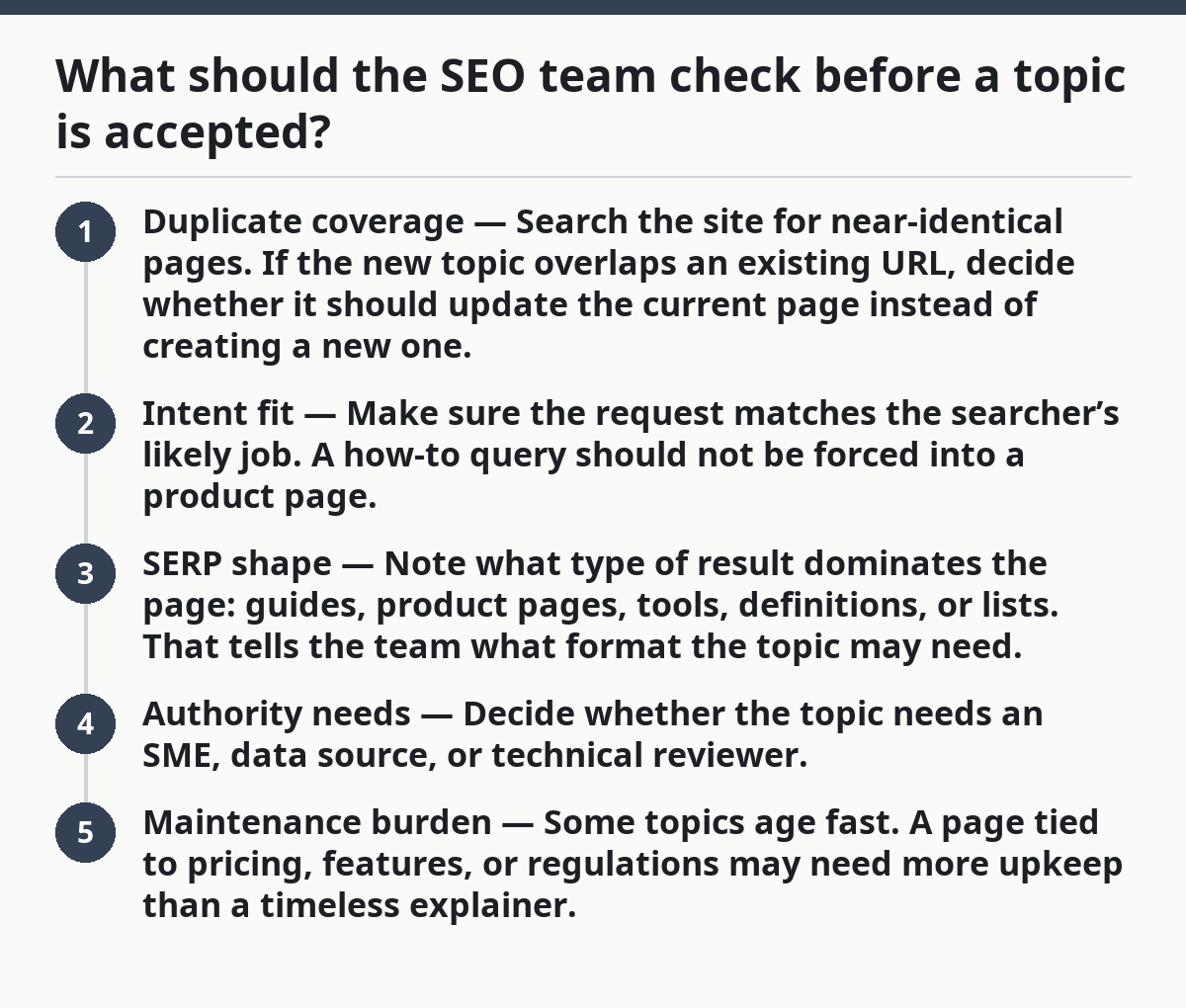
Use a one-page intake checklist if the team handles a steady stream of requests. A checklist works better than memory because it keeps review criteria consistent across different editors. The checklist can sit beside the request form in the same system or live in a spreadsheet, as long as the outcome is visible.
Not every request deserves a standalone article. That is the hardest judgment in the process, and it is where an honest intake system earns its keep. The page may be wrong for the site even if it is interesting in the abstract. If it does not fit the current audience, product mix, or editorial calendar, it should be merged, delayed, or declined.
How should notes move from intake to briefing?
Intake notes should move into a brief only after the topic is approved, assigned, and placed on the editorial calendar. The handoff should be clean enough that the next person can work without reading a 40-message thread.
Use a fixed handoff template with fields such as these:
- Approved topic title
- Primary audience
- Primary goal
- Final owner
- SME contact
- Key constraints or compliance notes
- Supporting sources or internal references
- Due date
- Priority score
- Status in the editorial calendar
The best handoffs are short and specific. “Needs review from the product marketing manager before draft” is useful. “Talk to Sarah about the angle” is not. One gives the writer a clear action; the other creates a chase.
If your team uses project software, the intake status should change in a visible way: submitted, triaged, approved, briefed, or parked. Five statuses are enough for most teams. More than that, and the system starts to look busy instead of useful.
A common failure is letting handoff notes become the brief itself. That creates gaps, because the intake note was written for triage, not for drafting. The writer then gets a page full of fragments and no clear objective. Keep the handoff narrow. The brief can expand the topic later with angle, subheads, sources, and structure.
This step also protects the subject matter expert. A good handoff tells the SME exactly what they are reviewing and when. That cuts down on broad review requests that ask them to “look at the whole thing” with no deadline and no scope.
What breaks an SEO content intake process?
An SEO content intake process usually breaks because it has no owner, no scoring rule, or no decision log. The fix is practical, not philosophical: assign one person to triage, one standard to score, and one place to record the outcome.
The most common mistakes are these:
- Too many submission paths — If requests arrive by email, Slack, meetings, and random docs, no one sees the full queue.
- No rejection path — If “no” is socially impossible, the calendar fills with weak ideas.
- No duplicate check — Two teams ask for the same topic and both think they own it.
- No SME named — The request enters the queue, but no one knows who can validate it.
- No priority rule — Every request becomes urgent, which means nothing is urgent.
Each mistake has a cost. Too many submission paths waste time. No rejection path raises production load. No duplicate check creates cannibalization risk and internal confusion. No named SME delays briefing. No priority rule destroys the calendar’s value as a planning tool.
The fix is to make intake boring in the best way, as long as boring means predictable and usable rather than dull for its own sake. One form. One scorecard. One owner. One visible queue. If a request cannot pass those gates, it is not ready to become work.
A good intake process is also humble. It should make room for exceptions, because not every important topic fits a standard path. A product launch, crisis update, or executive request may need a faster lane. The trick is to define that lane in advance so it does not swallow every other request.
How do I keep the intake process usable over time?
I keep the intake process usable by reviewing it on a 30-day or 90-day cycle and cutting fields no one uses. A process that started clean can become slow after a few months of small additions.
Audit three things in each review:
- Form completion rate — Look at which fields are blank most often. If a field is always skipped, it may be unnecessary or badly worded.
- Decision quality — Check whether approved topics later turn out to be poor fits. If they do, the scorecard may be too soft or too vague.
- Cycle time — Measure how long requests sit before they are triaged. If they pile up for more than a few business days, assign a backup reviewer.
You do not need a giant governance system to maintain it. A simple monthly review in a 30-minute meeting is often enough for a small team. Larger teams may need a weekly queue check and a quarterly form cleanup. The point is to keep the intake process aligned with the editorial calendar, not to let the process become its own project.
A useful signal is whether the marketing team trusts the queue. If people stop submitting because the process feels opaque, the system has already failed. If people submit every idea because they know it will be reviewed quickly and fairly, the process is doing its job.
The limitation is real: intake cannot fix weak strategy. It can only surface better decisions earlier. If the team has no clear priorities, the form will still collect bad ideas, just more neatly. That is why the intake process should be tied to the editorial calendar and not treated as a separate admin task.
Key takeaways
- A good intake process decides yes, no, or later before anyone writes a brief.
- Keep the request form short, specific, and tied to a real owner.
- Use a simple scorecard so topic decisions are consistent instead of political.
- Put duplicate checks, SME notes, and handoff rules in the intake stage, not the draft stage.
- Review the form and queue on a set cadence so the process stays useful.
What should a content request include?
A content request should include the topic, audience, business goal, and one clear owner. It should also name the SME if technical or product input is needed. If the request leaves out those basics, it is too early for briefing and should go back to the requester.
How do I triage new content ideas?
I triage new content ideas by checking fit, search value, effort, and reuse potential. Then I give each request a visible outcome: approved, parked, merged, or declined. A fixed scorecard keeps the decision consistent and makes the editorial calendar easier to manage.
Drafted with AI; not yet reviewed by a person.