How to Build a Content Aging Score for SEO Pages
Last updated: November 19, 2026
Key Takeaways
- A content aging score ranks pages by likely decay risk, not by instinct.
- You build content aging scoring by assigning points to a few signals, normalizing them to the same scale, and adding them into one total.
- The score should include signals that show both age and decay, not vanity metrics that look tidy but do not predict work.
- You need a process that turns those rows into a score you can trust each month, not a one-off audit.
Your SEO pages need a content aging score for SEO pages when you have too many URLs to review by hand. Build one from content age, organic traffic trend, search intent changes, and SERP feature loss. The steps below show how to score pages, weight the signals, and decide which pages rise to the top.
What a content aging score should tell you
Picture this: you have 200 SEO pages, traffic is slipping, and you need a fast way to sort the pages that are quietly going stale from the ones that are still healthy. A content aging score should rank those pages by likely decay risk, not by gut feel.
Therefore, the score is a triage tool. It should answer one question: which pages are most likely losing value because the page, the query, or the SERP has changed? That means the score has to combine page age with performance signals, not just count months since publish.
A useful content aging score usually blends four things:
- Content age: how long the page has been live or untouched.
- Organic traffic trend: whether clicks and impressions are falling over 28, 90, or 180 days.
- Search intent changes: whether the query now favors a different format, depth, or angle.
- SERP features: whether snippets, video blocks, shopping units, or AI-style answers have pushed the page down.
The best part is that you do not need a perfect model to start. A simple weighted score is enough if it is repeatable and tied to action. If the number changes nothing, it is just reporting theater.
Use this page as the scoring layer in the larger content freshness and update systems — The Complete Guide. This article stays on the score itself.
How do you score content aging?
You score content aging by assigning points to a few signals, normalizing them to the same scale, and adding them into one total. Start with a 0-100 model if you want something easy to explain to stakeholders.
The core job is to turn messy SEO data into a single priority number. Here’s the catch: the score should reflect risk, not just age. A 3-year-old page with stable traffic may be fine. A 6-month-old page with a steep click drop may be overdue for work.
A practical scoring framework looks like this:
- Set your scale. Use 0-100, where 0 means “no aging risk” and 100 means “high aging risk.”
- Choose 4-6 inputs. Keep the model small enough to maintain in a spreadsheet or BI tool.
- Normalize each input. Convert each signal to a 0-10 or 0-20 range so one large metric does not dominate by accident.
- Weight the inputs. Give the heaviest weight to the signals that track decay best for your site.
- Sum the weights. A page with weak performance and old age should score higher than a page with only one warning sign.
- Set action bands. For example: 0-29 low risk, 30-59 watch, 60-79 review, 80-100 update now. Use bands only as internal labels, not as a public promise.
- Recheck monthly. If the score is not refreshed on a schedule, it stops being a current signal.
A score like this is simple enough to run in Sheets and serious enough to guide work. It also leaves room for tuning later.
Which signals should go into the score?
The score should include signals that show both age and decay, not vanity metrics that look tidy but do not predict work. If a factor does not help you choose between two pages, leave it out.
I would start with five signals:
- Age since publish or last meaningful update
- Organic traffic trend
- Impression trend
- CTR change
- SERP feature loss or shift
A page older than 18 months is not automatically stale, but age matters because content gets overwritten by new competitor pages, new SERP features, and changed intent. A page can also age fast if the query is tied to prices, tools, laws, product specs, or “best” lists.
Therefore, the signal mix should match the page type. A tutorial page may need less weight on age and more on click loss. A comparison page may need heavier weight on intent change and SERP shift. A product-led page may need more attention when the query starts showing shopping units or AI answers.
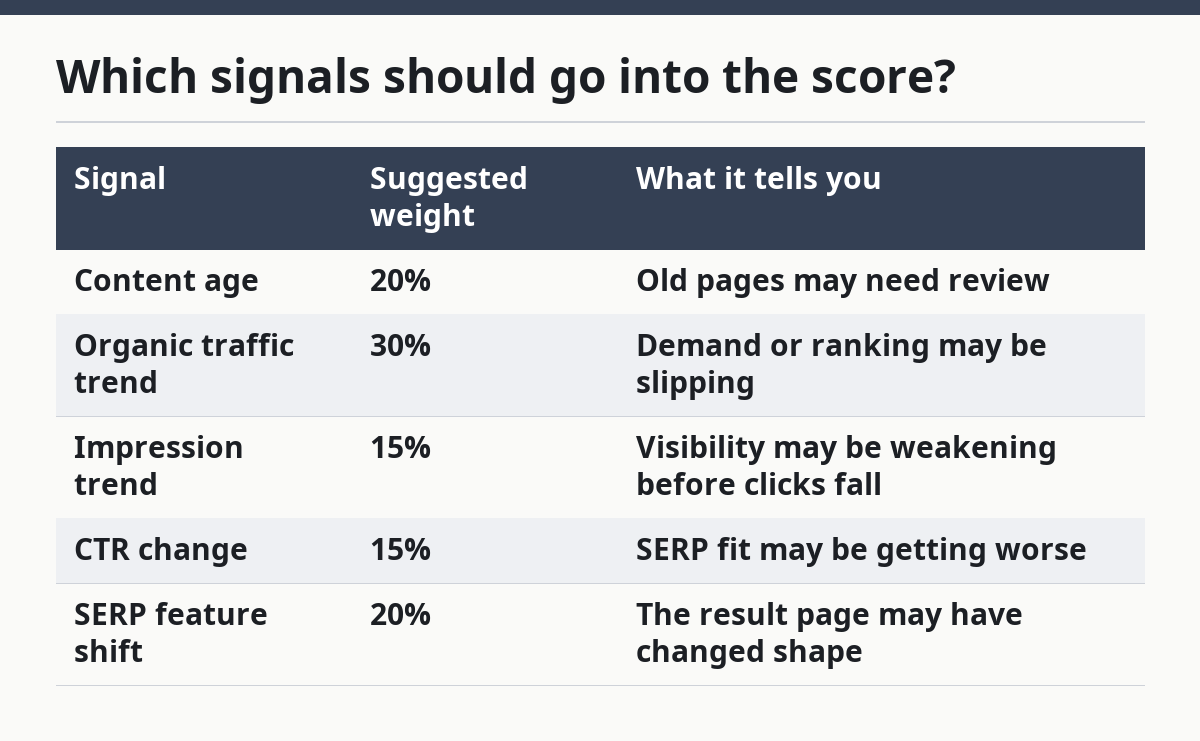
Use this simple weighting model as a starting point:
| Signal | Suggested weight | What it tells you |
|---|---|---|
| Content age | 20% | Old pages may need review |
| Organic traffic trend | 30% | Demand or ranking may be slipping |
| Impression trend | 15% | Visibility may be weakening before clicks fall |
| CTR change | 15% | SERP fit may be getting worse |
| SERP feature shift | 20% | The result page may have changed shape |
Do not overweight age just because it is easy to measure. A page can be old and still healthy. That is a common trap.
Build the score step by step
Picture this: you are in a spreadsheet with page URLs in column A, publish dates in column B, and Search Console exports in the next tabs. You need a process that turns those rows into a score you can trust every month, not a one-off audit.
Because of that, the best way to build it is to keep the math boring and the rules visible. Use one formula, one scoring band, and one owner for updates.
- Collect the page list. Pull every indexable SEO page you want to evaluate.
- Add publish date and last meaningful update date. Use the last substantial edit, not just a typo fix. That distinction matters.
- Pull 90-day and 180-day Search Console data. Capture clicks, impressions, CTR, and average position for each page.
- Measure trend direction. Mark whether each metric is up, flat, or down compared with the prior matching period.
- Check the current SERP manually or with a rank tool. Note whether the query now shows more video, shopping, local, featured snippet, or AI-style answers than before.
- Score each input on the same scale. For example, 0-10 for each factor, where higher means more aging risk.
- Apply weights and total the score. Multiply each factor by its weight, then add them.
- Sort pages from highest to lowest score. The top group becomes your update queue.
A simple example helps. A page that is 30 months old, has lost clicks for two straight 90-day windows, and now sits under a richer SERP should score much higher than a 4-month-old page with stable impressions. The exact formula matters less than the consistency.
How do you score decay indicators without fooling yourself?
You score decay indicators by looking for patterns that show the page is losing fit, not by reacting to one bad week. A one-week dip is noise. A three-month slide is a signal.
The truth is, each decay indicator needs a rule. That stops the score from becoming a mood ring. Use thresholds that fit your site and keep them fixed for a quarter before you change them.
A clean way to score common indicators:
- Organic traffic trend
- Flat or rising: low risk
- Down slightly over 90 days: medium risk
- Down sharply over 90 days and 180 days: high risk
- Impression trend
- Stable impressions with lower CTR: the snippet may be the issue
- Falling impressions and clicks together: broader visibility loss
- CTR trend
- CTR down while position holds: title, description, or SERP format may be hurting
- CTR down with position loss: ranking pressure and snippet fit may both be in play
- SERP feature shift
- New featured snippet, AI answer, video block, or shopping unit above your result: higher risk
- Result page looks unchanged: lower risk
- Search intent changes
- Query now favors a different content format: high risk
- Query still matches the page type: lower risk
Do not score every dip the same way. A page with fewer clicks because search demand dropped is not the same as a page losing clicks because competitors took the first screen. That difference is the whole job.
What should you do with the score once it exists?
You should use the score to rank work, not to replace judgment. A score is a queue builder. It is not a final verdict on the page.
Set action bands that map to real work:
- Low risk: monitor monthly
- Moderate risk: review content, title, and SERP fit
- High risk: prioritize for update this cycle
- Very high risk: review fast, because the page may be out of sync with intent or SERP shape
The score is most useful when it feeds a fixed workflow. For example, a team might review the top 20 scoring pages every month and update the top 5 first. That makes the process predictable.
Here’s the catch: a high score should trigger a diagnosis, not an automatic rewrite. Some pages need a new intro, some need fresher examples, and some need a title that matches current query language. Others need nothing but a watch list.
A good rule is to pair the score with a notes field. Capture why the page scored high: age, traffic decline, featured snippet loss, intent shift, or a mix. That note helps the next reviewer avoid guessing.
Common mistakes that make the score useless
Picture this: you have a clean spreadsheet, but the top-scoring pages are not the ones you would actually update. That usually means the scoring model is too simple, too noisy, or too detached from search behavior.
The most common mistakes are easy to spot:
-
Using age alone
This ignores stable evergreen pages and over-prioritizes old pages that still perform well. -
Mixing raw metrics without normalization
One large metric can swamp the others if you do not convert everything to the same scale. -
Scoring only traffic, not intent
A page can keep traffic while the SERP changes underneath it. -
Treating every content type the same
A news-style page, a guide, and a money page age differently. In YMYL cases, consider consulting a qualified SEO, legal, financial, or medical professional, depending on the topic, and use authoritative guidance such as Google Search Central and the FTC. -
Updating the score too often
Daily changes make the model noisy. Monthly is usually enough for most SEO teams. -
Ignoring last meaningful update date
A page may be old on paper but fresh in practice if it was genuinely revised last week.
The fix is boring and effective: keep the model narrow, define your scoring rules in writing, and review a sample of pages manually each month. If the score keeps picking the wrong pages, the weights are wrong.
How to keep the model useful over time
You keep the model useful by checking whether it predicts the pages you would have chosen anyway. If the top 10 pages are consistently wrong, the model needs repair.
The best maintenance habit is often a monthly review. Look at three things:
- Were the highest scores actually weak pages?
- Did updated pages improve after review?
- Did any low-score page suddenly drop in traffic or rankings?
If the answer to the first question is “mostly no,” adjust weights. If the answer to the second is “no,” the score may be missing the real cause of decay. If the answer to the third is “yes,” your thresholds may be too slow.
This is also where search intent changes matter most. A page can age out because the query itself changes shape, not because the copy is old. The score should catch that shift early enough to move the page into review before traffic falls off a cliff.
Keep the model simple enough that someone else can run it in 15 minutes. A clever score nobody maintains is dead on arrival. A plain score that gets used every month is worth more.
FAQ
What is a content aging score?
A content aging score is a ranking system that shows which SEO pages are most likely losing value over time. It blends content age, traffic trend, impression trend, CTR, and SERP changes into one number so you can prioritize work.
How do I score content decay?
You score content decay by giving each signal a fixed range, weighting the signals, and adding them into one total. Therefore, use the same scale for every page, then sort from highest risk to lowest risk so the worst pages rise to the top.
What factors should go into freshness scoring?
Freshness scoring should include page age, organic traffic trend, search intent changes, SERP feature changes, and content performance signals like impressions and CTR. Those factors show whether a page is simply old or actually losing fit in search.
Drafted with AI; not yet reviewed by a person.