How to Prioritize Pages to Build a Niche Content Map
Last updated: November 19, 2026
Quick Answer: For How to prioritize pages to build a niche content map first, start with the 5 to 7 pages that cover the core search intent and the main dependencies, then expand in layers. Content prioritization comes first when your niche site has more page ideas than time, and the right order is the one that builds search intent coverage before thin pages pile up.
Start with the pages that carry the most topic value and the clearest dependencies.
The steps below settle which pages belong in your first topic map, what to publish before anything else, and what to leave in the content backlog for later.
Prioritize the pages that teach the whole niche
Picture this: you have 40 page ideas, a blank content map, and a team that wants to publish something this week. If you start with the easiest pages, you can end up with five posts that all sit on the edge of the topic and none that hold the center.
Start with the pages that answer the main job, the main problem, and the main subtopics in the niche. That gives you a topic map that can support the rest of the site instead of a pile of isolated articles. The first pages often cover the core search intent, not the flashiest keyword.
A simple rule helps here: if a page would make the niche harder to explain without it, it belongs near the front. If it only adds color or a narrow angle, it belongs later. That sounds plain because it is.
Use these signals to sort the first batch:
- The page covers the core subject, not a side case.
- The page can link out to 3–5 related pages once they exist.
- The page helps define the site’s seo roadmap for the next 3 months.
- The page fills a known coverage gap rather than repeating another draft.
A common mistake is ranking pages by how easy they are to write. Easy-to-write pages can still be low value. That creates gap debt: you publish fast, then spend months backfilling missing pages the site should have had from day one.
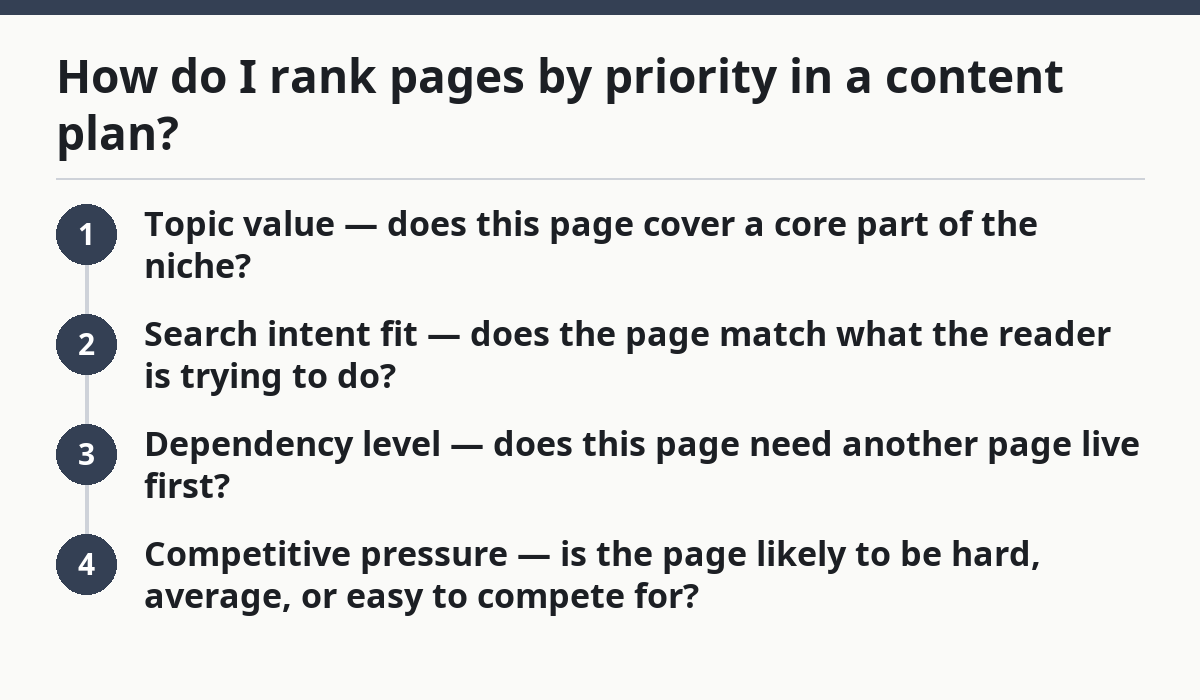
How do I rank pages by priority in a content plan?
You rank pages by value, dependency, and risk, then publish the highest-scoring pages first. That gives you a content backlog that grows in the right order instead of by gut feel.
Use a 1–5 score for each page idea in four buckets:
- Topic value — does this page cover a core part of the niche?
- Search intent fit — does the page match what the reader is trying to do?
- Dependency level — does this page need another page live first?
- Competitive pressure — is the page likely to be hard, average, or easy to compete for?
A page with a high topic value and low dependency score should move to the top. A page with high dependency but low topic value usually waits. That is the main rule.
Here’s a practical way to score the list in 15 minutes:
- Put every page idea into one sheet.
- Give each bucket a number from 1 to 5.
- Add the scores.
- Sort from highest to lowest.
- Mark any page that needs another page before it can work.
That last step matters. A support page without its parent page often has nowhere to live in the site structure. It can rank, but it usually wastes internal links and muddies the map.
The truth is, not every page with search demand deserves an early slot. A page that sits far from your core topic can drag the map sideways before the niche is even established.
Build the first content map around page dependencies
Picture this: you want to publish an article on a narrow keyword, but the page depends on a parent guide, a glossary term, and two supporting explainers. If you publish it first, the page has nowhere to sit in the structure.
Page dependencies decide sequence. Parent pages should usually come before child pages, because the child page gets context from the parent and internal links from the rest of the cluster. That is how a niche content map stops being a list and starts becoming a system.
A clean order often looks like this:
- Core pillar or hub page
- Main “what it is” page
- Main “how it works” page
- Main comparison or use-case page
- Supporting detail pages
- Long-tail edge cases
That order is not fixed, but it prevents one big mistake: writing the edge before the base. A support page on its own can feel complete in a doc. On the site, it can look stranded.
Use dependency checks before you publish:
- Can the page link to at least one live parent page?
- Does the page depend on a term the site has not defined yet?
- Would the page make more sense if a broader guide existed first?
- Does the page need sibling content to show topical depth?
If the answer is yes to two or more, move the page down the queue. The first content map should make the site easier to understand in 30 seconds. If the structure makes a reader hunt for basic context, the order is wrong. For guidance on structuring topics and links, see Google’s SEO Starter Guide and Ahrefs’ internal linking guide.
Which pages get published before expansion into related topics?
You publish the core pages first, then the pages that prove breadth inside the niche, then the related-topic pages after the map has a center. That keeps your coverage gaps small and your site from drifting into nearby subjects too soon.
A strong first wave usually includes:
- One main hub page
- Two to four core subtopic pages
- One comparison page if the niche has a clear choice point
- One problem-solving page for the main pain point
That gives the site enough shape to support internal linking and enough depth to show the niche is real. A page on a related topic should wait until the main topic has at least a few live pages around it.
The best test is often this: if a new page would force you to explain a new audience, a new problem, or a new language set, it probably belongs in the second wave. The first wave should stay tight.
This is where many teams go wrong. They chase adjacent topics because the search volume looks tempting. Then the map starts to sprawl, and the site never finishes the original niche.
On the flip side, a tight first wave can still leave room for growth. You are not locking the site forever. You are building the base that lets later pages make sense. For broader planning, you can also align this with your topical hub structure and content strategy workflow.
Use competitive pressure without letting it drive the whole map
Picture this: you open a SERP, see strong domains, and feel tempted to skip the hard pages. That reaction is normal, but it should not control the first draft of your map.
Competitive pressure belongs in the priority score, not at the top of the list by itself. A page can be hard to rank and still deserve early publication if it anchors the niche. In some cases, the hardest page is the one that defines the site.
Use competition as a filter, not a veto:
- If a page is central and hard, keep it early but support it better.
- If a page is peripheral and hard, push it back.
- If a page is central and easier, publish it early.
- If a page is peripheral and easy, it may still wait if it adds little to the structure.
This is also where search intent matters. A page can look promising by keyword alone and still miss the reader’s task. If the intent is off, the page will not help the map, no matter how much demand it has.
A useful habit is to ask, “Does this page help the site explain itself?” If the answer is no, the page may still be useful later, but it is not a first-move page. The same idea applies when you compare a niche cluster against your pillar content plan.
What should I put in the content backlog first?
Put the pages with the highest topic value and the clearest build order into the content backlog first, then keep the rest grouped by cluster. That makes the backlog usable instead of bloated.
A good backlog for niche content planning has only a few fields:
- Page title
- Target search intent
- Priority score
- Dependency notes
- Cluster label
- Status
That is enough to run an seo roadmap without turning the sheet into a museum. You do not need 20 columns to make a decision. You need the next action.
The fastest way to clean a backlog is to separate it into three lanes:
- Publish now — core pages with high value and low dependency.
- Prepare next — pages that need one more supporting article first.
- Hold — pages that belong to later expansion.
This keeps the map honest. If a page sits in “publish now” for weeks, the score system is probably broken. If everything sits in “prepare next,” the team has built a planning file, not a publishing plan.
One more guardrail: if a page does not improve the niche map, remove it from the first batch. A crowded backlog can feel productive, but it often hides weak thinking.
The simple order I’d use for a first niche map
Picture this: you need to go from zero to a useful map without overplanning for 6 weeks. The answer is to publish in an order that gives the niche a spine, then the ribs, then the smaller branches.
Use this order for the first pass:
- Core hub page
- Main intent page
- Support page for the biggest subtopic
- Support page for the second-biggest subtopic
- Comparison or decision page
- Detail page with a clear dependency
- Adjacent topic page only after the main cluster is live
That order works because it reduces the chance of orphan pages. It also gives internal links a place to land from day one. A topic map built this way is easier to expand because every new page has a home. For related setup work, see the site architecture guide and the internal linking guide.
The part most teams miss is restraint. A niche map does not need 25 pages on day one. It needs the right first 5 to 7 pages in the right order.
How do I know the first map is good enough to publish?
The first map is good enough when every page has a clear place, a clear role, and a clear next link. If a reader can move from the hub to the subtopics without guessing, the map is ready.
Check the map against four questions:
- Does the first batch cover the main search intent?
- Do the pages support each other?
- Are there any missing parent pages?
- Are any early pages too far from the niche core?
If you can answer those cleanly, publish. If not, keep editing the order, not just the headlines.
For a broader planning framework, the hub on AI search visibility planning can sit above this process and shape the bigger strategy. This page stays focused on the first move: choosing which pages deserve the earliest slot in the niche map.
Which pages should I create first?
Create the pages that explain the niche from the center out. Start with the hub page, then the main subtopic pages, then the support pages that fill the biggest gaps. If a page needs another page to make sense, it usually comes later.
How do I rank pages by priority in a content plan?
Score each page by topic value, search intent fit, dependency level, and competitive pressure. The pages with the highest total and the fewest dependencies go first. That order keeps the content backlog tied to the actual structure of the niche.
What should I publish before expanding into related topics?
Publish the core cluster first: the hub, the main subtopics, and the pages that answer the primary intent. Only expand into related topics after the first cluster can stand on its own. If the base is thin, expansion just spreads the site out.
Key takeaways
The first pages are the ones that make the niche easier to understand, not the ones that are easiest to draft. Rank pages by value, intent, and dependency, then publish the core cluster before side topics. A tight first map gives later content a place to fit and keeps the backlog from turning into clutter.
Drafted with AI; not yet reviewed by a person.