
AI-Assisted Content Refresh Workflows — The Complete Guide
Last updated: November 19, 2026
Key Takeaways
- A refresh updates an existing post to better match search intent, current facts, and page structure.
- AI is most useful for structure, gap-finding, and draft cleanup because those tasks are repetitive.
- AI should not be trusted alone for dates, specs, policies, medical guidance, legal rules, or anything that can change without warning.
- A post needs a refresh when it still has a search job to do, but it no longer does that job cleanly.
AI-assisted content refresh workflows help you update old posts faster by using models for audit, rewrite, and QA — but only if a human sets the brief and checks the facts. This guide to AI-assisted content refresh workflows — The Complete Guide shows the workflow, the decision points, and the traps that waste time.
I write and edit SEO content for posts that have to keep earning traffic after launch, so I know where refresh work usually breaks.
The quickest way to think about a content refresh

A content refresh is not a rewrite from scratch; it is a targeted update of an existing post so it better matches search intent, current facts, and page structure. AI helps most when you feed it a page, a search goal, and a list of gaps — and the best results usually come when a human defines the goal clearly.
Picture this: you have a 2,000-word post that still gets clicks, but it now answers the wrong version of the query and buries the useful part halfway down the page. You need faster diagnosis, not more brainstorming. The workflow below shows where AI saves time and where it makes a mess.
A good refresh workflow usually has four jobs:
- Find what changed in the query, the SERP, or the product.
- Identify what the post is missing, repeating, or burying.
- Draft new sections in the post’s voice and structure.
- Check claims, links, and search intent before publishing.
That sounds simple, but the hard part is deciding what not to touch.
What AI should do in a refresh workflow
AI should do the first pass on structure, gap-finding, and draft cleanup, because those tasks are repetitive and easy to compare against a brief. It should not be the final authority on facts, product claims, or whether a post still deserves to rank.
Here’s the catch: one of the most practical uses of AI is often the least glamorous one. Feed it the current post, the target query, and the top competing pages, then ask it to label missing subtopics, weak headings, stale examples, and places where the post wanders. That gives you a map, not a verdict.
For example, Google’s Search Essentials emphasize creating helpful, reliable, people-first content, which is why a refresh workflow should keep the human editor in charge of the final page. See Google Search Central’s guidance on helpful content and quality in search results.
Source: https://developers.google.com/search/docs/fundamentals/creating-helpful-content
A practical AI-assisted refresh workflow often looks like this:
- Paste the live post into the model.
- Paste the target keyword and search intent.
- Ask for a content gap list by section.
- Ask for a proposed new outline.
- Ask for draft replacements for only the weak sections.
- Run a human fact check and link check.
- Publish, then watch rankings and clicks.
The point is speed with control. AI handles the boring first draft work, while the editor decides what stays, what moves, and what gets cut.
What a refresh workflow should never hand to AI alone
AI should not be trusted alone for dates, specs, policies, medical guidance, legal rules, or anything that can change without warning. It also should not decide whether a post still matches intent if the query has shifted from “how-to” to “best tools,” or from “definition” to “step-by-step guide.”
This matters because a refresh can fail in quiet ways. The post may read better, but still rank worse if it answers the wrong question. Or it may rank fine for a while, then fall off after the next search update because the rewrite flattened the exact phrasing and examples the query needed.
Use AI with hard guardrails:
- Facts from source documents only, not memory.
- No new claims without a source.
- No rewritten code, schema, or steps unless a human checks them.
- No “this is the best” language unless the page is actually a comparison page and the claim is supported.
- No invisible drift in tone, terminology, or brand voice.
The truth is, AI is strongest on pattern work. It is weak on accountability. That means it can suggest 12 fixes in a minute and still miss the one line that matters most.
How do I know if a page needs a refresh?
A post needs a refresh when it still has a search job to do, but it no longer does that job cleanly. The trigger is usually one of three things: declining traffic, outdated facts, or a mismatch between the page and the current search result set.
The Search Engine Journal has long noted that content updates can be effective when the underlying topic still matters, which is why timing matters as much as wording. Source: https://www.searchenginejournal.com/content-refresh-seo/
Picture this: your post still has links and impressions, but the click-through rate drops because the title no longer matches what people want. Or the page ranks for a query that now expects a quick answer, while your post is buried in context and examples. That’s a refresh signal, not a “wait and see” moment.
Common refresh triggers include:
- A drop in clicks or rankings after a competitor update.
- Outdated screenshots, product names, laws, prices, or dates.
- Thin sections that no longer answer the query fully.
- Repeated content that adds length but not value.
- A title or H2 set that no longer fits the intent.
- New subtopics showing up in competing pages.
You do not need to refresh every page on a schedule just because “content ages.” Some posts can sit for a long time if the facts are stable and the query is stable. Others need attention every quarter because the market changes fast.
The best AI-assisted refresh workflow, step by step
A reliable AI-assisted refresh workflow starts with diagnosis, then moves to drafting, then ends with quality control. That order matters, because asking AI to rewrite before you know the problem usually creates a polished wrong answer.
Before you touch the copy, consider the content goal, the query, and the page’s current role in search. That is where a refresh becomes a workflow instead of a random rewrite.
Picture this: you open an old post and your instinct is to make it “better.” The smarter move is to ask what kind of better the post needs — clearer, shorter, fresher, more complete, or more aligned with intent. That one choice shapes the whole workflow.
A dependable refresh workflow looks like this:
- Audit the post. Note the title, H1, main sections, intent, and obvious stale points.
- Audit the SERP. Look at the current top results and note what they emphasize.
- Mark gaps. Identify missing questions, missing examples, and missing proof.
- Set rewrite scope. Decide whether you are updating a few sections or rebuilding the outline.
- Use AI for drafts. Ask for new intros, better H2s, tighter summaries, or replacement sections.
- Fact-check every claim. Especially anything numeric, legal, technical, or time-sensitive.
- Edit for voice and flow. Keep the post sounding like one author.
- QA the post. Check headings, internal links, schema, meta title, and image alt text.
- Measure after publish. Track clicks, rank, and engagement, then refine.
Use AI most heavily in steps 3, 5, and 7. Use humans most heavily in steps 1, 2, 4, 6, and 8.
A simple prompt pattern that works
A useful prompt gives the model a role, a target, and a constraint. It does not ask for “improvements” in the abstract. It asks for a specific job on a specific post.
Try this structure:
- “Here is the current post.”
- “Here is the target search intent.”
- “List the top content gaps.”
- “Rewrite only the weak section.”
- “Keep the tone direct and plain.”
- “Do not add new facts unless they appear in the source material.”
That prompt pattern works better than vague requests because it gives the model a lane. Vague prompts produce vague posts.
The real risks: where AI breaks refresh work
AI breaks refresh work when it smooths over differences that matter. It can merge two subtopics into one, remove a useful nuance, or invent a clean-sounding answer where the real answer is “it depends.”
The biggest risk is false confidence. A post can come back looking tidy and still be wrong in three places. That is especially dangerous on posts about health, money, law, software settings, product specs, or policy changes. In those cases, the editor needs the final say. For medical, legal, or financial topics, consult a qualified professional and verify claims against current source material.
A refresh can also go sideways in less obvious ways:
- The rewrite shifts the angle from beginner help to expert detail, or the other way around.
- The post loses a key term that searchers still use.
- The intro gets longer and weaker.
- The update adds duplicate ideas in fresh wording.
- The post becomes “AI-sounding” and less credible to readers.
To reduce that risk, use a two-pass review:
- First pass: compare the draft against the original and the brief.
- Second pass: compare the draft against the current top-ranking posts and any source documents.
If a section cannot be checked, it should not be published yet. That is slower than skipping the step, but faster than repairing a bad refresh later.
Which posts should be refreshed by hand, and which can be AI-led?
AI-led refreshes work best on posts with stable facts, clear structure, and obvious cleanup needs. Hand-led refreshes win when the post requires judgment, sensitive claims, or a sharp editorial voice.
Picture this: you have 40 older posts and only time to fix the ones that matter. You do not need the same process for all 40. Some are simple content maintenance jobs. Others are strategic posts that should be treated like product copy or expert reference material.
Use AI-led refreshes for:
- How-to posts with stale intro copy.
- Glossary pages with weak examples.
- Listicles that need better subheadings.
- Evergreen content with duplicated sections.
- Older posts that need tighter summaries and cleaner structure.
Use hand-led refreshes for:
- Posts with legal, medical, or financial implications.
- Product comparisons where specs change.
- Brand pages where tone matters.
- Thought leadership pieces that depend on a strong point of view.
- Anything where a mistake could hurt trust more than a ranking drop.
The choice is not about “high value” versus “low value.” It is about how much judgment the post needs. A post can be important and still be easy to refresh. Another can be modest and still need deep editorial care.
A head-to-head: AI-led refreshes vs human-led refreshes
AI-led refreshes are faster for structure and scale, while human-led refreshes are safer for nuance and high-stakes claims. The right choice depends on the post type, not on team ideology.
| Criteria | AI-led refreshes | Human-led refreshes | Winner for this condition |
|---|---|---|---|
| Speed to first draft | Very fast once the brief is set | Slower, especially on large posts | AI-led, when you need a draft today |
| Fact accuracy | Depends on source quality and checking | Stronger when the editor knows the topic | Human-led, for date- or spec-heavy posts |
| Tone consistency | Can drift if prompts change | Usually stronger across the post | Human-led, for brand-sensitive content |
| Scaling across many posts | Strong for repeatable updates | Harder to scale without burnout | AI-led, for content libraries |
| Judgment on search intent | Good at pattern spotting, weaker on nuance | Better at deciding what the post should be | Human-led, for shifting SERPs |
| Cost of correction | Low if caught early | Higher if the draft is built by hand | AI-led, for early-stage cleanup |
| Handling stale sections | Good at rewrite and compression | Good, but slower | AI-led, for section replacement |
| Risk of over-editing | Higher if unchecked | Lower when the editor is careful | Human-led, for sensitive evergreen posts |
| Best use case | Rewrites, summaries, outline cleanup | Final approval, source checks, positioning | Split workflow |
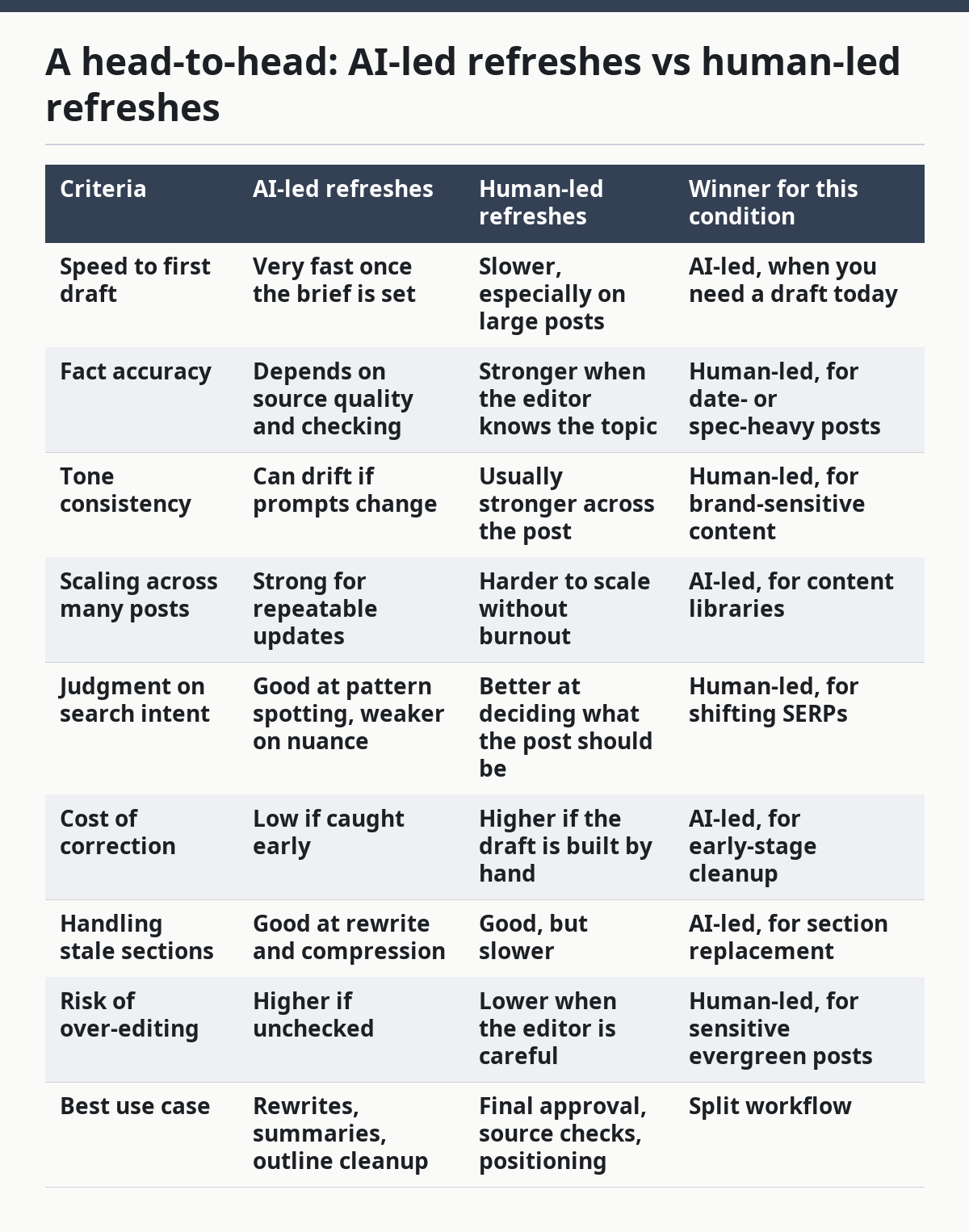
The table points to the same answer most teams reach after a few bad refreshes: AI should assist the workflow, not own it. That is not a compromise. It is the only setup that scales without turning the post into mush.
The verdict: which workflow to use
Choose AI-led with human QA if you need to refresh a large set of posts, the facts are fairly stable, and the main problem is structure or clarity. Choose human-led with AI support if the post carries risk, the facts change often, or the search intent is shifting fast. Neither if the post has no current search value and should be retired or merged instead.
Picture this: you are deciding how to spend the next week of content work. The right answer is not “AI everywhere” or “AI nowhere.” It is picking the lightest workflow that still protects accuracy and intent.
A strong default looks like this:
- AI drafts the audit and rough replacement copy.
- A human checks the query, sources, and editorial angle.
- A human decides whether the post needs a refresh, merge, or deletion.
- AI helps clean up headings, summaries, and duplicated paragraphs.
That split works because it respects what each side does well. AI is fast at first passes. Humans are better at judgment.
When to reconsider the refresh entirely
A refresh is the wrong move when the post is outdated in a way that cannot be fixed with edits. If the topic no longer matters, the query has changed beyond the post’s scope, or the post is cannibalizing a stronger asset, a merge or removal is better.
Here’s the catch: many teams refresh because it feels safer than deleting. That can keep weak posts alive for years. A post with a few stale lines is one thing. A post built around the wrong search goal is another.
Reconsider the refresh if:
- The post gets almost no impressions.
- The topic is duplicated elsewhere on your site.
- The content is too thin to rescue without a near-rewrite.
- The post now targets a different intent than the one it originally served.
- The topic has become obsolete and should be archived.
In those cases, AI can still help — but as a diagnosis tool, not a rewrite engine. Ask it to compare overlap, suggest consolidation, or identify the missing angle before you decide what to do.
How to keep the workflow honest after publish
A refresh workflow is only useful if it feeds the next decision. After publish, watch the post for rank movement, click-through changes, and any sign that the new structure created new confusion.
Picture this: you finish the update, mark the task complete, and move on. Two weeks later, the post is still underperforming because the title promises one thing and the body delivers another. That is why post-publish review belongs in the workflow, not outside it.
Use a simple post-publish checklist:
- Confirm the updated post is indexed.
- Check the title and meta description in search results.
- Review whether the new H2s answer the main query.
- Watch for broken internal links or missing images.
- Compare traffic and engagement against the previous version.
If the post improves, note what changed. If it does not, ask whether the issue was the draft, the intent match, or the decision to refresh at all.
FAQ
What is an AI-assisted content refresh workflow?
It is a process for updating existing content with AI help at selected steps, usually audit, outline, draft cleanup, and rewrite support. The human editor still decides what to change, what to keep, and what must be fact-checked before publication.
Should AI write the whole refreshed post?
No, not if accuracy, voice, or intent matter. AI can draft large chunks quickly, but a full automated rewrite often misses nuance, flattens the angle, or introduces claims that need verification. A human should still own the final post.
Which part of the refresh process benefits most from AI?
The first pass does. AI is strongest at spotting gaps, grouping similar ideas, rewriting weak paragraphs, and suggesting cleaner headings. It saves the most time when the post already exists and the job is to improve it, not invent it.
How do I know if a refresh is better than a rewrite?
A refresh is better when the post already targets the right query and has some equity worth keeping. If the intent changed, the post is too thin, or the structure is beyond repair, a rewrite or merge is usually the better move.
What should I check before publishing a refreshed post?
Check the facts, the search intent, the headings, the internal links, and the meta title. If the post contains dates, specs, policy language, or technical steps, verify those against source material before it goes live.
Drafted with AI; not yet reviewed by a person.