AI Search Visibility Planning: The Complete Guide
Last updated: November 19, 2026
AI search visibility planning is how you make your content easier for AI search systems to find, trust, and cite. Quick Answer: for most sites, one clear topic map and a quarterly review are enough to start. This guide on AI search visibility planning — The Complete Guide settles what to publish, what to update, and what to measure so your pages can win answers in AI-driven search.
What AI search visibility planning actually means
Picture this: you already rank for a few useful queries, but AI search results still skip your site when they build an answer. AI search visibility planning is how you tell search systems what your page is about, why it deserves a citation, and which page should own each topic. That starts with entity clarity, source quality, and page purpose.
AI search visibility planning is the work of turning a site into a clean source set for answer engines. It is not only about classic SEO rankings. It also covers how your pages appear in Google’s AI Overviews, Bing Copilot, ChatGPT-style search tools, and other systems that summarize web content. For a practical standards baseline, I’d keep Google Search Central and Bing Webmaster Guidelines on hand:
- Google Search Central: https://developers.google.com/search/docs
- Bing Webmaster Guidelines: https://www.bing.com/webmasters/help/webmaster-guidelines-30fba23a
The best plans answer three questions before anything gets written:
- What topics should this site be cited for?
- Which page should answer each topic?
- What proof does that page contain that an answer engine can trust?
The real job is topic ownership. If a page mixes ten ideas, AI systems have a harder time extracting one clean answer.
Key Takeaways
- AI visibility is about being easy to quote, not just easy to crawl.
- One page should own one primary question.
- Proof matters more than puffery.
- Page structure, source quality, and entity signals all affect citations.
- A good plan reduces overlap before it creates new content.
How do I plan AI search visibility without rebuilding the whole site?
You start by auditing what you already have and then assigning each page a single job. In many cases, restructuring beats publishing more. Most sites already have enough content; the problem is that it is scattered, duplicated, or too vague for AI systems to trust.
Picture this: you have 60 blog posts, five landing pages, and a handful of guides. Some pages target the same phrase. Others mention the same product, service, or concept in slightly different ways. The right move is to build a visibility map, not a bigger backlog. That map should list page URL, primary topic, secondary questions, audience stage, source type, and update priority.
Use this process:
- List every page that matters for search.
- Mark the primary topic of each page in plain language.
- Group pages that overlap.
- Pick a single owner page for each topic cluster.
- Note what each page still lacks: examples, definitions, comparisons, data, or clearer wording.
This is where many teams go wrong. They treat AI search like a new channel and ignore the old content pile. If three pages all try to answer the same query, answer engines may choose none of them. For guidance on prioritization, use the Google Search Central docs and the Bing Webmaster Guidelines above, and consult a qualified SEO professional if the site is large or regulated.
What to put in the audit
- Primary question: the one query the page should answer
- Supporting questions: 3 to 5 follow-ups a reader would ask next
- Entity terms: brand names, product names, standards, people, locations
- Proof type: first-party data, documentation, citations, or examples
- Risk level: thin, duplicated, outdated, or mismatched intent
What a generic plan misses
A generic SEO plan often stops at keywords. AI visibility planning goes further. It needs to identify whether the page can be summarized cleanly, whether the content has a clear source of truth, and whether another page already does the same job better. The result is closer to information architecture than to old-school keyword stuffing.
Which pages are most likely to earn AI citations?
The pages that win citations are usually the ones that answer one specific question with clean structure and visible proof. Definition pages, comparison pages, step-by-step guides, and product or service pages with concrete facts win most often. Pages that ramble usually lose.
Picture this: a search system is trying to answer a simple user question in one paragraph. It wants a page that states the answer early, supports it with detail, and avoids side quests. Pages with one topic, strong headings, and factual backing are much easier to quote than pages that try to rank for everything.
The most citation-friendly pages usually share the same traits:
- The topic appears in the title and the first paragraph.
- Headings match real sub-questions.
- The page uses plain nouns, not marketing fog.
- Sources are named where facts matter.
- The page gives a direct answer before it explains the edge cases.
That said, not every page should be built for citation. A deep case study may attract links and trust even if it never becomes the answer snippet. A conversion page may need sales clarity more than encyclopedic detail. The mistake is expecting every page to do every job.
Pages that usually need a rewrite first
- Pages with two or more main topics
- Pages that bury the answer after a long intro
- Pages with no named source or standard
- Pages with vague claims like “best-in-class” and no evidence
- Pages that repeat the same idea across multiple URLs
Pages that often work well for AI search
- “What is…” explainers with one definition
- “How to…” guides with numbered steps
- Comparison pages with clear criteria
- FAQ pages that answer real objections
- Service pages with hard facts, scope, and process
The truth is, format helps, but clarity wins. A poor page in a perfect format still loses. A sharp page with ordinary design can still earn citations.
What should each page contain to show trust?
Each page should contain a clear answer, a visible source of truth, and enough detail that a machine can extract meaning without guessing. That usually means one topic, one audience, one claim set, and one main action. If the page tries to be all things at once, the signals blur.
Picture this: your page says what the thing is, who it is for, how it works, and what to do next. That sounds simple, but many pages skip one of those pieces. AI systems tend to reward pages that make the job easy. They do not need fluff. They need structure.
A strong page usually includes:
- A title that names the subject plainly
- An opening line that answers the page’s core question
- H2s that match likely follow-up questions
- Specific terms and entities, not vague wording
- Internal consistency between title, headings, and body
- A closing section that points to the next action or related topic
You also need visible trust signals. Those can be author bios, citations to standards, updated dates where relevant, and references to the organization’s own data or process. For technical topics, standards bodies matter. For search guidance, Google and Bing documentation matter. For health, finance, or legal material, consult qualified professionals before publishing claims that could affect people.
Good proof sources include
- Official documentation
- Standards organizations
- Government guidance
- Peer-reviewed summaries
- First-party product or service documentation
Weak proof sources include
- Repeated marketing claims
- Unsourced superlatives
- Copy lifted from competitor pages
- Thin paraphrases with no added value
- Claims that cannot be traced to a real source
The catch: trust is not only about citations. It is also about restraint. A page that claims too much looks less believable than a page that states exactly what it knows.
How does an AI visibility content map work?
An AI visibility content map matches each important topic to one page, one intent, and one proof pattern. That map is the backbone of the whole plan. Without it, you will keep creating overlap and confusion.
Picture this: you have a main guide, a pricing page, three blog posts, and an FAQ. If all five pages mention the same core phrase in different ways, the site sends mixed signals. A content map fixes that by deciding which page owns which intent. The guide teaches. The page sells. The FAQ handles objections. The blog post expands one narrow angle.
A useful map has columns like these:
- Topic
- Search intent
- Audience stage
- Primary page
- Supporting page
- Content gap
- Source needed
- Update owner
- Priority
That sounds like operations work because it is. AI search visibility is not a copywriting trick. It is a publishing system. When the system is clear, the content gets easier to maintain and easier to cite.
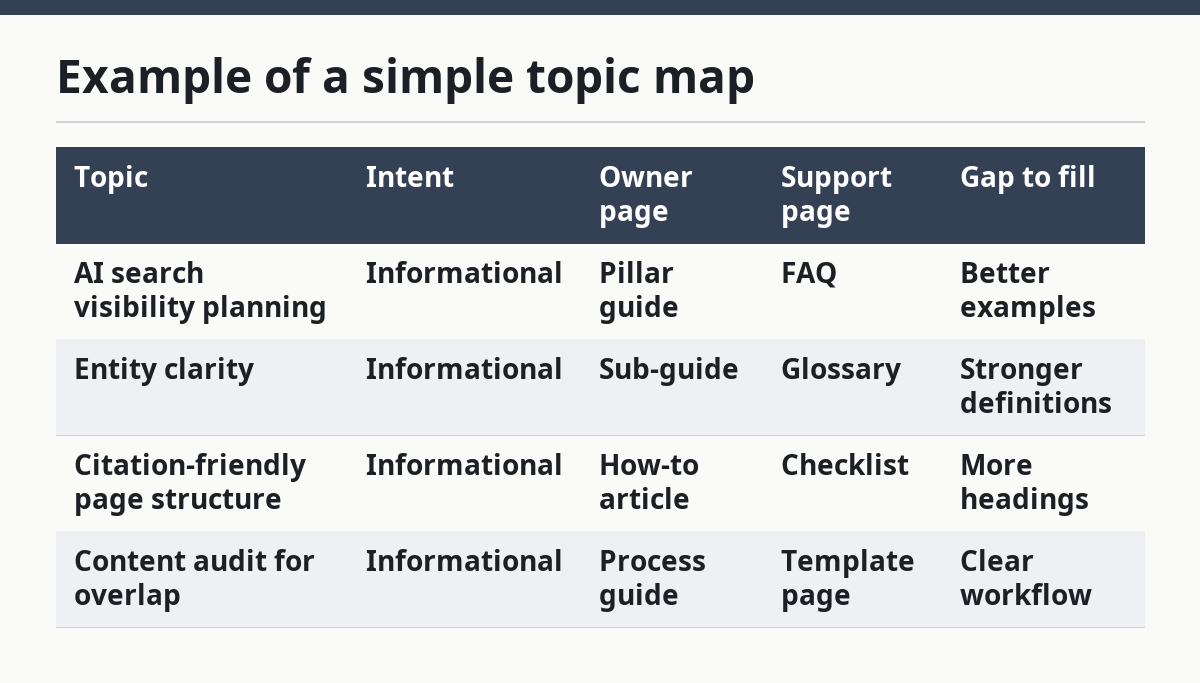
Example of a simple topic map
| Topic | Intent | Owner page | Support page | Gap to fill |
|---|---|---|---|---|
| AI search visibility planning | Informational | Pillar guide | FAQ | Better examples |
| Entity clarity | Informational | Sub-guide | Glossary | Stronger definitions |
| Citation-friendly page structure | Informational | How-to article | Checklist | More headings |
| Content audit for overlap | Informational | Process guide | Template page | Clear workflow |
The best part is that you do not need a giant site to use this. Even a small site can map 10 to 20 core topics well and get cleaner AI visibility from that alone.
Why content structure matters more than word count
Content structure matters more than word count because AI systems need a page they can parse, not a page that just keeps talking. A 1,200-word page with clear sections can beat a 3,000-word page that rambles. The page should answer fast, then support the answer.
Picture this: a reader asks a direct question, and the answer appears in the first few lines. Then the page unfolds in a sensible order: definition, use case, steps, limits, examples. That is the shape answer engines can work with. Dense paragraphs without headings make extraction harder.
Use this structure where possible:
- State the answer in the opening paragraph.
- Use H2s for the main sub-questions.
- Keep paragraphs short.
- Put important facts near the top.
- Use tables for comparisons.
- Use lists for steps and choices.
A lot of teams still write for human browsing only. That misses how answer systems read. They scan for patterns, sentence boundaries, terms, and relationships. Clean headings and direct wording give them those signals, and that matters in AI search visibility planning.
Structural habits that help
- Repeat the main topic naturally in the intro and one heading
- Use one idea per paragraph
- Put the most useful sentence first
- Avoid long preambles
- Close sections with a clear takeaway
Structural habits that hurt
- Openings that delay the answer
- Multiple topics in one heading
- Generic subheads like “Learn more”
- Walls of text with no lists
- Keyword stuffing that sounds fake
Here’s the catch: structure is not decoration. It is part of the content. If the structure is messy, the meaning looks messy too.
What are the biggest mistakes in AI search visibility planning?
The biggest mistake is treating AI visibility like a keyword race instead of an information design problem. The second biggest mistake is publishing more pages before fixing overlap. Both waste time and weaken the site’s signals, so consult a qualified SEO professional if the site is large or sensitive.
Picture this: you launch five new articles because a tool says those terms have volume. But the site already has older articles on the same topics, and none of them are clearly better. Now the new content competes with the old content, and neither page becomes the obvious choice. That is how teams lose momentum fast.
The common mistakes are usually these:
- Writing for search terms instead of topics
- Creating multiple pages for one question
- Hiding the answer under brand language
- Using vague claims without evidence
- Skipping content updates after publication
- Ignoring page purpose and audience stage
One more problem shows up often: teams want every page to be “optimized” in the same way. That is not smart. A support article, a comparison page, and a service page need different signals. A support article should answer fast. A comparison page should show criteria. A service page should show scope, process, and trust.
What to fix first
- Merge overlapping pages
- Rewrite weak intros
- Add clear headings
- Remove filler claims
- Add named sources where facts matter
What not to do
- Stuff the exact phrase into every heading
- Turn one page into a dozen mini pages
- Add AI language just to sound current
- Assume more content equals more visibility
- Publish without a maintenance plan
The truth is, a smaller site with tighter structure can beat a larger site with messy architecture. That is not theory. It is how clarity works.
How often should you update AI visibility plans?
You should update the plan whenever the site adds a major topic, changes a core page, or sees a shift in how people search. A quarterly review is a good baseline for most teams. Fast-moving niches may need monthly checks.
Picture this: your top pages looked fine six months ago, but now the search results show different questions, new competitors, or different wording. AI systems change with the index, and user phrasing changes with the market. A stale plan starts to drift quickly.
A good review usually checks:
- Which pages gained or lost visibility
- Which topics now overlap
- Which pages need fresh proof
- Which new questions users are asking
- Which old pages no longer deserve to lead
You do not need to rebuild the map every time. You need to keep it honest. If a page no longer matches the query it was built for, move it, merge it, or rewrite it.
Trigger events for a review
- New product or service launch
- Major site restructure
- Large content rollout
- Core algorithm shift
- Major drop in impressions or citations
- New competitor content that steals the answer
Signs the plan is stale
- Several pages answer the same query
- Titles no longer match the body
- Old stats or references stay in place
- New pages get added without removing old ones
- Search visibility drops while publishing volume rises
On the flip side, a stable plan is a living asset. It keeps the site aligned as the business grows.
When does the whole approach need to change?
The whole approach needs to change when the site’s content model no longer fits the business model or the search behavior around it. If the site is built around categories that users no longer care about, patching won’t fix it. You need a new map.
Picture this: you started with a blog-heavy site, but now your audience wants tools, comparisons, and product proof. Or maybe your service area changed, but the old articles still talk to the old market. In cases like that, a few edits won’t solve the deeper mismatch.
Reconsider the approach if:
- The brand has moved into a new category
- The old site architecture no longer matches user intent
- Search results now favor different page types
- The content team cannot maintain the old volume
- The site keeps losing to simpler, more direct pages
This is where many teams over-edit. They try to force old pages to do new jobs. That usually fails. Sometimes the cleanest answer is a fresh structure with tighter ownership and fewer pages per topic.
Exception scenarios where the verdict flips
- If your site has strong backlinks but weak page clarity, a structure-first rewrite can beat new content. Authority already exists; the page just needs to say the right thing.
- If your niche changes weekly, a lighter plan with frequent updates can work better than a heavy content map.
- If your site has only a few pages, you may not need a full topic cluster system yet. A sharp homepage, one guide, and one FAQ can be enough.
- If your content is regulated, source quality and review steps matter more than volume. Fewer, tighter pages usually win.
The best move is not always to publish more. Sometimes it is to stop publishing until the map is clean.
Should I build for AI search, classic SEO, or both?
You should build for both, but treat AI search as the stricter test of clarity. If a page is good enough for AI citations, it is usually better for human readers too. The reverse is not always true.
Picture this: a page ranks well in classic search because it has links and age, yet AI systems still skip it because the answer is buried or the topic is fuzzy. That is common. AI search tends to reward exactness. Classic SEO can tolerate more noise.
A combined plan should cover:
- Search demand and topic ownership
- Clean page structure
- Strong source signals
- Internal linking
- Human readability
- Maintenance over time
The right balance depends on the site. A local business may need service pages with hard facts and location signals. A media site may need fast, well-structured explainers. A software company may need feature pages, comparison pages, and support content that all agree on naming.
A practical rule
- If the page answers a question, make it clear and cite-worthy.
- If the page sells something, make the value and scope plain.
- If the page explains a process, make the steps easy to follow.
That simple rule covers most cases better than a long checklist ever will.
FAQ
How is AI search visibility different from SEO?
AI search visibility focuses on whether a page can be summarized, quoted, and trusted by answer systems. SEO still matters because crawlers, links, and on-page signals help the page get discovered and ranked in the first place. The difference is that AI search puts more pressure on clarity, structure, and proof.
Do I need new content for AI search visibility planning?
Not always. Many sites get better results by fixing overlap, rewriting weak intros, and improving page structure before they publish anything new. New content helps when there is a real topic gap or the current page cannot be repaired without changing its purpose.
What kind of pages are best for AI citations?
Pages that answer one question cleanly tend to do best. That includes definitions, how-to guides, comparisons, and pages with clear facts and named sources. Pages that try to cover too many topics usually get weaker signals.
How often should I review the plan?
A quarterly review is a solid default for most sites. If your niche changes quickly, monthly checks make more sense. Review sooner whenever the business adds a new product line, shifts audience, or sees a clear drop in visibility.
What is the biggest mistake to avoid?
The biggest mistake is creating more pages before fixing page ownership. If two or three URLs answer the same question, the site sends mixed signals and none of them may become the preferred source. Clean up the map first.
Drafted with AI; not yet reviewed by a person.